Chhattisgarh Vedanta power plant blast: Death toll rises to 24
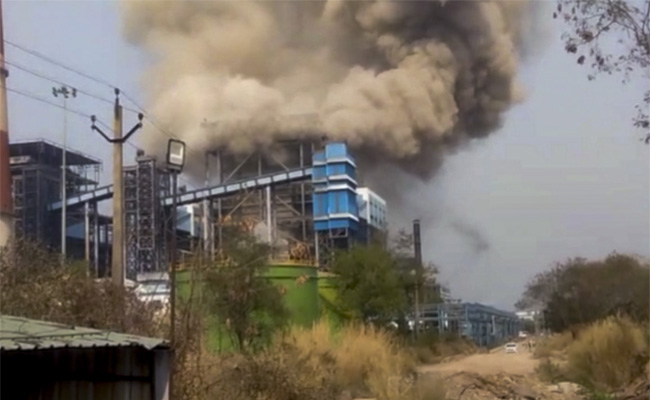
Raipur (PTI): The death toll in a blast at the Vedanta power plant in Chhattisgarh's Sakti district has gone up to 24 with one more worker succumbing to injuries on Sunday, officials said.
Eleven other persons were undergoing treatment in different hospitals. Two of them were reported to be in critical condition, they said.
A worker, identified as Manish Kumar, a native of Sonbhadra in Uttar Pradesh, died during treatment at Raigarh medical college in the wee hours, a government official told PTI.
With this, the death toll has gone up to 24 in the incident that occurred on April 14.
The explosion occurred in a steel tube carrying high-pressure steam from the boiler to the turbine at the Vedanta Ltd power plant located in Singhitarai village, leaving several workers with severe burn injuries.
According to officials, four workers died on the spot, while nine others succumbed to injuries soon after the incident. Seven more injured workers succumbed to injuries in hospitals on April 15, while another worker died on April 16 at a hospital in Raipur. Two more workers died in hospitals on Saturday.
The deceased include seven labourers from West Bengal, five from Chhattisgarh, four from Jharkhand, four from Uttar Pradesh, and two each from Bihar and Madhya Pradesh.
Of the 11 injured, six are admitted to Jindal Hospital, Raigarh, and two each at Balaji Metro Hospital and Apex Hospital, Raigarh. Another worker is undergoing treatment at Shri Shankara Hospital, Raipur, an official said.
Of them, two are critical, he said.
Police have registered an FIR under sections related to causing death by negligence and negligent conduct with machinery.
"Eight to ten individuals, including Vedanta Group Chairman Anil Agarwal and plant head Devendra Patel, have been named in the FIR. If more persons are found responsible during the investigation, their names will be added," Sakti Superintendent of Police Prafull Thakur had said.
A preliminary technical investigation into the blast found that excessive fuel accumulation inside the boiler furnace led to a pressure build-up, triggering the explosion, police officials earlier said.
A report by the Forensic Science Laboratory (FSL) in Sakti also confirmed that the accumulation of fuel and the resulting excessive pressure were the primary causes of the explosion, they said.
Chief Minister Vishnu Deo Sai had directed the Bilaspur divisional commissioner to conduct a probe into the incident.
The Sakti district administration has also ordered a magisterial probe into the incident.
The Opposition Congress has demanded that stricter charges of culpable homicide not amounting to murder be invoked in the case.
Let the Truth be known. If you read VB and like VB, please be a VB Supporter and Help us deliver the Truth to one and all.
Telangana survey flags 89,000 child labourers, highlights caste disparities in employment
Hyderabad: A caste-based survey conducted by the Telangana government for 2024–25 has identified around 89,000 children engaged in labour across the state, with a large share belonging to Scheduled Caste (SC) and Scheduled Tribe (ST) communities.
The findings are part of the Socio, Economic, Educational, Employment, Political and Caste (SEEEPC) Survey, which covered about 3.5 crore people across 242 caste groups. According to the report, nearly one per cent of individuals below 18 years are involved in daily wage work. While the percentage appears small, officials noted that the absolute number reflects a serious concern.
The survey found that 11 per cent of identified child labourers belong to the ST Lambadi community, while 14 per cent are from the SC Madiga community. The highest incidence was reported among the ST Kolam group, where 7.2 per cent of minors are engaged in daily wage labour.
The data also revealed wider socio-economic disparities. Nearly half of the Scheduled Caste population is dependent on daily wage work, while only around 5 per cent are employed in the private sector, compared to about 30 per cent among General Castes.
State Welfare Minister Ponnam Prabhakar said the findings show that SC and ST communities remain three times more backward than General Castes, while Backward Classes are about 2.7 times more disadvantaged.
The report further noted that, on average, 31.3 per cent of people in the 25–65 age group depend on daily wage work. Among communities, the BC-A Odde group recorded the highest share at 55 per cent. In contrast, only 2.6 per cent of OC Brahmins rely on such work.
Several SC and ST communities, including Kolam, Beda, Madiga, Koya, Gond, Yerukulas and Mala Sale, were found to have among the highest proportions of daily wage earners. On the other hand, most General Caste communities and some Backward Class groups such as Goldsmiths and BC-C Christians showed lower dependence on daily wage employment.
The survey also pointed to inequalities in access to formal employment. Communities such as OC Rajus, OC Brahmins and Kapus were found to have a higher presence in private sector jobs, with up to 27 per cent of their population employed in such roles.