
Four madrasa students thrashed for not chanting 'Jai Shri Ram'
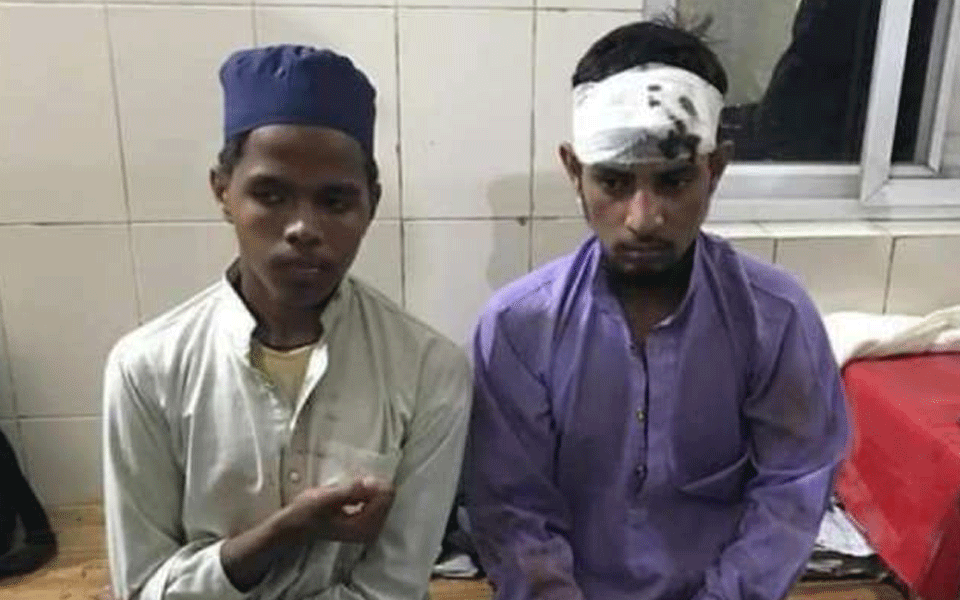
Unnao, July 12: A group of young students at a madrasa in Unnao district were allegedly forced to chant "Jai Shri Ram" and then beaten up when they refused to repeat the slogan.
According to reports, the victims, who are all minors, had their clothes torn off and their bicycles were vandalized by the group when the children went to a ground to play cricket after concluding their afternoon namaz.
It was then that a group of four men arrived at the ground and after a debate over playing cricket, they allegedly started beating the children and even forced them to chant "Jai Shri Ram".
After the incident, the children came back to the madrasa and narrated the incident. The police arrived, thereafter, and took cognizance of the matter.
According to the Imam of the Jama Masjid, a group of men from Bajrang Dal were involved in the incident that took place on Thursday.
The police have registered a case in connection with the incident and have also identified three accused by tracing their Facebook accounts. The accused have purportedly identified themselves as members of Bajrang Dal in their social media accounts.
Circle Officer Umesh Kumar Tyagi said that investigations were on in the matter.
This is not for the first time that an incident like this has come to light in Uttar Pradesh.
In a similar incident on July 4, where an auto driver Mohammad Aatib, alleged that a group of men locked him up in a washroom and pelted stones for refusing to chant "Jai Shri Ram".
Earlier, a Muslim youth, who was wearing a skull cap, was allegedly thrashed and insulted in Kanpur by some unidentified persons after he refused to chant "Jai Shri Ram". The attack took place when the youth, identified as Taj Mohammad, was returning to his home in the Barra area from the local madrasa.

Let the Truth be known. If you read VB and like VB, please be a VB Supporter and Help us deliver the Truth to one and all.
Mission operations key to space success: ISRO chief Narayanan
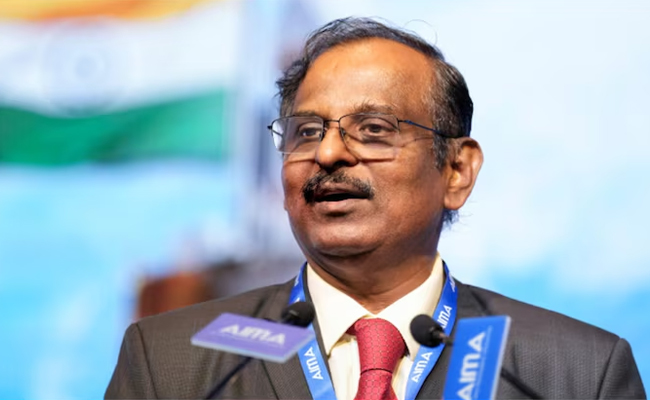
Bengaluru, Apr 8 (PTI): ISRO Chairman V Narayanan on Wednesday highlighted the importance of mission operations in ensuring success, calling it key to India’s expanding space programme.
He was addressing a gathering of scientists, industry experts, and students at the three-day international conference on Spacecraft Mission Operations (SMOPS-2026), themed 'Innovative Operations for Smart and Sustainable Space Mission Management–Next Generation'.
"Mission operations are crucial, especially for long-duration ones. This is an important domain," Narayanan said.
Welcoming delegates from leading global space agencies, including Roscosmos, the Japan Aerospace Exploration Agency (JAXA), the European Space Agency (ESA), and the French space agency, Centre National d'Études Spatiales (CNES), the ISRO chief said the conference marked a significant milestone, as it brought together international expertise, startups, and the broader space ecosystem on a common platform.
"This is not just another conference—it is quite a major global gathering with participation from many countries, experts, startups, and ecosystem partners," he said.
Narayanan pointed to the successful Chandrayaan-3 mission, noting that the "historic landing" near the Moon’s south pole was the outcome of sustained teamwork and operational precision.
He credited the leadership and continuous involvement of senior scientists in mission control, saying their contribution remained indispensable during key phases.
The ISRO chief also recalled the challenges faced after the Chandrayaan-2 mission and said the subsequent success demonstrated India’s technological resilience.
"After the partial setback of Chandrayaan-2, Chandrayaan-3 had to be perfect," he said, adding that the achievement had earned global recognition.
Tracing the evolution of India’s space programme since its inception in 1962, Narayanan said the country has accomplished a wide spectrum of missions spanning launch vehicles, scientific exploration, and satellite operations.
He added that while rockets operate for a brief duration, spacecraft require continuous monitoring and control over several years.
"While a rocket functions only for about 15 to 25 minutes, it must generate tremendous energy to place the spacecraft into orbit. However, the spacecraft itself must operate for years—sometimes from two to 15 years," he said.
The ISRO chairman said even minor errors in command execution could jeopardise an entire mission, and commended engineers, software teams, and planners for their role in sustaining mission health.
Narayanan stressed the importance of emerging technologies such as artificial intelligence and cloud-based systems in transforming mission operations.
He also cited key milestones achieved since the previous conference, including space docking experiments, the Chandrayaan-3 mission, and the Aditya-L1 solar mission, noting that each required advanced operational strategies.
On human spaceflight, he described the Gaganyaan programme as a "defining step" for India’s ambitions.
He added that preparations were progressing towards the first uncrewed mission.
Speaking to reporters later, Narayanan reiterated the long-term nature of mission operations and its significance across mission lifecycles.
"A launch vehicle works only for about 20 to 25 minutes, but mission operations must continue for a long time," he added.
Narayanan explained that communication satellites require continuous monitoring for up to 15 years, while interplanetary missions demand sustained operational control over several months.
He said the SMOPS-2026 conference would focus extensively on advancements in this domain.
"Around 400-plus papers will be presented and discussed. This will be useful for the student community, startup companies, and engineers working in this field," the ISRO chief said.
Responding to queries on the Gaganyaan programme timeline, Narayanan said ISRO was proceeding in a phased manner.
"Before proceeding with the crewed mission, three uncrewed missions are planned. At present, we are working on the first uncrewed mission," he said.
Narayanan said further details would be announced at an appropriate time. On the challenges involved, he pointed to the complexities of developing human-rated systems and integrating numerous technologies.
"We have to human-rate the launch vehicle. There are also many new developments involved, such as the crew escape system, environmental control and life-support systems, and the interface between humans, machines, and software," he said.
Narayanan described the programme as a "coordinated national effort" involving multiple laboratories.
When asked about the procurement of critical systems, he said, "The process is underway."

_vb_29.jpeg)
_vb_72.jpeg)