China 'chose' not to stop coronavirus from spreading across the world: Trump
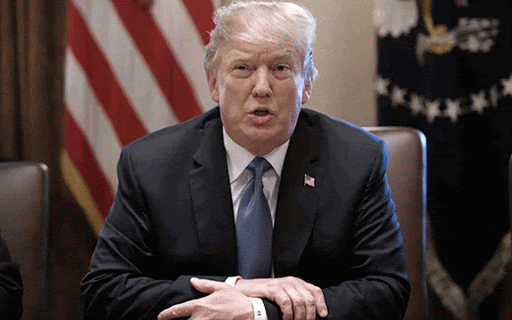
Washington: Accusing China of not being transparent about the COVID-19, US President Donald Trump has said that Beijing could have stopped the deadly virus from spreading across the world but they "chose" not to.
Trump has in the past expressed disappointment over China's handling of the COVID-19 pandemic. In May, he claimed that it was the incompetence of Beijing that led to the mass killing across the globe.
More than 600,000 people globally, including 143,000 Americans have died due to coronavirus that emerged from China's Wuhan city.
Over 14 million people across the world, including over 4 million in the US, have tested positive with this deadly virus that has brought the global economy to standstill.
China has denied US' claim of covering up the extent of its coronavirus outbreak and has accused the US of attempting to divert public attention by insinuating that the virus originated from a virology laboratory in Wuhan.
It came from China. It should have never been allowed to get out. They could have stopped it. They could have stopped it easily. They chose not to, Trump told reporters in the Oval Office of the White House on Monday.
We'll have further reports on that. But it came from China. They could have stopped it, but they didn't. They stopped it from going into China, but they didn't stop it from going to the rest of the world. It didn't stop it from going to Europe, to us, he said.
They should have stopped it. They could have stopped it. They weren't transparent at all; they were the opposite. It's not good, Trump said.
Trump spoke with French President Emmanuel Macron and Egypt President Abdel Fattah Al-Sisi on Monday over the pandemic.
And all of us, and all of us together -- I've had many conversations with leaders all over the world over the weekend, and over the last couple of weeks in particular. And this is a pandemic that is flaring up all over the place. Countries thought they were in good shape and then, all of a sudden, they have a big flare-up, he said.
Coronavirus, he said, is a worldwide problem and the US is helping other countries with ventilators.
We're helping a lot of countries. They don't have ventilators, and we're sending thousands of ventilators to different countries. But I do want people to understand this is a worldwide problem caused by China, but it's a worldwide problem, Trump said.
Countries are going through hell. We're going to give you a lot of briefings in the next week and over the next few weeks as to -- I think it's very important to do it, the vaccines and the therapeutics. I think I'm going to bring some of the great companies that are working, and very successfully in the past have worked on these things, and they're going to tell you very specifically what they're doing and how they're doing. But we think we're doing very well in that regard, said the president.
Meanwhile, the State Department on Monday announced that Secretary of State Mike Pompeo during his July 20-22 visit to the UK will meet with Prime Minister Boris Johnson? and Foreign Secretary Dominic? Raab? to discuss global priorities, including coordination on COVID-19 recovery and? issues related to the People's Republic of China (PRC).?
He will also discuss the ongoing negotiations for the US-UK Free Trade Agreement, an official statement said.
In another development, Congressman Michael Burges said that China and the Chinese Communist Party continues to threaten American national security with cyber-attacks.
The US should get more specific with sanctions and use our economic power to punish hackers, he demanded.
Let the Truth be known. If you read VB and like VB, please be a VB Supporter and Help us deliver the Truth to one and all.
AI, IndiGo, SpiceJet seek ATF price relief; say airline industry on verge of 'stopping operations'
Mumbai (PTI): Air India, IndiGo and SpiceJet have told the government that the country's airline industry is under extreme stress and on the verge of "stopping operations", as they sought revision in ATF pricing and financial support.
The West Asia turmoil has pushed up oil prices, and airspace restrictions have increased airlines' operating costs, especially on long-haul routes. Aviation Turbine Fuel (ATF) accounts for around 40 per cent of a carrier's operational expenses.
Against this backdrop, the Federation of Indian Airlines (FIA) has written to the civil aviation ministry, seeking steps to extend the same fuel pricing mechanism uniformly across both domestic and international operations as was done in the past with the establishment of the crack band.
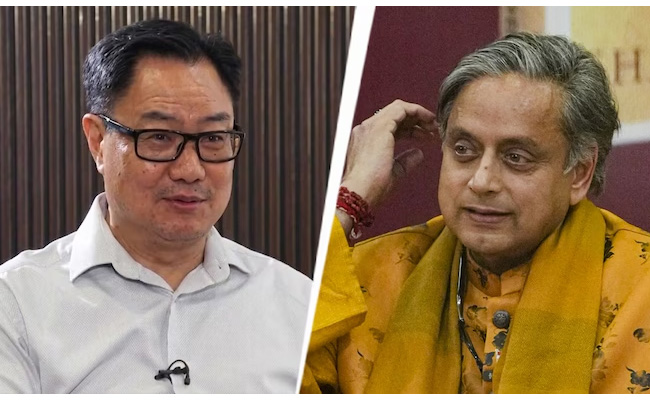
ALSO READ: Tharoor junks Rijiju's claim that he agreed Cong is 'anti-women'; hails his party
With an unprecedented rise in jet fuel prices and exorbitant crack/differential between crude and ATF, the federation said the operation of airlines is being challenged in totality.
"... any ad hoc pricing (domestic vs international) and/or irrational increase in the price of ATF will result in unsurmountable losses for airlines and will lead to grounding of aircraft, resulting in cancellation of flights," the federation, which represents Air India, IndiGo and SpiceJet, said.
"In order to survive, sustain and continue operation, we request your urgent intervention for immediate and meaningful financial support to tide over the current situation," it said in a letter on April 26.
Also, the airlines have sought temporary deferment of excise duty on ATF, which is at 11 per cent.
"With the abnormal increase in ATF prices from the pre-crisis period, adding rupee depreciation to the increased prices, the 11 per cent excise duty also increases manifold for the airlines and adds to the ATF price as a big impact on airlines," they said.
Last month, the government limited the hike in ATF price to Rs 15 per litre for domestic operations, but for international operations, the price rose by Rs 73 per litre.
The airlines said the situation has practically made international operations, along with domestic operations, completely unviable and resulted in significant losses for the aviation sector in April.
Seeking urgent intervention on the current ATF ad hoc pricing, FIA said the current situation is creating a severe imbalance in domestic and international operations and rendering airline networks unviable and unsustainable.
"The airline industry in India is under extreme stress and is on the verge of closing down or of stopping its operations."
The federation has pitched for a transparent pricing framework under the crack band mechanism (USD 12–22/BBL) that was implemented in October 2022, saying there was a fair and reasonable margin for Oil Marketing Companies (OMCs).
According to FIA, the country's largest aviation hub Delhi has the second-highest value-added tax (VAT) of 25 per cent on jet fuel, while the highest rate is 29 per cent levied in Tamil Nadu.
"The other major aviation cities, viz. Mumbai, Bangalore, Hyderabad, and Kolkata range between 16 per cent and 20 per cent. These 6 cities cover more than 50 per cent of airlines' operations within India," the federation said.