China doubles air bases, air defence positions and heliports near LAC after 2017 Doklam standoff
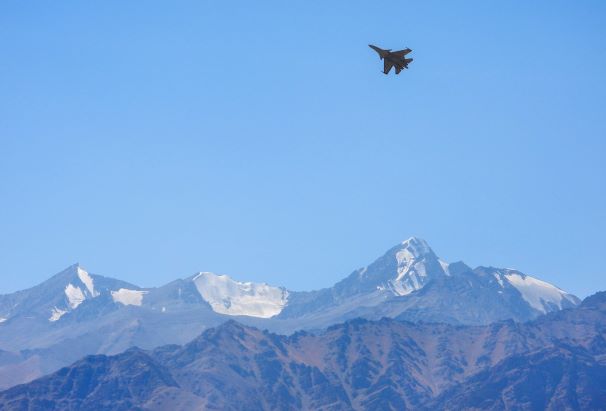
New Delhi: China has started construction of at least 13 entirely new military positions including three air bases, five permanent air defence positions and five heliports near the Line of Actual Control(LAC) in the aftermath of the Doklam standoff in 2017, according to a report by global security consultancy Stratfor.
The report also said construction on four of those new heliports started only after the current border standoff erupted in eastern Ladakh in early May.
"The 2017 Doklam crisis appears to have shifted China's strategic objectives, with China more than doubling its total number of air bases, air defense positions, and heliports near the Indian border over the past three years," it said.
The report authored by security expert Sim Tack and released on Tuesday said China's construction drive projects a future military capability that will see long-term regional tensions with India sustained beyond the two countries' recent standoffs.
The report said the recent procurement of the Rafale fighter aircraft by India has started to provide it some relief, but more time will be required to see indigenous production and foreign acquisitions truly rebuild the strength of India's air force.
It observed that the ongoing escalation in the Ladakh region has started to formulate an Indian response to the broader strategic threat posed by China's ongoing military infrastructure drive.
The report titled 'A Military Drive Spells Out China's Intent Along the Indian Border' analysed that the rapid expansion of permanent Chinese military infrastructure points to Beijing's intentions that span a wider timeframe than current and recent border standoffs.
"Indian and Chinese forces clashed in the Doklam region in June 2017. Since then, China has started constructing at least 13 entirely new military positions near its borders with India, including three air bases, five permanent air defense positions and five heliports," the report said.
It said China's strategy aims to confront India with an "insurmountable" challenge in territorial disputes by leaning on broad support capabilities that provide Beijing with a tremendous ability to mobilise forces into disputed border areas.
The report noted that such an approach is similar to China's strategy in the South China Sea, where a buildup of permanent defense facilities supports Chinese localised military superiority and significantly raises the potential cost of military opposition to Beijing's maritime claims.
"In applying this same strategy on the Indian border, China aims to discourage Indian resistance or military action during future border disputes by ostentatiously demonstrating its ability and intent to engage in military confrontations."
The troops of India and China were engaged in a 73-day stand-off in Doklam tri-junction in 2017 which even triggered fears of a conflict between the two nuclear-armed neighbours.
Tensions were defused after several rounds of talks.
The armies of the two countries have been locked in a fierce faceoff in eastern Ladakh since May 5 following a violent clash in Pangong Tso area.
The current row is turning out to be the biggest military standoff between the two sides since the 1962 Sino-India war.
A significant portion of Beijing's recent infrastructure developments is aimed directly at strengthening its ability to project air power along the entire Indian border at a time when New Delhi itself is trying to rebuild its air power, the report said.
"While these new developments are geographically focused on the region of current tensions, Chinese activity across India's entire border will likely drive future expansions of Indian military infrastructure near disputed borders at Sikkim and Arunachal Pradesh," it said.
The report said New Delhi will continue to upgrade its overall military capabilities, particularly in those fields where capability gaps exist vis-a-vis China, such as air power, ground-based air defence and missile forces.
Let the Truth be known. If you read VB and like VB, please be a VB Supporter and Help us deliver the Truth to one and all.
AIITA welcomes Karnataka’s ban on obscene songs in school events

Bhatkal: The Karnataka unit of the All India Ideal Teachers Association (AIITA) has welcomed the Karnataka government’s decision to strictly ban school children from dancing to obscene songs during educational and cultural programmes in government, aided, and private schools across the state.
AIITA Karnataka State President M. R. Manvi congratulated the government for taking what he termed an important step to preserve the sanctity of education.
“Such decisions to safeguard the dignity of school children and uphold the values of education are the need of the hour. This rule should not be limited to government schools alone but must be strictly implemented in all private educational institutions as well,” he said.
He further urged the government to address other concerns within school programmes.
“The government should not only prohibit obscene dances in the name of school anniversaries, but also ensure that plays and dialogues that incite religious hatred are avoided. Schools should be centres of harmony, not platforms for spreading hatred,” he added.
According to a recent circular issued by the Department of School Education and Literacy, obscene dances are adversely affecting the mental health and moral values of students.
In this regard, schools have been advised to use songs that promote nationalism, positive thinking, the greatness of Kannada culture, and value-based traditions instead of inappropriate content during programmes.
The circular also emphasises that students should be dressed in decent attire.
AIITA also backed the department’s warning that disciplinary action would be taken against head teachers if such guidelines are violated. The association has further demanded that district Deputy Directors of Public Instruction strictly monitor the implementation of these rules.