Chinese products showcased at AI Summit; irreparable damage caused to country's image: Cong
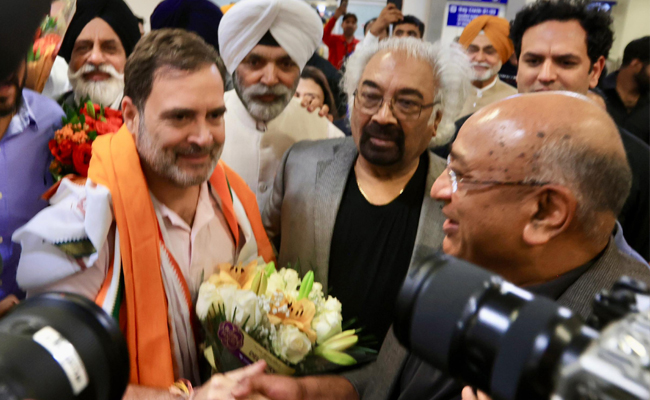
New Delhi (PTI): Congress leader Rahul Gandhi on Wednesday dubbed the ongoing AI Summit a "disorganised PR spectacle" and alleged that Chinese products are being showcased there.
Gandhi's remarks came amid a controversy over Galgotias University allegedly showcasing a robotic dog labelled "Orion" at the AI Summit Expo that critics said was actually a Chinese-made Unitree Go2 and not an in-house innovation.
"Instead of leveraging India's talent and data, the AI summit is a disorganised PR spectacle - Indian data up for sale, Chinese products showcased," the former Congress president said in a post on X.
According to sources, Galgotias University has been asked to vacate its stall at the AI Summit Expo immediately.
Gandhi also tagged a post of the Congress which alleged, "The Modi government has made a laughing stock of India globally, with regard to AI."
"In the ongoing AI Summit, Chinese robots are being displayed as our own," he charged.
The Congress claimed that the Chinese media has mocked India.
"This is truly embarrassing for India. What is even more shameful is the fact that Modi's minister Ashwini Vaishnaw is indulging in the same falsehood, promoting China's robots at the Indian summit," it said.
"The Modi Government has caused irreparable damage to the image of the country - they have reduced AI to a joke - a field in which we could be world leaders given our data power. Brazenly shameless," the party said on X.
Congress' media and publicity department head Pawan Khera said in a post on X, "Ashwini Vaishnaw has proved that in India AI means 'Ashwini is Incompetent'."
"As for the 'Pradhan (Tamasha) Mantri' - every event is a 'Jhappi-pappi' fest. This was supposed to be an AI Summit - a platform for innovation and exchange of ideas. BJP reduced it to a cheap China Bazaar," Khera said in his post, adding that the Gen Z of the country would not forgive them.
Let the Truth be known. If you read VB and like VB, please be a VB Supporter and Help us deliver the Truth to one and all.
Karnataka School Edu Dept prohibits children from being made to dance to obscene songs
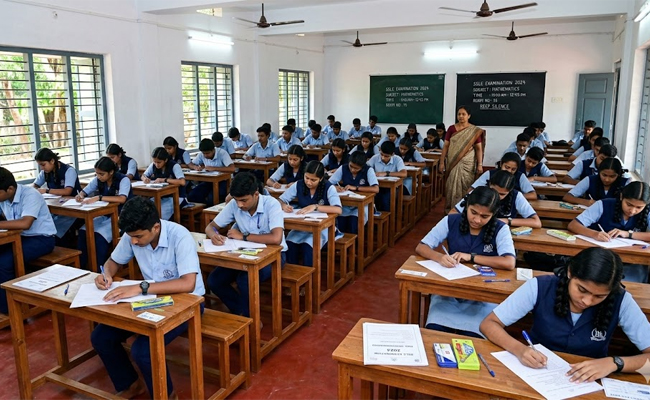
Bengaluru (PTI): The Karnataka School Education Department has issued a circular strictly prohibiting children from being made to dance to obscene songs in educational and cultural programmes.
It stated that such dances would negatively impact students' mental health and moral values. It will create indiscipline and harm the sanctity of education.
"All the Deputy Directors (Administration) of the state's School Education Department have been asked to take strict measures to prevent children or students from dancing to obscene songs in all government, aided and unaided schools in the state," the office of the commissioner of the School Education Department said in a recent circular.
"If it is found that children are being made to dance to obscene songs, appropriate action will be taken against the headmaster or management of such school," it added.
The department also listed certain measures in this regard, which include: strictly prohibiting children from being made to dance to obscene songs during educational and cultural programmes; selecting songs that are inspiring, positive, instilling national pride in children and reflecting the greatness, dignity, values, culture, and morality of the state.
Stating that the school headmaster and management are responsible for selecting songs and dances for cultural programmes, it said, they should also ensure that students wear decent clothes in dance or cultural programmes.