Christian Michel to be extradited to India tonight: Report

Dubai, Dec 4 : British national Christian Michel, wanted by Indian investigative agencies in the Rs 3,600 crore AgustaWestland VVIP choppers deal case, was taken to the Dubai International Airport on Tuesday to be extradited to India, according to a media report.
The Court of Cassation last month upheld a lower court order which said that Michel could be extradited.
Michel, 54, was taken to the Dubai International Airport from where he will be extradited to India later in the day, Khaleej Times reported.
The extradition procedure happens in coordination with the Interpol and the CID.
The development comes on a day when External Affairs Minister Sushma Swaraj held exhaustive discussions with her UAE counterpart Abdullah bin Zayed in Abu Dhabi.
India officially made the request to the Gulf nation in 2017 for his extradition, based on the criminal investigations conducted in the case by the CBI and the Enforcement Directorate (ED).
The ED, in its chargesheet filed against Michel in June 2016, had alleged that he received ?EUR 30 million (about Rs 225 crore) from AgustaWestland.
The money was nothing but "kickbacks" paid by the firm to execute the 12 helicopter deal in favour of the firm in "guise of" genuine transactions for performing multiple work contracts in the country, according to the chargesheet.
Michel is one of the three middlemen being probed in the case, besides Guido Haschke and Carlo Gerosa, by the ED and the CBI. Both the agencies have notified an Interpol red corner notice (RCN) against him after the court issued a non-bailable warrant against him.
The ED investigation found that remittances made by Michel through his Dubai-based firm Global Services to a media firm he floated in Delhi, along with two Indians, were made from the funds which he got from AgustaWestland through "criminal activity" and corruption being done in the chopper deal that led to the subsequent generation of proceeds of crime.
Michel denies the charges.
On January 1, 2014, India scrapped the contract with Italy-based Finmeccanica's British subsidiary AgustaWestland for supplying 12 AW-101 VVIP choppers to the IAF over alleged breach of contractual obligations and charges of paying kickbacks to the tune of Rs 423 crore by it for securing the deal.
The CBI has alleged there was an estimated loss of Euro 398.21 million (approximately Rs 2,666 crore) to the exchequer in the deal that was signed on February 8, 2010 for the supply of VVIP choppers worth Euro 556.262 million.
Let the Truth be known. If you read VB and like VB, please be a VB Supporter and Help us deliver the Truth to one and all.
Emotional tributes paid to cops killed in blast at gunpowder dump of Maoists in Chhattisgarh
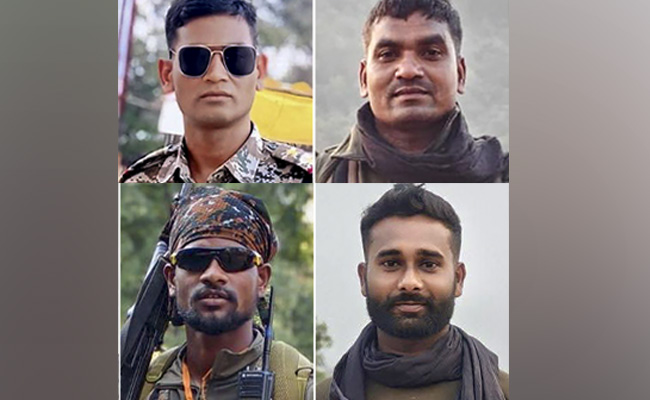
Narayanpur (Chhattisgarh) (PTI): Emotional scenes were witnessed on Sunday as wreaths were laid on the mortal remains of three of the four police personnel killed in an explosion in a gunpowder dump of Maoists in Chhattisgarh's Kanker district.
The grieving family members were inconsolable, while security personnel tried to comfort them.
Amid chants of "Bharat Mata ki Jai" and "Vande Mataram," public representatives, along with senior police and administrative officials, paid tributes to the deceased personnel.
The wreath-laying ceremony to pay homage to Inspector Sukhram Vatti (40), constables Krishna Komra (35) and Sanjay Gadhpale (29), killed in the explosion on Saturday, was held at the Police Lines in Narayanpur district, neighbouring Kanker.
The mortal remains of constable Parmanand Komra (29), who succumbed to injuries during treatment in Raipur, will be shifted to Kanker, where a separate wreath-laying ceremony will be held, police said.
Inspector General of Police, Bastar Range, Sundarraj Pattilingam, after paying homage, told reporters that the four police personnel made the supreme sacrifice while protecting the region.
"I pay my homage to them," he added.
The four personnel were killed while they were attempting to dispose of a gunpowder dump hidden earlier by Maoists in a forest near Aadnar village under Chhotebethiya police station limits in Kanker district, according to police.
It was the first explosion linked to Naxalites in the state since it was declared free from armed Maoists on March 31, and also the first instance this year in which security personnel engaged in anti-Naxal operations lost their lives.
District Reserve Guard (DRG) official Vatti, who was leading the team, hailed from Bijapur district. Constable Krishna Komra of the district force and constables Gadhpale and Parmanand Komra of the Bastar Fighters were residents of different villages in Kanker.