Chronology of events in Ram Janmabhoomi-Babri Masjid land dispute case
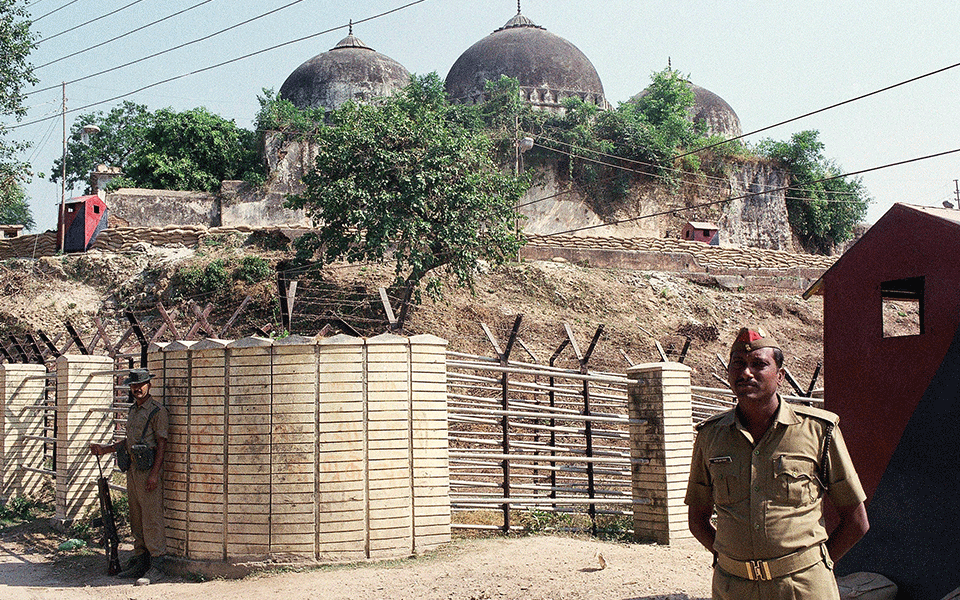
New Delhi: The following is the chronology of events in the Ram Janmabhoomi-Babri Masjid land dispute case in Ayodhya in which the Supreme Court Saturday granted entire 2.77 acre of disputed land in Ayodhya to deity Ram Lalla.
► 1528: Babri Masjid built by Mir Baqi, commander of Mughal emperor Babur.
► 1885: Mahant Raghubir Das files plea in Faizabad district court seeking permission to build a canopy outside the disputed structure. Court rejects the plea.
► 1949: Idols of Ram Lalla placed under central dome outside the disputed structure.
► 1950: Gopal Simla Visharad files suit in Faizabad district court for rights to worship the idols of Ram Lalla.
► Paramahansa Ramachandra Das files suit for continuation of worship and keeping the idols.
► 1959: Nirmohi Akhara files suit seeking possession of the site.
► 1961: UP Sunni Central Waqf Board files suit for possession of the site.
► Feb 1, 1986: Local court orders the government to open the site for Hindu worshippers.
► Aug 14, 1989: Allahabad HC orders maintenance of status quo in respect of the disputed structure.
► Dec 6, 1992: Babri Masjid demolished.
► Apr 3, 1993: 'Acquisition of Certain Area at Ayodhya Act' passed for acquiring land by Centre in the disputed area.
► Various writ petitions, including one by Ismail Faruqui, filed in Allahabad HC challenging various aspects of the Act.
► SC exercising its jurisdiction under Article 139A transferred the writ petitions, which were pending in the High Court.
► Oct 24, 1994: SC says in historic Ismail Faruqui case mosque was not integral to Islam.
► Apr, 2002: HC begins hearing on determining who owns the disputed site.
► Mar 13, 2003: SC says, in the Aslam alias Bhure case, no religious activity of any nature be allowed at the acquired land.
► Sep 30, 2010: HC, in a 2:1 majority, rules three-way division of disputed area between Sunni Waqf Board, the Nirmohi Akhara and Ram Lalla.
► May 9, 2011: SC stays HC verdict on Ayodhya land dispute.
► Mar 21, 2017: CJI JS Khehar suggests out-of-court settlement among rival parties.
► Aug 7: SC constitutes three-judge bench to hear pleas challenging 1994 verdict of the Allahabad HC.
► Feb 8, 2018: SC starts hearing the civil appeals.
► Jul 20: SC reserves verdict.
► Sep 27: SC declines to refer the case to a five-judge Constitution bench. Case to be heard by a newly constituted three-judge bench on October 29.
► Oct 29: SC fixes the case for the first week of January before an appropriate bench, which will decide the schedule of hearing.
► Dec 24: SC decides to take up petitions on case for hearing on January 4, 2019.
► Jan 4, 2019: SC says an appropriate bench constituted by it will pass an order on January 10 for fixing the date of hearing in the title case.
► Jan 8: SC sets up a five-judge Constitution Bench to hear the case headed by Chief Justice Ranjan Gogoi and comprising justices S A Bobde, N V Ramana, U U Lalit and D Y Chandrachud.
► Jan 10: Justice U U Lalit recuses himself prompting SC to reschedule the hearing for January 29 before a new bench.
► Jan 25: SC reconstitutes 5-member Constitution Bench to hear the case. The new bench comprises Chief Justice Ranjan Gogoi and Justices S A Bobde, D Y Chandrachud, Ashok Bhushan and S A Nazeer.
► Jan 29: Centre moves SC seeking permission to return the 67-acre acquired land around the disputed site to original owners.
► Feb 26: SC favours mediation, fixes Mar 5 for order on whether to refer matter to court-appointed mediator.
► Mar 8: SC refers the dispute for mediation by a panel headed by former apex court judge F M I Kallifulla.
► Apr 9: Nirmohi Akhara opposes in SC Centre's plea to return acquired land around Ayodhya site to owners.
► May 9: 3-member mediation committee submits interim report in SC.
► May 10: SC extends time till Aug 15 to complete mediation process.
► Jul 11: SC seeks report on "progress of mediation".
► Jul 18: SC allows mediation process to continue, seeks outcome report by Aug 1.
► Aug 1: Report of mediation submitted in sealed cover to SC.
► Aug 2: SC decides to conduct day-to day hearing from Aug 6 as mediation fails.
► Aug 6: SC commences day-to-day hearing on the land dispute.
► Oct 4: SC says it will wrap up hearing on Oct 17, judgment by Nov 17.
► SC directs UP govt to provide security to state Waqf Board Chairperson.
► Oct 16: SC concludes hearing; reserves order.
► Nov 9: SC grants entire 2.77 acre of disputed land in Ayodhya to deity Ram Lalla, possession of land will remain with Central government receiver. SC also directs Centre and UP govt to allot 5 acre land to the Muslims at a prominent place for building mosque.
Let the Truth be known. If you read VB and like VB, please be a VB Supporter and Help us deliver the Truth to one and all.
Neutrality of polls can't be assured if EC dependent on contestants: Justice Nagarathna
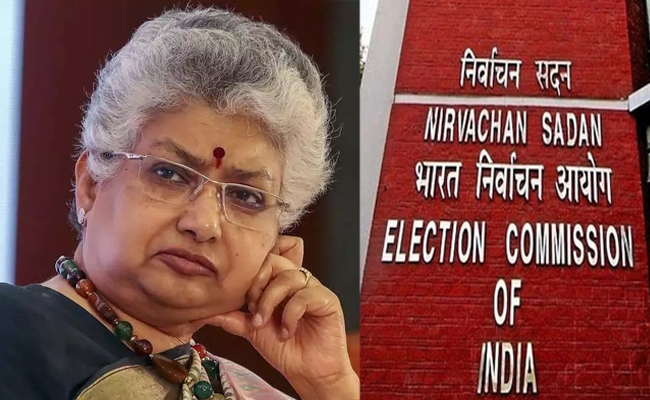
New Delhi (PTI): Supreme Court judge Justice BV Nagarathna, while highlighting that the Election Commission is the primary institution entrusted with maintaining the integrity of polls, has said if those who conduct elections are dependent on those who contest them, the neutrality of the process cannot be assured.
The apex court judge raised a critical concern regarding the structural independence of those tasked with overseeing the ballot while delivering the Rajendra Prasad Memorial Lecture at the Chanakya Law University in Patna on Saturday.
Citing a 1995 verdict where the Supreme Court recognised the Election Commission as a constitutional authority of high significance, entrusted with ensuring the integrity of elections, she said, "The concern, once again, was structural: if those who conduct elections are dependent on those who contest them, the neutrality of the process cannot be assured."
Justice Nagarathna said elections are not merely periodic events but a mechanism through which political authority is constituted.
"Our constitutional democracy has amply demonstrated smooth changes in government due to elections being held on a timely basis. Control over that process is, in effect, control over the conditions of political competition itself," she said.
The Supreme Court judge said power is not exercised only through formal institutions but also through the processes that sustain them, including elections, public finance, and regulation.
"A constitutional structure that seeks to restrain power must therefore go beyond its classical forms and address these fourth-branch institutions. A set of institutions, while not always fitting within the classical tripartite scheme, is nonetheless central to the maintenance of constitutional order," she said.
Justice Nagarathna said the unmistakable lesson of history is that constitutional collapse occurs through the disabling of its structure, and the violation of rights merely follows.
"The dismantling of structure, in turn, occurs when institutions stop checking each other. At that moment, elections may continue, courts may function, laws may be enacted by Parliament, and yet, power is effectively not restrained because the structural discipline no longer exists," she said.
The apex court judge also urged the Centre to view states as "coordinates and not subordinates" and asserted that the separation of powers was a "constitutional arrangement of co-equals."
Justice Nagarathna also called for keeping aside "inter-party differences" in the matter of "Centre-state relations", underscoring that governance must not depend on "which party may be ruling the Centre and which other party may be ruling at the state level".