Circumstantial evidence can be used for conviction if it leads to guilt only: SC
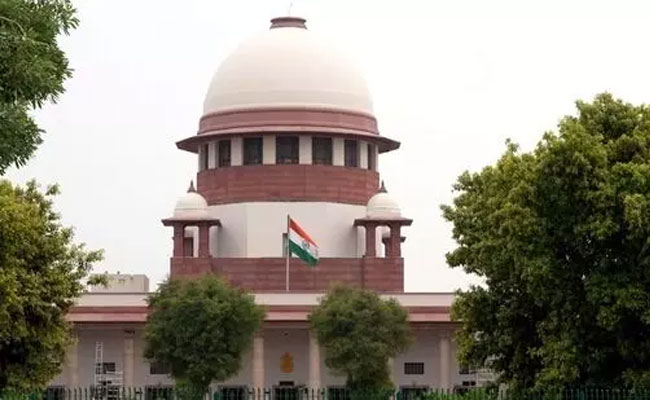
New Delhi(PTI): Circumstantial evidence can be used to convict an accused in a criminal case if it is of such a nature that is "consistent only with his guilt", the Supreme Court said on Thursday.
Setting aside the conviction and life sentence of a man accused in a 2004 murder case, a bench of Justices Sanjay Karol and Prashant Kumar Mishra reiterated the legal principle that the "last seen together" theory alone is insufficient to sustain a conviction in cases resting entirely on circumstantial evidence.
"It is a well-established rule in criminal jurisprudence that circumstantial evidence can be made the basis of the conviction of an accused person if it is of such a character that it is wholly inconsistent with the innocence of the accused and is consistent only with his guilt," Justice Mishra, who authored the judgement, said.
The verdict said in a case that lacks direct evidence, the incriminating circumstances being used against the accused must be such as to lead only to a hypothesis of guilt and must exclude every other possibility of the innocence of the accused.
ALSO READ: Red Fort blast: Court sends ninth arrested accused to NIA custody till Dec 26
"And if the circumstances proved against the accused, in a particular case, are consistent with the innocence of the accused, he will be entitled to the benefit of the doubt," it said.
The bench acquitted appellant Manoj alias Munna, granting him the benefit of the doubt after finding significant gaps in the prosecution's chain of evidence.
Referring to the facts of the case, the court said, "We are of the opinion that the nature of circumstantial evidence available against the appellant though raises a doubt that he may have committed the offence but the same is not so conclusive that he can be convicted only on the evidence of the last seen together (theory)."
It is a settled proposition that whenever any doubt emanates in the mind of the court, the benefit shall accrue to the accused and not the prosecution, it added.
"The present case is one where except for the evidence of last seen together, there is no other corroborative evidence against the appellant. Therefore, the conviction only on the basis of last seen together cannot be sustained," it said while setting aside the impugned judgments.
The case dates back to June 2004. The prosecution had alleged that Manoj, along with five co-accused, killed one Yuvraj Singh Patle, a tractor driver, to steal the vehicle and sell it.
The deceased was found with burn injuries and ligature marks on his neck.
While the trial court acquitted the five other co-accused, Manoj was convicted under sections 302 (murder) and 201 (causing disappearance of evidence) of the Indian Penal Code, primarily based on the testimony of witnesses who saw him leaving with the deceased on the evening of June 6, 2004.
The Chhattisgarh High Court upheld his conviction in 2011.
Let the Truth be known. If you read VB and like VB, please be a VB Supporter and Help us deliver the Truth to one and all.
Maharashtra sets up state vaccination task force to strengthen immunisation programme

Mumbai (PTI): The Maharashtra government has set up a State Vaccination Task Force to strengthen the regular immunisation programme and review the progress of related campaigns, a health department official said on Monday.
The State Vaccination Task Force will comprise at least 29 members and will be headed by the administrative head of the health department, he informed.
The government has also constituted separate district-level and municipal vaccination task forces to improve implementation and address challenges at the grassroots level, he said.
Municipal task forces, chaired by respective civic commissioners, have been constituted in view of the vast urban population in Maharashtra and the role of civic bodies in implementing different health programmes.
The district-level task forces will function under the chairmanship of collectors.
"Complete immunisation of children at the appropriate age is an extremely simple, cost-effective and highly effective measure to reduce child mortality and the prevalence of diseases among kids. Immunisation is a powerful tool for reducing illness in children," maintained the official.
To ensure full vaccination of all children, the state government implements various campaigns from time to time as per the central government guidelines, he pointed out.
"Active participation and cooperation of other relevant government departments are essential (in making these campaigns successful)," according to the official.
The state-level body will review the regular immunisation programme, associated campaigns and vaccine-preventable diseases in detail. It will also conduct focused assessments of high-risk districts and municipal corporations, including vacancies at district, municipal and sub-district levels, availability of cold chain equipment, resource gaps and training requirements, he noted.
The state task force will review allocation and utilisation of funds for immunisation and ensure timely action by officers concerned based on reports from district and municipal task forces and state-level monitoring mechanisms, the official said.
It will also ensure active coordination and participation of other government departments in immunisation drives, while district and municipal task forces will carry out similar functions at their respective levels, the official added.