CITES warns India against issuing more permits for Vantara-bound animals
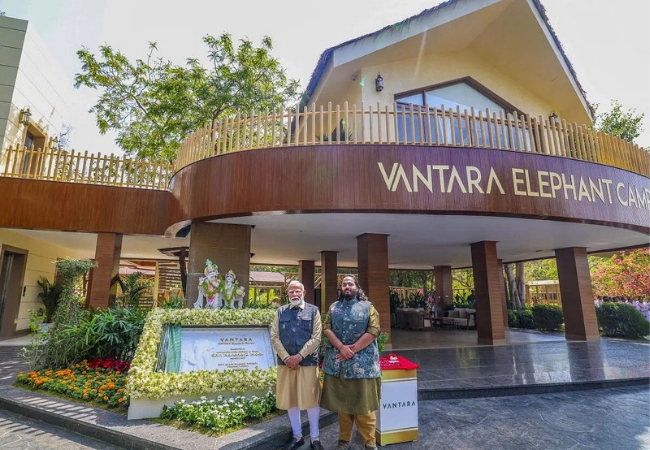
Bengaluru: After an on-site inspection at Vantara the Reliance-backed zoo and rescue complex in Jamnagar, the Convention on International Trade in Endangered Species of Wild Fauna and Flora (CITES) has told India to stop issuing import permits for wild animals until the country applies stronger checks and implements a set of CITES recommendations, The Wire has reported.
The CITES team visited Vantara between September 15 and 20 this year as part of an inquiry that followed media reports and complaints about a surge of international animal transfers to the Jamnagar facility. The inspection, and a CITES “compliance document” published this week, found multiple issues in the record and handling of some transfers and concluded that India had not applied adequate “due diligence” when it issued several import permits for animals bound for Vantara. The Wire has published a detailed report on its website regarding the findings of the inquiry.
What CITES found
CITES, a multilateral treaty that regulates international trade in endangered species so that trade does not threaten survival of those species, flagged a range of concerns after the Jamnagar visit. The main findings in the compliance document include: questions over the origin of certain animals, inconsistent use of CITES source and purpose codes, mismatches in export and import numbers recorded in databases, and cases where India issued import permits based on export documents that CITES says were forged.
CITES concluded that India should not issue any further import permits for wild animals until it establishes and applies proper due-diligence procedures and implements the Secretariat’s recommendations. India must report back to CITES on steps taken before the 81st meeting of the CITES Standing Committee.
Why the visit happened
The CITES inspection was triggered by investigative news reports and allegations about transfers to Vantara from countries including the Democratic Republic of the Congo, Mexico and others. Some reports suggested Vantara’s demand for rare and endangered animals might have fuelled illegal wildlife trade. These allegations prompted India’s Supreme Court to set up a Special Investigation Team (SIT), which the court said, on September 15, had found “no foul play” and that transfers were “carried out in regulatory compliance”; the court also said it was “closing the matter” and would not entertain further “objections” on the issue. The CITES inspection and its findings stand separately, and the new compliance document raises fresh questions.
Source and purpose codes: CITES uses standard codes to record the source of specimens (for example, Source C for bred in captivity, Source I for seized/confiscated) and the purpose of the transaction (for example, B for breeding, T for commercial). The CITES team found several transfers to Vantara where the codes used did not appear appropriate for the specimens’ likely origins. In one instance CITES noted that nine chimpanzees exported from the Democratic Republic of the Congo were described as “in captivity,” but that alone does not justify the use of Source C; they must be shown to have been bred in captivity. Proper due diligence, CITES says, would have required India to trace and verify the full origin of the specimens before permitting import.
Imports declared as seized or with unknown origin: CITES said questions remain about imports recorded under Source I (seized or confiscated). These 54 specimens included 10 jaguars, 10 ocelots, 10 margays, 10 jaguarundis declared as seized by Mexico, as well as four chimpanzees, one orangutan and eight cheetahs traded by the United Arab Emirates and declared with unknown country-of-origin. CITES flagged the need for clarity on how these specimens were acquired and coded.
Numbers do not tally: The Trade Database entries and permit records for some transfers do not match. For example, in the case of African cheetahs from Mexico, the CITES Trade Database recorded an export of 14 cheetahs to India, but it also recorded an import of 24 cheetahs from Mexico, while the Indian CITES Management Authority had cleared only 12 cheetahs for import. India later told CITES that no cheetahs had in fact been imported from Mexico — leaving a paper trail that did not reflect actual trade. CITES recommended that Parties update the Trade Database to reflect what actually moved, not just permits issued.
Lone mountain gorilla documentation: CITES raised specific concerns about a mountain gorilla that Vantara received via the UAE in 2024. The gorilla’s country of origin was shown as Haiti, which is not a natural range state for mountain gorillas and is not a CITES Party. There is no record of transfers of any gorilla species into Haiti in the CITES Trade Database. The Indian CITES Management Authority justified the import by saying the gorilla needed rescue from conflict and civil unrest in Haiti. CITES said Appendix-I species traded through or declared as originating from non-Parties and non-range States require a much higher level of due diligence.
A Tapanuli orangutan case: A critically endangered Tapanuli orangutan (an Appendix-I species) imported from the UAE and listed as originating from Indonesia with Source C (bred in captivity) was another red flag. CITES noted that orangutans do not breed easily in captivity and, given the species’ rarity, India should have applied strict checks to verify whether the animal met the formal definition of “bred in captivity.” Without that, there is a risk that wild-caught individuals are traded as captive-bred.
Fake export permits: The CITES Secretariat found that export permits purportedly issued by Cameroon for eight chimpanzees were forged. India, CITES said, issued import permits without verifying the authenticity of these export permits beyond accepting them at face value. That particular transfer did not take place because the exporting entity in Cameroon did not allow GZRRC representatives to inspect animals or facilities. CITES warned that large-scale acquisitions by facilities like GZRRC and RKTEWT may attract people who try to exploit demand to traffic animals, and that reinforced caution is needed.
Numbers at Vantara
Vantara comprises two entities: the Greens Zoological Rescue and Rehabilitation Centre (GZRRC) and the Radhe Krishna Temple Elephant Welfare Trust (RKTEWT). The GZRRC’s last available annual report (2023–24) said it housed 10,360 rescued animals of 345 species as of March 2024. But the CITES compliance document reports that, as of September 11 this year, the GZRRC held 41,839 animals and the RKTEWT held 5,794 animals. CITES’ source-code breakdown for Appendix-I species at Vantara in that document included: C (bred in captivity) – 2,049 specimens; I (seized/confiscated) – 54; D (Appendix-I bred in captivity for commercial purposes) – 17; F (born in captivity) – 9; W (taken from the wild) – 3. The discrepancy between GZRRC’s 2023–24 annual report and the CITES figures is one of the core data issues flagged by observers and the Secretariat.
Vantara’s response and claims
Vantara, in a press release on November 4, claimed that CITES had given the facility “a clean chit” and that the Secretariat “noted that all animal transfers to the facility were fully legitimate and transparent, in accordance with Indian law.” Vantara has previously denied media allegations of wrongdoing and told The Wire in March that claims its acquisition numbers were “deliberately misleading” were untrue and that transfers had proper documentation. The Wire has written to Vantara seeking clarifications about its November 4 claims.
The contrast with India’s SIT and official stance
On August 25 this year, India’s Supreme Court set up a Special Investigation Team that included former Supreme Court Justice J. Chelameshwar to probe allegations about Vantara. On September 15 the top court said the SIT found “no foul play” and that transfers were “carried out in regulatory compliance” — and that the court would close the matter and not hear further objections on these grounds. India’s CITES Management Authority and other national authorities have in submissions said they have systems to ensure CITES provisions are followed; they also welcomed the Secretariat’s visit to Vantara. But the Secretariat’s separate inspection has drawn a different set of conclusions that are at odds with the SIT’s findings.
During the CITES visit, the Secretariat met several Indian agencies: the Ministry of Environment, Forest and Climate Change (whose Director General of Forests & Special Secretary is the Indian CITES Management Authority), the Wildlife Crime Control Bureau, the Central Zoo Authority (CZA), Customs and other departments. The CITES document records that Indian representatives acknowledged gaps in their understanding of the rules governing source and purpose codes and that their due diligence often limited itself to verifying the authenticity and validity of export permits rather than tracing specimen origin. Indian authorities reportedly expressed willingness to improve procedures; they have also committed in writing to work on these improvements in submissions to CITES. Given the Secretariat’s findings, CITES has asked India to strengthen its import procedures and apply systematic, risk-based due diligence before issuing permits or allowing shipment. India must report to CITES on actions taken before the 81st Standing Committee meeting.
Voices of experts and observers
A researcher who studies illegal wildlife trade and who spoke to The Wire said the need to send endangered rescued animals from their natural range to places like Vantara must be questioned — such transfers reduce opportunities for reintroduction and risk promoting cross-border movement that may not be in the animal’s conservation interest. An ecologist who follows the issue told The Wire that the CITES findings cast a poor light on India’s regulatory agencies and raise awkward questions about how the Supreme Court’s “clean chit” to Vantara sits alongside the Secretariat’s concerns.
What this means in practice
Here’s the thing: CITES’ recommendation for India to halt new import permits for wild animals until due-diligence gaps are closed is not a paperwork formality. For Appendix-I species, and other high-risk transfers, the Secretariat expects traceability, concordance between export and import records, clarity about how each specimen was acquired, and tight checks against forgery or misuse of permits. Without these, authorities run the risk of enabling or masking illegal harvests that are then declared as captive-bred or otherwise misclassified. CITES’ compliance document suggests India should reassess its procedures urgently and run risk-based checks for facilities that import large numbers of animals.
The Wire stated that it has written to Vantara for clarifications about the CITES compliance document and Vantara’s November 4 press release, and has also contacted the Indian CITES Management Authority and members of the Supreme Court-appointed SIT for comment. The Wire said it will update the story if and when responses are received.
Let the Truth be known. If you read VB and like VB, please be a VB Supporter and Help us deliver the Truth to one and all.
One dead due to electrocution on 'Jailer 2' movie set in Chennai

Chennai (PTI): A 28-year-old worker died of electrocution on the sets of the upcoming Tamil film 'Jailer 2', starring Superstar Rajinikanth, at a private film studio here, police said.
The deceased has been identified as Karthikeyan.
The incident occurred at the venue in Panaiyur. According to preliminary reports, Karthikeyan suffered a fatal electric shock while engaging in art direction work, erecting a house-like set for the movie's shooting, police said
Kanathur police said FIR is yet to be filed, but further investigations are underway to determine the circumstances that led to the electrical leak.