Citing confidentiality, government declines to share black money details received from Switzerland
New Delhi: The government has declined to share information on black money cases received from Switzerland, citing confidentiality. Replying to an RTI query, the Finance Ministry said India and Switzerland share information on black money on a case to case basis as per the investigations being carried out.
It is an ongoing process, it added.
"The information shared by Switzerland on black money cases is governed by confidentiality provisions," it said in reply to the RTI application filed by this PTI journalist.
The ministry was asked to provide details of black money cases received from Switzerland, including the names of firms and individuals, besides the details of action taken on the information.
India and Switzerland are signatories to Multilateral Convention on Mutual Administrative Assistance in Tax Matters (MAAC). Indian and Switzerland have, for automatic sharing of financial account information between the two countries, signed a joint declaration on November 22, 2016, it said.
"The necessary legal arrangements have been put in place and from 2019 onwards, India will receive information of financial accounts held by Indian residents in Switzerland for the calender year 2018 and subsequent years," the ministry said.
This, it said, will be useful in tracing unaccounted income and assets of Indian residents in Switzerland and bringing the same to tax. There is no estimation of amount of black money in circulation both inside and outside the country, the ministry said.
The Finance Ministry was also asked to provide details of black money cases received from other countries.
It said, based upon the information received from France under the Indo-French Double Taxation Avoidance Convention, assessment proceedings have been completed in all 427 actionable HSBC bank account cases.
"In these cases, undisclosed income of about Rs 8,465 crore has been brought to tax on account of deposits made in the unreported foreign bank accounts. Out of the above mentioned 427 cases in which assessments have been completed, concealment penalty of about Rs 1,291 crore has been levied in 162 cases," the ministry said.
In reply to an earlier RTI application, the Finance Ministry had declined to share copies of three reports on the quantum of black money held by Indians inside the country and abroad, saying they were being examined by a parliamentary panel and disclosing details will cause a breach of privilege of the House.
These reports were submitted to the government more than four years ago.
The UPA government had in 2011 commissioned the studies by the Delhi-based National Institute of Public Finance and Policy (NIPFP) and the National Council of Applied Economic Research (NCAER) and the National Institute of Financial Management (NIFM) in Faridabad.
The study reports of the NIPFP, NCAER and NIFM were received by the government on December 30, 2013, July 18, 2014, and August 21, 2014, respectively.
The reports and the government's response to it had been forwarded to the Lok Sabha secretariat for placing them before the Standing Committee on Finance.
The Lok Sabha secretariat has informed that the same has been placed before the committee which will examine it, it had said while replying to the RTI application in February.
"The issue of black money has attracted a lot of public and media attention in the recent past. So far, there are no reliable estimates of black money generated and held within and outside the country," the Finance Ministry had said while ordering the studies in 2011.
These estimates were based on various unverifiable assumptions and approximations, it had said.
The Terms of Reference (ToR) for the studies included the assessment or survey of unaccounted income and wealth, and profiling the nature of activities engendering money laundering both within and outside the country.
The studies were to identify, among other issues, important sectors of the economy in which unaccounted money was generated and examine the causes and conditions that resulted in the generation.
Let the Truth be known. If you read VB and like VB, please be a VB Supporter and Help us deliver the Truth to one and all.
Marxism will remain relevant despite Left electoral's losses, says general secretary M A Baby
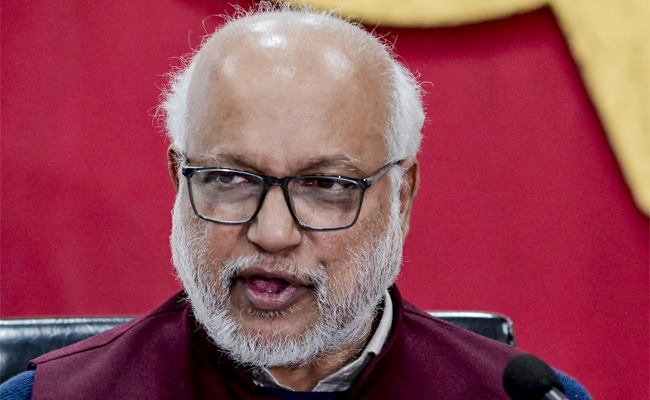
New Delhi (PTI): CPI(M) General Secretary M A Baby on Thursday asserted that the Left movement would remain relevant despite not being in power in any state, saying the ideology would continue to endure as long as social and economic inequalities persist.
Hitting back at BJP leader Rajeev Chandrasekhar over his reported remarks that Marxism had become irrelevant, Baby, in an interview with PTI Videos, said, "So long as there is division in society, so long as there is exploitation of the majority of workers, peasants and ordinary masses by a handful of billionaires, Marxism will remain relevant."
"That perhaps Mr Rajeev Chandrasekhar may not be able to understand, but this is the fact of the matter," he said.
Baby acknowledged that the CPI(M)-led Left was currently without an elected government in any state, but maintained that electoral setbacks would not diminish the movement's role.
"We may not have an elected government in any state. There were occasions when we didn't have a government. But the red flag and the commitment to organise and struggle for the rights of the dispossessed, marginalised and exploited will always be upheld by CPI(M) and the Left movement," he said.
He said the Left continued to enjoy support among workers, peasants, agricultural labourers, youth, students and women, and argued that the movement remained necessary because "oppression and assault" continued in society.
"So long as such problems exist in society, the red flag and the working class movement will continue to work among the masses," the Left leader said.
Exuding confidence on the Left's revival, Baby said the party would reflect on the reasons behind its electoral loss.
"We may be rejected in one election, but we will stage our comeback by understanding what went wrong with us," he said, adding, "We will listen to people and we will come back with higher strength."
Baby also criticised the Congress over reported factional tensions in Kerala after the Congress-led United Democratic Front's victory in the state.
"The way they are behaving is being watched by the people of Kerala," he said, referring to infighting within the Congress.
"Those who have given a massive majority to Congress and UDF would be watching all this," he added, while urging party leaders to "settle the problem in an amicable, democratic manner".
Referring to West Bengal, Baby alleged that violence had escalated following the BJP's victory in the state assembly polls.
"It is quite unfortunate that the moment BJP snatched a massive victory in West Bengal, violence has also started on a big scale," he said.
He also accused the Trinamool Congress of being "notorious for violent activities" and alleged that the "RSS-controlled BJP" had "unleashed violence in many places" after the election results.
"This is not good for Bengal, not good for the country. We wish and hope that normalcy would be restored as soon as possible," he said.
Baby said the CPI(M) and the Left in West Bengal would continue efforts to "pacify people" and avoid violence and confrontation.
Asked about former Kerala chief minister Pinarayi Vijayan not reacting publicly to the election results, Baby said Vijayan would respond "at an appropriate time".