CJI’s mother to be chief guest at RSS event, brother says invite, ideology ‘separate’: Report
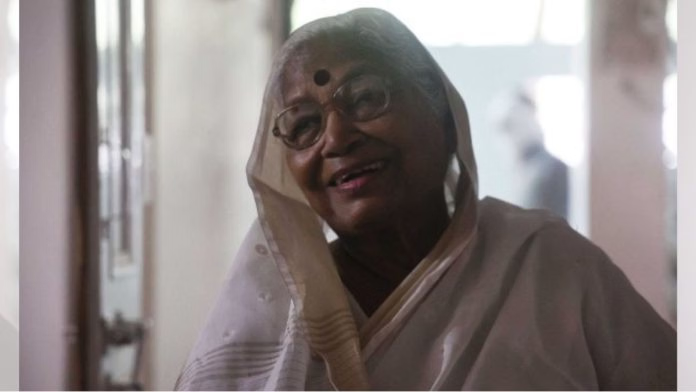
Amravati: Kamaltai Gavai, the mother of Chief Justice of India B.R. Gavai and a political activist, is set to be the chief guest at an upcoming RSS event linked to the Vijayadashami celebrations in Amravati, Maharashtra, on October 5.
The event, which follows the Sangh’s annual Vijayadashmi celebration at its headquarters in Nagpur, coincides with the centenary of the Sangh’s formation. This development has raised eyebrows due to her son’s high-profile position as the Chief Justice of India. However, Dr Rajendra Gavai, CJI’s brother and a leader of the Republican Party of India (RPI), confirmed that Kamaltai would attend the event, as reported by The Indian Express on Wednesday.
“The Gavai family has always maintained relationships that go beyond political boundaries, relationships that are above party lines,” TIE quoted him as saying.
According to RSS sources quoted in the report, Kamaltai’s invitation is in her personal capacity, acknowledging her activism and her role as the wife of the late Ramakrishna Gavai, former Governor of Maharashtra, who was known as ‘Dadasaheb Gavai’.
Officials of the RSS communication wing Vishwa Samvad Kendra mentioned that Kamaltai’s consent was sought before sending the official invitation. “The programme is in Amravati. It has nothing to do with the Nagpur event. The publicity department swayamsevaks in Amravati went to them (the Gavais), gave an official invitation, and they accepted it,” TIE quoted them as saying.
Speaking to the media, Rajendra Gavai said: “The Sangh’s programme is being held in Amravati, and Aai Saheb (mother) has received and accepted the invitation. It is important to note that in the past, leaders like B.D. Khobragade, a barrister and former Deputy Chairman of the Rajya Sabha, and Dadasaheb Gavai have attended the Sangh’s Vijayadashmi events in Nagpur. Hence, even our mother accepted the invite.”
Responding to questions about the Chief Justice’s mother attending a Sangh event, Rajendra Gavai clarified: “My brother holds a very important position today, and that is why some opponents do not like it. They continue to spread baseless things about our family. We visit temples, churches, and mosques with equal respect, but opponents deliberately speak ill and make false remarks about us.”
Rajendra emphasised that their father has maintained cordial relationships with political leaders across the spectrum, from Atal Bihari Vajpayee to Indira Gandhi, yet their ideological beliefs remained distinct. “Attending someone’s function does not mean one’s ideology changes. That is absolutely not the case. In fact, I believe people should attend each other’s events as a matter of respect and goodwill,” he added.
Let the Truth be known. If you read VB and like VB, please be a VB Supporter and Help us deliver the Truth to one and all.
India, New Zealand ink free trade agreement
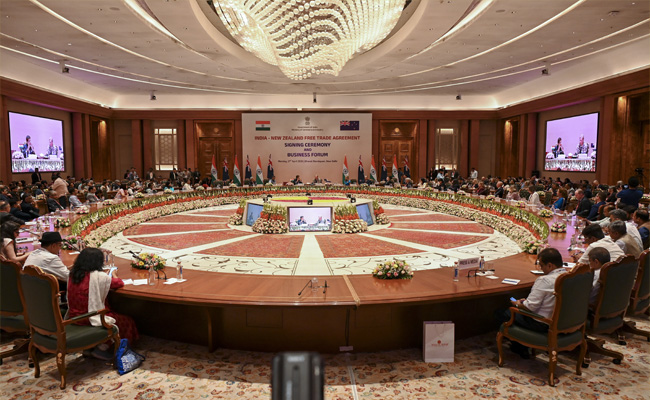
New Delhi (PTI): India and New Zealand on Monday inked a free trade agreement, aimed at boosting two-way commerce and investments.
The pact was signed by Commerce and Industry Minister Piyush Goyal and visiting New Zealand's Trade and Investment Minister Todd McClay.
The FTA provides duty-free access for 100 per cent of India's exports to New Zealand, covering all tariff lines or produce categories, and is expected to significantly boost MSMEs and employment by enhancing competitiveness in labour-intensive sectors such as textiles, apparel, leather, footwear, gems and jewellery, engineering goods, and processed foods.
Earlier, New Zealand maintained peak tariffs of up to 10 per cent on key Indian exports, including ceramics, carpets, automobiles, and auto components.
With zero-duty market access from entry into force as New Zealand's other trade partners, Indian products will be fully competitive in that country, enjoying a level playing field.
ALSO READ: Cal HC urges EC to dispose of TMC complaint over police observer's meeting with BJP nominee
Significantly, India also secured duty-free inputs for its manufacturing sector, including wooden logs, coking coal, and waste and scraps of metals, lowering production costs and enhancing the global competitiveness of the Indian industry.
On the other hand, India has offered tariff liberalisation on 70.03 per cent of tariff lines covering 95 per cent of bilateral trade value, while keeping 29.97 per cent of tariff lines excluded to protect India's sensitive sectors.
The products that are kept in exclusion are mainly -- dairy (milk, cream, whey, yoghurt, cheese etc.), animal products (other than sheep meat), agricultural products (onions, chana, peas, corn, almonds), sugar, artificial honey, animal, vegetable or microbial fats and oils, arms and ammunition, gems and jewellery, copper and articles thereof (cathodes, cartridges, rods, bars, coils), aluminium and articles thereof (ingots, billets, wire bars) among others.
On 30 per cent of tariff lines of New Zealand, India will provide duty elimination on goods such as wood, wool, sheep meat, and leather-raw hides.
Similarly, 35.60 per cent of tariff lines are subject to phased elimination over 3, 5, 7, and 10 years, including petroleum oil, malt extract, vegetable oils, selected electrical and mechanical machinery, and peptones.
New Zealand products which enjoy tariff reductions include wine, pharmaceutical drugs, polymers, aluminum, iron and steel articles, and goods that only 0.06 per cent fall under tariff rate quotas, including Manuka honey, apples, kiwi fruit, and albumins, including milk albumin.
The FTA also includes a commitment to facilitate USD 20 billion in investment into India.
A rebalancing clause is incorporated into the Agreement to provide a framework for addressing any shortfall in investment delivery, thereby ensuring robust and tangible economic outcomes.
Total bilateral trade in goods and services reached USD 2.4 billion in 2024.