Classes for first year to start from November 1: UGC to universities
New Delhi: The delayed academic session for freshers in universities and colleges will begin from November 1, and the winter break this year, the summer vacation in 2021 and other holidays would be curtailed to compensate for the time lost, according to the University Grants Commission.
The guidelines by an expert committee, set up for revising the academic calendar in view of COVID-19 pandemic, have been accepted by the UGC and accordingly universities have been recommended a six-day teaching-learning schedule every week.
In view of the COVID-19 pandemic, the Commission has accepted the Report of the Committee and approved the UGC Guidelines on Academic Calendar for the First Year of Under-Graduate and Post-Graduate Students of the Universities for the Session 2020-21, Union Education Minister Ramesh Pokhriyal Nishank' tweeted.
The UGC had in April released an alternative academic calendar for colleges to reopen, with guidelines on exams, mode of study and the schedule.
At that time, the plan was to reopen colleges from September, but it could not materialise due to a continuing surge in coronavirus cases.
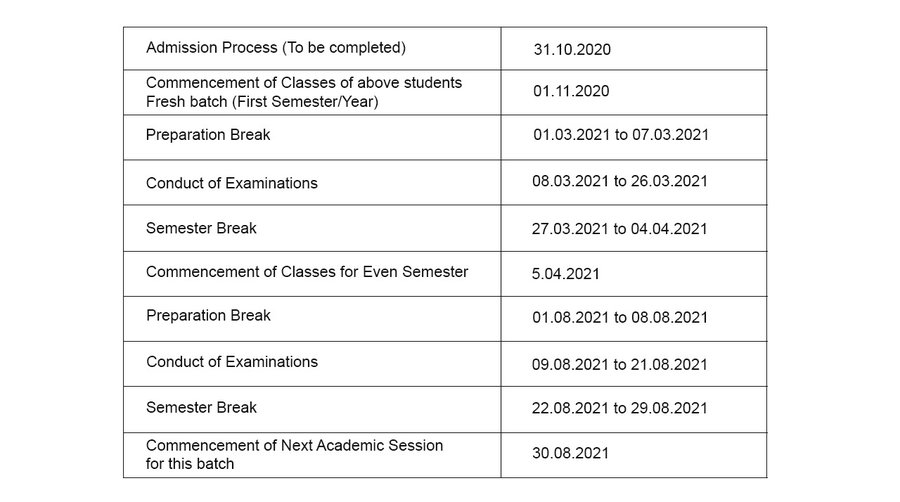
As per the revised calendar, the admission process for first year students needs to be completed by October 31 and classes for the first semester should commence by November 1.
In order to compensate for the loss of academic time, the UGC has asked colleges to teach six days a week and shorten the winter break this year and the summer break next year.
The universities are requested to compensate the delay in the start of academic sessions in the subsequent years by curtailing the breaks/vacations so that this batch of students would get their final results for award of degree timely," the guidelines said.
The start of first year of academic session 2020-2021 is delayed due to the circumstances beyond control but efforts be made to compensate the loss of this period by curtailing the breaks (Summer, Winter etc). This would ensure that these students would timely complete their 3 year UG/ PG programme, the UGC guidelines said.
All the universities may follow a 6-day week pattern for the academic session 2020-21 and 2021-2022 to compensate the loss for this batch of students, it added.
Universities and schools across the country have been closed since March 16 when the Centre announced a countrywide classroom shutdown as part of measures to contain the spread of the novel coronavirus.
Let the Truth be known. If you read VB and like VB, please be a VB Supporter and Help us deliver the Truth to one and all.
AIITA welcomes Karnataka’s ban on obscene songs in school events
Bhatkal: The Karnataka unit of the All India Ideal Teachers Association (AIITA) has welcomed the Karnataka government’s decision to strictly ban school children from dancing to obscene songs during educational and cultural programmes in government, aided, and private schools across the state.
AIITA Karnataka State President M. R. Manvi congratulated the government for taking what he termed an important step to preserve the sanctity of education.
“Such decisions to safeguard the dignity of school children and uphold the values of education are the need of the hour. This rule should not be limited to government schools alone but must be strictly implemented in all private educational institutions as well,” he said.
He further urged the government to address other concerns within school programmes.
“The government should not only prohibit obscene dances in the name of school anniversaries, but also ensure that plays and dialogues that incite religious hatred are avoided. Schools should be centres of harmony, not platforms for spreading hatred,” he added.
According to a recent circular issued by the Department of School Education and Literacy, obscene dances are adversely affecting the mental health and moral values of students.
In this regard, schools have been advised to use songs that promote nationalism, positive thinking, the greatness of Kannada culture, and value-based traditions instead of inappropriate content during programmes.
The circular also emphasises that students should be dressed in decent attire.
AIITA also backed the department’s warning that disciplinary action would be taken against head teachers if such guidelines are violated. The association has further demanded that district Deputy Directors of Public Instruction strictly monitor the implementation of these rules.