Cleaning up Delhi's air requires uncomfortable decisions involving rich people: Sunita Narain
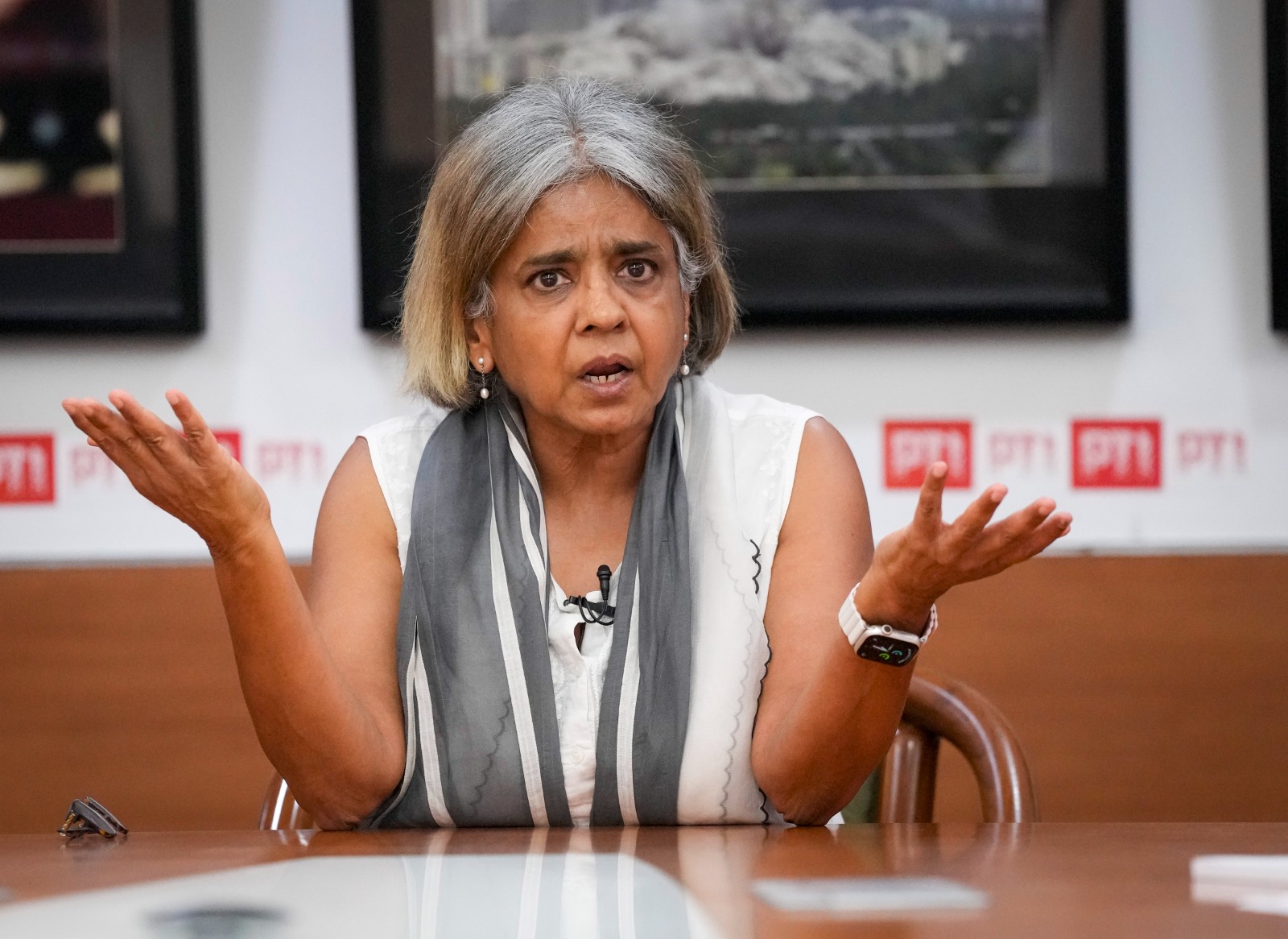
New Delhi (PTI): Cleaning up Delhi's air requires "uncomfortable and inconvenient" decisions, and it cannot be achieved by being nice to everyone, particularly the affluent residents who significantly contribute to the problem, leading environmentalist Sunita Narain has said.
In an interaction with PTI editors, Narain said although central and state governments have taken several steps to control air pollution in Delhi, including banning coal and introducing BSVI fuel, erratic weather patterns due to climate change and the inadequate speed of addressing the crisis continue to exacerbate the problem.
Narain, the Director General of the Centre for Science and Environment, said the episodic burning of crop residue by farmers in winter is not the primary concern. Instead, the persistent and major sources of pollution within the city, including transport and industries, are more worrisome.
"My only request for the new government is to take some uncomfortable, inconvenient decisions to move ahead on air pollution. We will never clean up the air of Delhi by being nice to everybody, particularly the rich of Delhi," she said.
Narain, who was part of the Supreme Court-appointed Environment Pollution (Prevention and Control) Authority, also urged the new government at the Centre to bring natural gas under the GST regime, arguing that the current triple taxation on gas makes it unaffordable compared to dirty coal. This change would make clean gas a more viable option, she said.
"My biggest request for the next government... The easiest thing we can do to reduce pollution in Delhi is to bring it under GST," Narain said.
She stressed the need for reducing vehicular pollution by enhancing public transport.
Source apportionment studies conducted in the past show that transport accounts for 17.9 per cent to 39.2 per cent of Delhi's PM2.5 pollution, while industries' contribution ranges from 2.3 per cent to 28.9 per cent.
"Delhi has taken several steps to control air pollution. It is the only city in the country to ban coal use, which is a major achievement. Delhi shut down its last coal-based power plant and transitioned to gas for power generation. The government introduced BSVI fuel and imposed a congestion charge on trucks entering Delhi. The construction of a peripheral expressway now allows trucks to bypass the city," Narain said.
Efforts have also been made to incentivise the use of natural gas. In Delhi, there is zero VAT on gas, and natural gas is now readily available in industrial areas across the city. These initiatives have collectively led to a year-over-year reduction in pollution levels, she said.
However, Narain said, there are two major factors that continue to exacerbate the problem -- worsening weather conditions, which are beyond human control, and the inadequate speed of tackling the crisis.
This winter, for instance, northwest India, including Delhi, did not experience rain. The lack of rainfall is due to changes in the Arctic jet stream affecting western disturbances, which are becoming more erratic and shifting northwards, she explained.
This has led to less snow in the hills and less rain in Delhi, resulting in higher pollution levels, Narain said.
"Secondly, after all the actions taken up to 2021, we are not taking actions at the speed required by the crisis that is happening," she said.
The environmentalist said the last major bus fleet expansion occurred during Sheila Dikshit's tenure as Delhi chief minister, around the time of the Commonwealth Games.
Since then, many buses have not been replaced, leading to a decline in bus ridership, she said and added that the bus system needs to be integrated with metro systems and parking facilities to be effective.
Unfavourable meteorological conditions, combined with vehicular emissions, paddy-straw burning, firecrackers, and other local pollution sources, contribute to hazardous air quality levels in the Delhi-NCR during winters.
According to a Delhi Pollution Control Committee (DPCC) analysis, the city experiences peak pollution from November 1 to 15, when the number of stubble-burning incidents in Punjab and Haryana increases.
Delhi's air quality ranks among the worst among the world's capital cities. According to a report compiled by the Energy Policy Institute at the University of Chicago (EPIC) in August, air pollution is shortening lives by almost 12 years in Delhi.
Let the Truth be known. If you read VB and like VB, please be a VB Supporter and Help us deliver the Truth to one and all.
25 lakh properties in Bengaluru brought under e-Khata system: Shivakumar
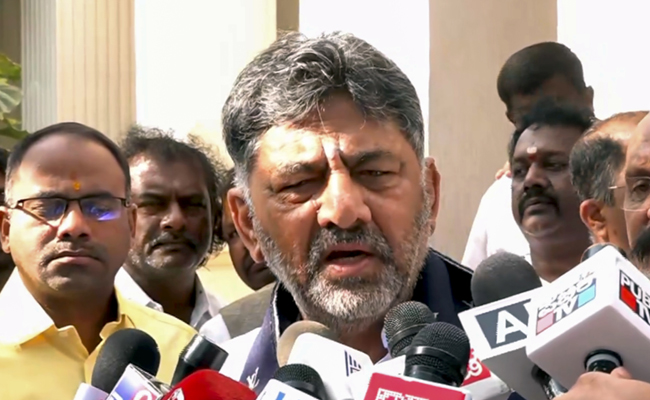
Bengaluru (PTI): Karnataka Deputy Chief Minister D K Shivakumar on Friday said that the state government has brought over 25 lakh properties under the e-Khata system in Bengaluru.
e-Khata is an electronic property certificate that maintains ownership information in an online database.
The e-Khata initiative aimed to ensure accuracy, transparency and universal coverage for property owners, he said.
Addressing a press conference here, Shivakumar, who is also the Bengaluru in-charge Minister, said over 25 lakh properties are being brought under the e-Khata system. Of them more than 7,000 applications have been processed, and additional outreach measures being planned for those yet to obtain their e-Khata.
"Twenty five lakh e-Khatas is a great number which has created history," he said.
The Deputy CM said the government is ensuring that every e-Khata will have its GPS, the shape of the property, and the measurement with every photo and document.
He explained that the government is integrating Aadhaar details, digital documentation, GPS mapping and property sketches to create a robust database.
"We want to see that every record is filled right. They (officials) are asking for documentation, stamp, digital documents. We wanted to connect every Aadhaar card and have it online," Shivakumar said.
To facilitate access, the Deputy CM announced the opening of more than 50 centres across Bengaluru, many of them in government schools, where citizens can apply for or rectify their e-Khata records.
"All of them will be working this Saturday. This 'Khata Mela' will be done. It is 'Nanna Khata, Nanna Swathu'," he said.
Applicants whose documents require verification will be given an acknowledgement and asked to return after 15 days, during which officials will conduct site inspections, he said.
Shivakumar said the government has also taken steps to identify and reclaim properties recorded as roads in revenue documents, asserting that such lands belong to the government.
"We have decided through the law that all the roads in the revenue records have been taken out. Those properties belong to the government itself," he said.
He noted that the initiative has received recognition from the Union government. "The Government of India has awarded us. It said that it is the model for the entire country," he said, while thanking officials involved in the project.
The Deputy CM said the government expects around 10 lakh additional households to benefit from the drive and assured that even those who have not downloaded their documents will receive printed copies free of cost at their residences.
"We will see that all the 25 lakh people will get their e-Khata to their home free of cost," Shivakumar said.
On apartment properties, he said all flats that have obtained occupancy certificates have been cleared.
"All the 37,460 flats (who have applied for e-Khata) have been issued an occupancy certificate. We have cleared all of them," the Deputy CM said.