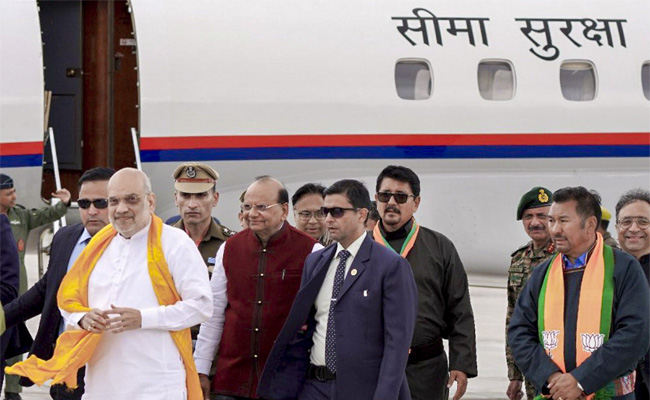
Climate change affecting agriculture in Bihar: CM
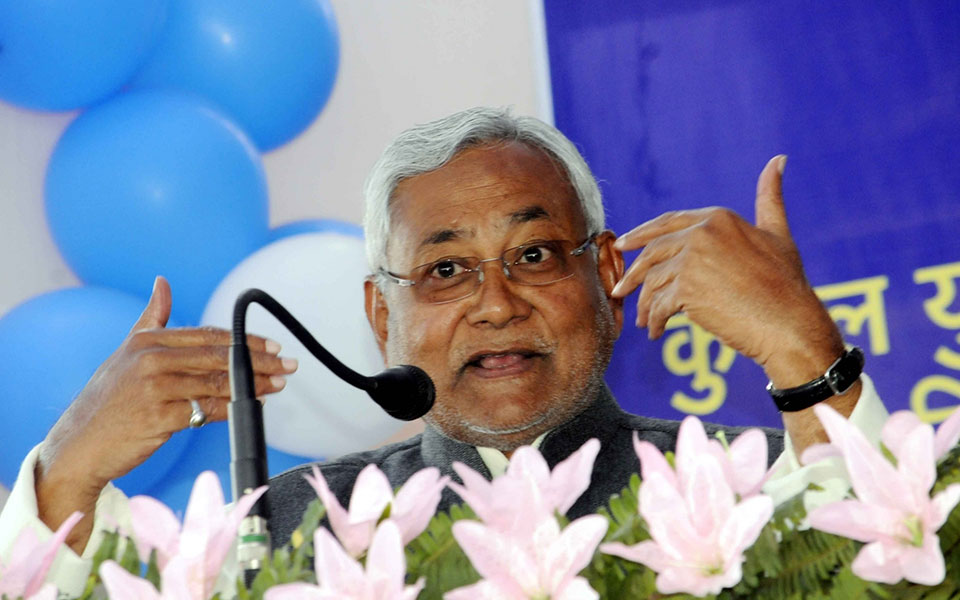
Patna, June 24: Bihar Chief Minister Nitish Kumar on Sunday said climate change has been affecting the state over the years and its impact is visible, with monsoon getting delayed every year and the volume of rain also showing a downward trend.
Although the state had hardly contributed to the phenomenon of global warming, it had to face the impacts of climate change, he said.
"Climate change is affecting Bihar and its impact is bad for the state. Not only monsoon arrival is getting delayed year after year, the rain volume during the season has also declined," Nitish Kumar said in his inaugural address at a two-day East India Climate Change Conclave that began here on Sunday.
Nitish Kumar said climate change was posing a new challenge to Bihar's agriculture and water resources.
"We have been working to mitigate the impacts of climate change in the state," the Chief Minister added.
Nitish Kumar and Union Minister for Environment, Forest and Climate Change Harsh Vardhan together inaugurated the climate change conclave.
He also raised the issue of increasing siltation in the river Ganga and urged Harsh Vardhan to take up this issue on priority.
"Centre's ambitious National Waterway-1 (NW-1) project will not succeed unless the issue of siltation is addressed to ensure free and adequate flow of water," Nitish Kumar said.
According to him, siltation in Ganga is the result of construction of several dams, including Farakka dam, which are interrupting the river's natural flow at the bottom, leading to deposition of silt.
Ministers and officials from six eastern states -- Bihar, West Bengal, Jharkhand, Odisha, Chhattisgarh and Assam -- also attended the conclave. They will discuss issues related to the impact of climate change in the region.
"The eastern part of the country is prone to disasters like floods, drought and earthquakes, and climate change has increased the threat of such disasters," Harsh Vardhan said.
The Union Minister said that personal initiative in addition to global initiative was important to save the world from the perils of climate change.
Bihar Deputy Chief Minister Sushil Modi said that the state government had set a target of either generating or buying 2,000 MW of solar power by 2022 in order to cut carbon emission.
The conclave has been organised by the Bihar Environment and Forests Department in association with two think tanks -- Asian Development Research Institute (ADRI) and Action on Climate.
Let the Truth be known. If you read VB and like VB, please be a VB Supporter and Help us deliver the Truth to one and all.
AIITA welcomes Karnataka’s ban on obscene songs in school events
Bhatkal: The Karnataka unit of the All India Ideal Teachers Association (AIITA) has welcomed the Karnataka government’s decision to strictly ban school children from dancing to obscene songs during educational and cultural programmes in government, aided, and private schools across the state.
AIITA Karnataka State President M. R. Manvi congratulated the government for taking what he termed an important step to preserve the sanctity of education.
“Such decisions to safeguard the dignity of school children and uphold the values of education are the need of the hour. This rule should not be limited to government schools alone but must be strictly implemented in all private educational institutions as well,” he said.
He further urged the government to address other concerns within school programmes.
“The government should not only prohibit obscene dances in the name of school anniversaries, but also ensure that plays and dialogues that incite religious hatred are avoided. Schools should be centres of harmony, not platforms for spreading hatred,” he added.
According to a recent circular issued by the Department of School Education and Literacy, obscene dances are adversely affecting the mental health and moral values of students.
In this regard, schools have been advised to use songs that promote nationalism, positive thinking, the greatness of Kannada culture, and value-based traditions instead of inappropriate content during programmes.
The circular also emphasises that students should be dressed in decent attire.
AIITA also backed the department’s warning that disciplinary action would be taken against head teachers if such guidelines are violated. The association has further demanded that district Deputy Directors of Public Instruction strictly monitor the implementation of these rules.