Uttarkashi tunnel collapse: All trapped workers safe, rescue efforts underway; CM Dhami visits site
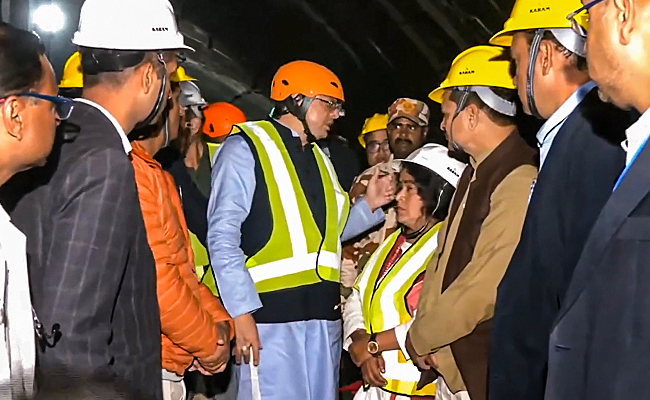
Uttarkashi (U'khand) (PTI): All 40 workers trapped after an under-construction tunnel collapsed in Uttarkashi are safe and communication has been established with them, officials said on Monday as Chief Minister Pushkar Singh Dhami reached the site to oversee rescue operations.
Rescuers who worked overnight trying to prepare an escape passage for the labourers have provided them with food and water, the Silkyara police control room said.
A portion of the tunnel being built between Silkyara and Dandalgaon on the Brahmakhal-Yamunotri National Highway caved in on Sunday morning.
VIDEO | Uttarakhand CM @pushkardhami arrives in Uttarkashi to take stock of situation after an under-construction tunnel on Brahmakhal-Yamunotri National Highway collapsed yesterday, trapping nearly 40 workers. pic.twitter.com/Bt9LpU5TZg
— Press Trust of India (@PTI_News) November 13, 2023
According to the District Emergency Operation Centre, the labourers trapped inside the tunnel for over 24 hours now are from Bihar, Jharkhand, Uttar Pradesh, West Bengal, Odisha, Uttarakhand and Himachal Pradesh.
The officials said attempts were being made to stabilise the constantly falling loose debris. A nearly 30-metre stretch of the tunnel, being built by the National Highways & Infrastructure Development Corporation Limited (NHIDCL), has been affected by the cave-in.
NHIDCL Director Anshu Manish Khalko said loose debris hampering the rescue efforts was being stabilised using shotcrete a process involving spraying concrete.
VIDEO | Uttarkashi tunnel collapse: "Rescue operation is underway. The Prime Minister is also monitoring the situation regularly. We are trying the best to rescue those who are trapped," says Uttarakhand CM @pushkardhami.#Uttkarshitunnelcollapse pic.twitter.com/ZycjdKz7HC
— Press Trust of India (@PTI_News) November 13, 2023
Rescue efforts by personnel from multiple agencies, including the National Disaster Response Force (NDRF), State Disaster Response Force (SDRF), Indo-Tibetan Border Police (ITBP) and the Border Roads Organisation (BRO), have been going on since Sunday morning.
Khalko said, "All the trapped labourers are safe. They have been contacted several times on walkie-talkie and edibles and drinking water have been supplied to them.
District Magistrate Abhishek Ruhela went inside the tunnel on Monday morning to review the rescue efforts and discuss the strategy to save the labourers.
Dhami was accompanied by Garhwal Commissioner Vinay Shankar Pandey as he arrived in Silkyara to assess the situation.
The officials are optimistic about the safety of the trapped labourers as enough oxygen was made available to them through a water pipeline.
VIDEO | Uttarkashi tunnel collapse: "Around 40 workers are trapped inside, but all of them are fine. At 12.30 am today, a contact was established with them. They are being provided food, water and oxygen using two pipes. We have a plan A, plan B and plan C to rescue them," says… pic.twitter.com/mAaI2IHZ5X
— Press Trust of India (@PTI_News) November 13, 2023
Let the Truth be known. If you read VB and like VB, please be a VB Supporter and Help us deliver the Truth to one and all.
Bengaluru Police bust major drug network; 16 arrested, narcotics worth Rs 36.67 crore seized

Bengaluru: In a major crackdown on drug trafficking and illegal narcotics trade, Bengaluru City Police have arrested 16 accused persons and seized narcotic substances worth Rs 36.67 crore.
According to Bengaluru City Police Commissioner Seemanth Kumar Singh, those arrested include four foreign nationals, eight persons from other states and four locals. Police said the network had interstate as well as international links.
Police recovered 9 kg 64 grams of MDMA, 5 kg 195 grams of hydro ganja, 19,755 LSD strips, 156 grams of heroin, 618 grams of charas, 332 grams of cocaine, 315 grams of drug-mixed gummies and 11 kg 470 grams of ganja from the accused.
The Commissioner said the action was carried out as part of a major anti-drug operation in the city. The network was busted with the support of the CCB Narcotics Control Squad and police stations of Bagaluru, Adugodi, Chikkajala, HSR Layout, Yeshwanthpur, Jalahalli and Jnanabharathi.
Cases were registered in CCB, East Division and West Division police stations based on specific intelligence received on different dates, following which raids were conducted.
Preliminary investigation revealed that the accused were procuring drugs at lower prices from foreign, interstate and local sources and selling them in Bengaluru at higher rates.
Police said college students and working professionals were among the main targets of the accused.