CM Siddaramaiah requests Railway Minister to extend Vande Bharat Express till Belagavi
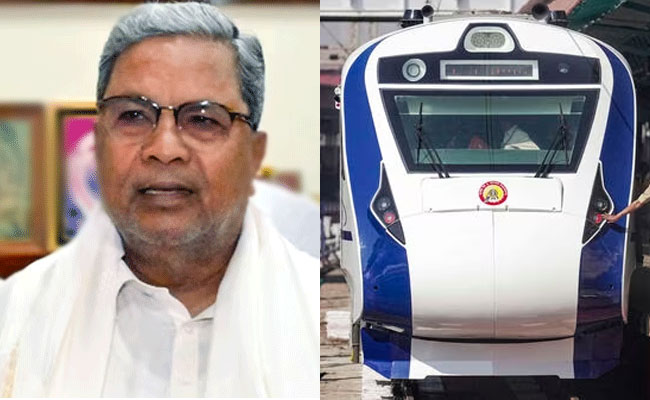
Bengaluru (PTI): Chief Minister Siddaramaiah on Tuesday urged Railway Minister Ashwini Vaishnaw to extend the Vande Bharat Express running on the Bengaluru-Hubballi-Dharwad route upto Belagavi city, in order to boost the connectivity between Karnataka, Goa and Maharashtra.
In a letter to Vaishnaw, Siddaramaiah said the second Vande Bharat Express in Karnataka "brought a paradigm shift in the connectivity of the region, between Dharwad, Hubballi, and Davangere with Bengaluru".
He noted that Belagavi was a significant vantage point for industrialists, students and tourists.
Calling Belagavi as an 'economically vibrant' district, he said it houses sugar, aluminum and major industries and also a support base for automobile and aerospace industries apart from several small and medium industries.
The CM pointed out that Belagavi was also a tourist destination with a rich cultural and historical background.
"I request you to extend the Bengaluru to Hubballi-Dharwad Vande Bharat train service upto Belagavi city. This will significantly boost the connectivity between the states of Karnataka, Goa and Maharashtra," he said.
Siddaramaiah reminded the railway minister that Karnataka MLC Prakash Hukkeri had also written to him in this regard.
"I would urge you to look into the matter and instruct the officials to do the needful. The spirit of holistic development of the region will be upheld in letter and spirit by this move," the CM said.
Let the Truth be known. If you read VB and like VB, please be a VB Supporter and Help us deliver the Truth to one and all.
Rickelton's ton in vain as SRH beat MI by 6 wickets
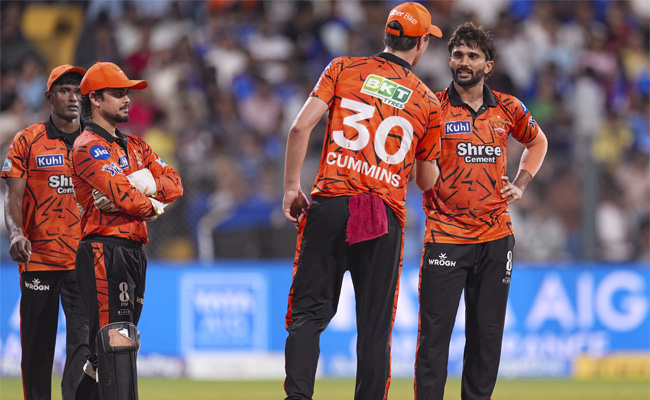
Mumbai (PTI): Ryan Rickelton's whirlwind unbeaten ton was overshadowed by Heinrich Klaasen's unbeaten 65 as Sunrisers Hyderabad defeated Mumbai Indians by six wickets in an IPL match here on Wednesday.
Chasing an imposing 244-run target, Travis Head (76 off 30) and Abhishek Sharma (45 off 24) shared 129 runs for the opening wicket to set the platform for SRH.
Klaasen (65 not out off 30 balls) then displayed his all-round hitting abilities to guide SRH home with the help of Nitish Kumar Reddy (21) and Salil Arora (30 not out off 10) in 18.4 overs.
Earlier, Rickelton's knock powered MI to 243 for five.
MI rode on a 93-run stand between Rickelton (123 not out off 55 balls) and Will Jacks (46 off 22) in 7.1 overs for the opening stand to power the side.
MI skipper Hardik Pandya scored a valuable 31 off 15 balls before being dismissed.
Praful Hinge (2/54), Eshan Malinga (1/29), Sakib Hasan (1/39) and Nitish Kumar Reddy (1/31) were the wicket-takers for SRH.
Brief Scores:
Mumbai Indian: 243 for 5 in 20 overs (Ryan Rickelton 123 not out; Praful Hinge 2/54).
Sunrisers Hyderabad: 249 for 4 in 18.4 overs (Travis Head 76, Heinrich Klaasen 65 not out; AM Ghazanfar 2/51).