Common for northern India, Nepal to have moderate quakes: Kiren Rijiju in LS

New Delhi (PTI): It is common for northern India and Nepal to occasionally experience moderate earthquakes due to fluctuations in seismic activity as the region is situated near active faults, Union Earth Sciences Minister Kiren Rijiju said on Wednesday.
In a written reply to a question in the Lok Sabha, Rijiju said the activation of the Almora fault in western Nepal was the reason for earthquakes in parts of north India and Nepal, which led to a 5.8 magnitude quake on January 24 and 6.2 and 6.4 magnitude temblors on October 3 and November 3, respectively.
These mainshocks, accompanied by subsequent aftershocks, led to an increased frequency of earthquakes in 2023, Rijiju said, adding that the background seismicity remained unchanged during this period.
The minister said northern India and Nepal experienced 97 earthquakes of magnitude 3.0 to 3.9 from January to November against 41 quakes each in 2022 and 2021 and 42 in 2020.
He said the region experienced 21 earthquakes of magnitude 4.0-4.9 from January-November against 20 in 2022 and 18 each in 2021 and 2020.
"It is common for northern India and Nepal to occasionally experience moderate earthquakes, and fluctuations in seismic activity. Nepal and the neighbouring northern part of India, situated near the active faults of the Himalayan region, are highly seismically active areas prone to frequent earthquakes due to collision tectonics, where the Indian plate subducts beneath the Eurasian Plate," he said.
The Almora fault is a high-angle west-northwest-east-southeast to northwest-southeast trending tectonic plane that separates the Garhwal group of inner lesser Himalayas in the north from the Jaunsar and Dudatoli groups of outer lesser Himalayas in the south.
Rijiju said the Bureau of Indian Standards (BIS) has published the Seismic Zoning Map of India, ranging from Zone II to V and offers guidelines for implementing the essential engineering codes and practices to construct earthquake-resistant buildings.
The National Disaster Management Authority has been the agency responsible for various precautionary measures such as earthquake drills, awareness programmes, earthquake management to enhance preparedness and response to earthquake related incidents.
On January 24, an earthquake of magnitude 5.8 hit Nepal. It was strongly felt in Delhi, Uttar Pradesh and Uttarakhand.
On October 3, two earthquakes of magnitude 4.6 and 6.2 jolted Nepal and the tremors were felt in Delhi-NCR.
On November 3, a powerful earthquake of 6.4 magnitude hit Nepal with more than 382 aftershocks.
Let the Truth be known. If you read VB and like VB, please be a VB Supporter and Help us deliver the Truth to one and all.
TMC will be voted back to power in Bengal: Tejashwi Yadav
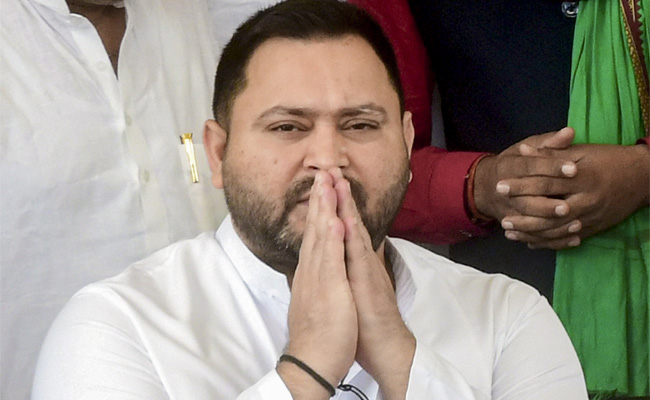
Patna (PTI): Leader of Opposition in Bihar assembly, Tejashwi Yadav, on Tuesday exuded confidence that the Mamata Banerjee-led TMC will again be voted to power in West Bengal.
Yadav returned to Patna after a four-day poll campaign in West Bengal.
“The atmosphere there is euphoric and people want to bring Didi (Mamata Banerjee) back to power. I am fully confident that the TMC will win the election,” he told reporters here.
He said that a large number of people from Bihar living in West Bengal share a lot of love and respect for Mamata Banerjee.
Responding to BJP’s allegations that the TMC had “ruined” West Bengal during its tenure, the RJD leader said the “entire country has been ruined under the Narendra Modi-led government”.
“I want to ask one question to Modi ji – you have been prime minister for more than 11 years, tell me one thing you have done for Bengal,” Yadav said.
The first phase of elections to the 294-member West Bengal assembly was held on April 23, while the second phase will take place on April 29. Votes will be counted on May 4.