Cong backs 'nari shakti' bill but quota should be effective immediately, include OBC women: Sonia
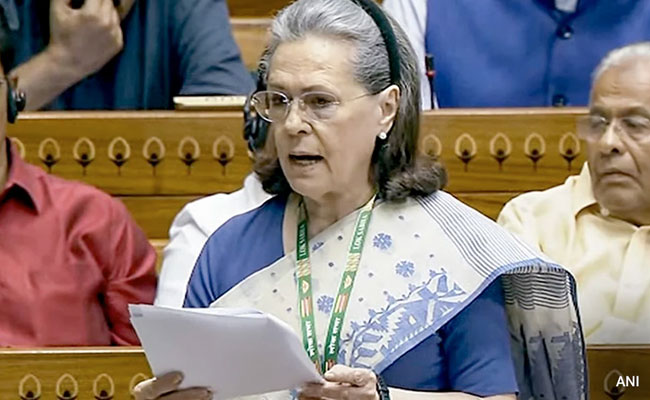
New Delhi (PTI): Extending her party's support to the women's reservation bill, Congress parliamentary party chief Sonia Gandhi on Wednesday demanded that the quota be implemented immediately and provision be made for reservation for OBC women.
Initiating the debate on the bill from the opposition's side, Gandhi said in the Lok Sabha that any delay in bringing the reservation into effect would be "gross injustice" to Indian women.
"Rajiv Gandhi's dream is only half fulfilled. It will be fulfilled with the passage of this bill. The Congress supports this bill. We will be happy with the passage of this bill but we also have a concern. I want to ask a question. For the last 13 years, Indian women have been waiting for their political responsibilities, and now they are being asked to wait for a few more years -- two years, four years, six years, eight years," the former Congress chief said.
Is such behaviour with Indian women appropriate, she asked.
"It is the demand of the Indian National Congress that the bill be immediately implemented... but, along with that, provision should be made for the reservation of SC, ST, OBC women after conducting a caste census," she said.
The government, Gandhi told the House, should take the required steps for this.
The bill has proposed that the reservation continue for a period of 15 years and there will be one-third quota for women also within the seats reserved for SC/STs.
"This is the most appropriate moment to acknowledge and thank women for their contribution," Gandhi said.
"On behalf of the Indian National Congress, I demand from the government that the Narishakti Vandan Adhiniyam 2023 be implemented as soon as possible while clearing all roadblocks in its way. Doing this is not only necessary but also possible," Gandhi said.
Initiating the discussion, Gandhi said she stands on behalf of the Indian National Congress to support the 'Narishakti Vandan Adhiniyam'.
"From smoke-filled kitchens to brightly-lit stadiums, the journey of Indian women has been long. But finally she has reached her destination. She gave birth, ran a household, ran fast among men and with infinite endurance often saw herself losing but won in the end.
"The Indian woman has patience like an ocean in her heart, she never complained about being wronged and never thought only about her own benefits. Like a river she worked for the welfare of all... remained steadfast like the Himalayas in difficult times. It is impossible to estimate a woman's patience, she does not recognise rest and does not even know how to get tired," Gandhi said.
"Woman is the mother of our great country. But she has not only given birth to us, she has also made us intelligent and powerful enough to think for ourselves by nourishing us with her tears, blood and sweat," the Congress leader added.
Only by recognising the hard work, dignity and sacrifice of women can we pass the test of humanity, Gandhi said.
"In the fight for independence and the creation of a new India, women have fought shoulder to shoulder with men on every front. She was not buried under the burden of hopes, aspirations, troubles and household chores," she said.
Lauding the contribution of the likes of Sarojini Naidu, Sucheta Kripalani, Aruna Asaf Ali, Vijaya Lakshmi Pandit, Rajkumari Amrit Kaur and millions of other women, she said they have always ensured that the dreams of Mahatma Gandhi, Jawaharlal Nehru Sardar Patel, Baba Saheb Ambedkar and Maulana Azad are realised on the ground.
"The personality of Indira Gandhi ji is a very bright and living example in this regard," she said in a speech that made its political points but also brought in personal, emotive notes.
"This is a very poignant moment in my life. It was my life partner Rajiv Gandhi ji who for the first time had brought the constitutional amendment for participation of women in local bodies, but it was defeated in the Rajya Sabha by seven votes. Later, the Congress government under the leadership of Prime Minister PV Narasimha Rao got it passed," Gandhi said.
Today, as a result of that, there are 15 lakh elected women leaders through local bodies across the country, she added.
After the House proceedings began, Union Law Minister Arjun Ram Meghwal on Wednesday moved the women's reservation bill for consideration and passage in the Lok Sabha, saying it is a step towards women empowerment.
The constitutional amendment bill was introduced in the Lower House on Tuesday. It was the first bill introduced in the new Parliament building.
The bill provides for 33 per cent reservation for women in the Lok Sabha and state assemblies. The reservation will come into effect only after the completion of the census and delimitation exercise.
Let the Truth be known. If you read VB and like VB, please be a VB Supporter and Help us deliver the Truth to one and all.
Ladakh a living land of dharma for centuries: Amit Shah
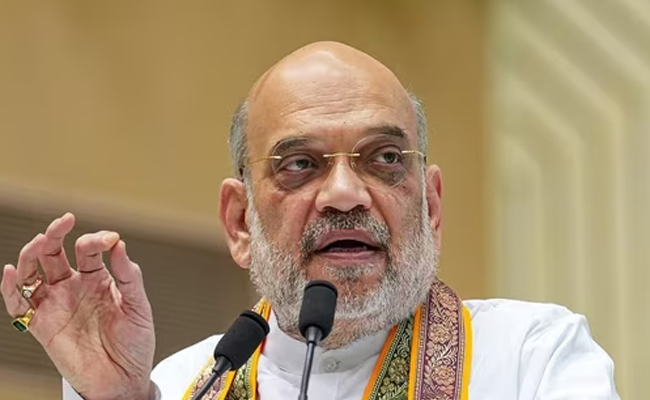
Leh/Jammu (PTI): Union Home Minister Amit Shah on Friday described the return of sacred relics of Lord Buddha to Ladakh after 75 years as a "historic reunion" and said that the Union Territory has remained a "living land of dharma", preserving and nurturing Buddhist knowledge for centuries.
Stressing the relevance of Buddha's teachings in modern times, Shah said the message of peace, compassion and the middle path was even more important today than it was 2,500 years ago.
"Ladakh has been a living land of dharma for centuries. When the Dalai Lama comes here, he says this land is not merely a geographical land but a living laboratory of Buddhist culture and compassion," Shah said, speaking after the inauguration of the sacred holy relics exposition of Tathagata Buddha and the 2569th Buddha Purnima celebrations at Jivetsal in Leh during his two-day visit to Ladakh.
Calling Ladakh a land of compassion, he said this land has preserved and nurtured knowledge. "Whenever Buddhism faced crises, this land worked to protect the teachings of Buddha. And when peace returned, it helped to expand and carry forward that preserved wisdom," he added.
"Unless one internalises knowledge and makes it a part of oneself, liberation is not possible. Knowledge is incomplete without spiritual practice, while spiritual practice without knowledge is blind. Therefore, the union of spiritual practice and knowledge is the right path. Even after all this, if there is no moral discipline, one cannot lead a truly wise life. The basis of a life of wisdom is moral discipline," he said.
Shah said it was through Ladakh and adjoining routes that the teachings of Tathagata Buddha, which originated in India, spread to China and several other countries.
"The message that emerged from the land of Ladakh has become a guiding force for many people around the world to take their lives forward. The presence of these sacred relics in Ladakh reminds us that India's civilisation has, for thousands of years, given the message of peace and coexistence," he said.
He said that in a diverse region like Ladakh and Kargil, this message becomes even more relevant. "This heritage still tells us today that amidst conflict and unrest, only the path of peace and compassion can provide solutions."
He said the return of the relics on Buddha Purnima had enhanced the significance of the festival for the people of Ladakh.
"These sacred relics have come to Ladakh after 75 years. It is as if Buddha himself is present here today," Shah said, adding that followers of Buddhism and people of other faiths in Ladakh and Kargil would draw spiritual energy from the relics.
Highlighting Ladakh's role in the spread of Buddhism, Shah said Kashmir was once an ancient centre of Buddhist studies, Mahayana philosophy and Buddhist art, from where Ladakh first came into close contact with Buddhism.
He said Emperor Ashoka's envoys laid the foundation of Buddhist influence in Ladakh through Kashmir and Gandhara, while Mahayana Buddhism expanded in the region during the Kushan period between the first and third centuries CE.
The Silk Route linking Kashmir, Leh, Yarkand, Khotan and Tibet became a channel not only for trade but also for ideas, monks, manuscripts and artistic traditions, Shah said.
He added that later, Tibetan influence between the seventh and tenth centuries further enriched Ladakh through Mahayana and Vajrayana traditions.
Stressing the relevance of Buddha's teachings in modern times, Shah said the message of peace, compassion and the middle path was even more important today than it was 2,500 years ago.
"Amid conflict and unrest, only the path of peace and compassion can provide solutions," he said.
Shah also appealed to the Ladakh administration to ensure complete arrangements so that followers of all faiths, especially Buddhists, could visit and pay obeisance to the relics.
#WATCH लेह, लद्दाख: केंद्रीय गृह मंत्री अमित शाह ने कहा, "जब दलाई लामा यहां आते हैं तो वे कहते हैं कि यह भूमि केवल भौगोलिक भूमि नहीं है। यह भूमि बौद्ध संस्कृति और करुणा की जीवंत प्रयोगशाला है। इस भूमि पर ज्ञान का संरक्षण हुआ है... भारत की सभ्यता हजारों वर्षों से शांति का संदेश… https://t.co/2nwG0w2CE6 pic.twitter.com/W13itRBqeX
— ANI_HindiNews (@AHindinews) May 1, 2026