Cong condemns govt over handling of Ladakh situation, seeks judicial probe into killing of 4 youths
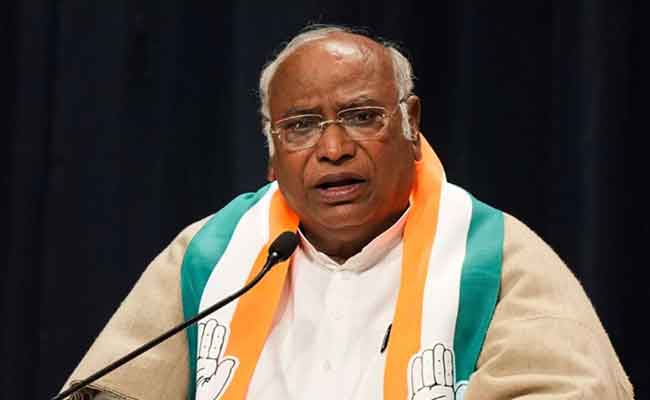
New Delhi (PTI): The Congress on Saturday condemned the manner in which the government handled the violent situation in Ladakh and demanded a judicial inquiry into the death of four youths during protests earlier this week.
The Congress also demanded immediate revival and restoration of institutions and democracy in Ladakh.
"The Indian National Congress strongly condemns the pathetic handling of the situation in Ladakh by the Government and subsequent arrest of Sonam Wangchuk under the draconian National Security Act," Congress president Mallikarjun Kharge said in a post on X.
He alleged that at the heart of the crisis lies the BJP's "persistent betrayal" of the aspirations of people of Ladakh.
For over a year now, there has been turmoil and instead of lending a patient hearing to the cries of the people for inclusion under the Sixth Schedule of the Constitution, the Modi government is responding with violence, the Leader of Opposition in Rajya Sabha claimed.
"The BJP had pledged Sixth Schedule status for the region, sadly that promise has been squarely abandoned.
"The Indian National Congress seeks nothing but peace in Ladakh. For decades, we have ensured that this beautiful border region remains harmonious and secure, upholding both the spirit of Democracy and the cause of National Security," Kharge said in his post.
"We demand a judicial investigation into the deaths of four innocent young men and the serious injuries inflicted upon many others. The democratic institutions and democracy need to be revived and restored in Ladakh," he also said.
In a post on X, Congress general secretary (communications) Jairam Ramesh said, "In 2019, the National Commission on Scheduled Tribes recommended that all of Ladakh be brought under the Sixth Schedule. The Home Ministry, Law Ministry, and the Tribal Affairs Ministry all expressed no objection. It also featured as a promise in the BJP manifesto for the 2020 Leh Hill Council Election."
"Sonam Wangchuk was only repeating this demand. But he now finds himself in jail without bail. And we are supposed to think of ourselves as the mother of democracy," he added.
Ladakh has been on the boil with curfew clamped in Leh town on Wednesday evening after widespread violence resulted in the death of four persons and injuries to 90 others during a shutdown called by the Leh Apex Body (LAB) to advance talks with the Centre on the demands for statehood and extension of the Sixth Schedule to Ladakh.
The restrictions were relaxed Saturday afternoon in a phased manner for a few hours, providing relief to residents who lined up outside shops selling essential commodities.
Let the Truth be known. If you read VB and like VB, please be a VB Supporter and Help us deliver the Truth to one and all.
19-yr-old woman found hanging from tree in UP village; juvenile held

Lucknow/Pratapgarh (UP) (PTI): Police have apprehended a 16-year-old boy for his alleged involvement in the rape and murder of a 19-year-old woman whose body was found hanging from a tree in a village here, officials said on Monday.
Additional Superintendent of Police (West), Brijnandan Rai, said that the body of a 19-year-old woman was found hanging from a tree in an orchard in the Manikpur police station area on Sunday morning. A post-mortem examination subsequently confirmed that she had been raped.
Police registered a case against unidentified persons under sections 103(1) (punishment for murder) and 70(1) (gangrape) of the Bharatiya Nyaya Sanhita, and initiated an investigation.
During the course of the investigation, the police found that the deceased was in contact with a juvenile who was also her relative.
Acting on this information, during a joint checking operation, sub-inspector Amit Kumar Singh of Manikpur police station and SOG In-charge Amit Kumar Chaurasia, along with their team, apprehended the 16-year-old near the Lehdari Ganga River bridge.
The search for other accused persons is ongoing, police said.
According to the police, the woman had gone to sleep after dinner on Saturday night but was found hanging in an orchard nearly 400 metres away from her home the following morning.
Additional Superintendent of Police (West), Brijnandan Rai, had earlier said that the circumstances suggest foul play.
"The victim's slippers and undergarments were recovered 50 metres away from the spot where the body was found. There are visible injury marks on her body," Rai said.
While locals have alleged that the woman was murdered after being raped, the ASP said that it is "prima facie a case of murder."
"Based on the complaint filed by the victim's brother, a case of murder has been registered against unidentified persons," the officer added.
Meanwhile, Samajwadi Party chief Akhilesh Yadav, in a post on X in Hindi on Monday, said, "The news of the heinous murder of a Dalit daughter in Pratapgarh is deeply tragic and condemnable."
"The question remains: why does the spate of murders of 'PDA daughters' continue unabated in Uttar Pradesh? Are the BJP government's claims regarding women's safety merely hollow rhetoric, or is there, in fact, discrimination even in the provision of security for women?" he said.
"Whenever the 'wandering Honourable (ghumantu maananiye)' finds a moment of respite from election campaigning, he should cast a glance at the plight of the daughters of his own Uttar Pradesh. In any case, apart from injustice and oppression, no sister, daughter, or mother of this state holds any hope from you," Yadav added.