Cong not averse to supporting regional party leader for PM post: Ghulam Nabi Azad
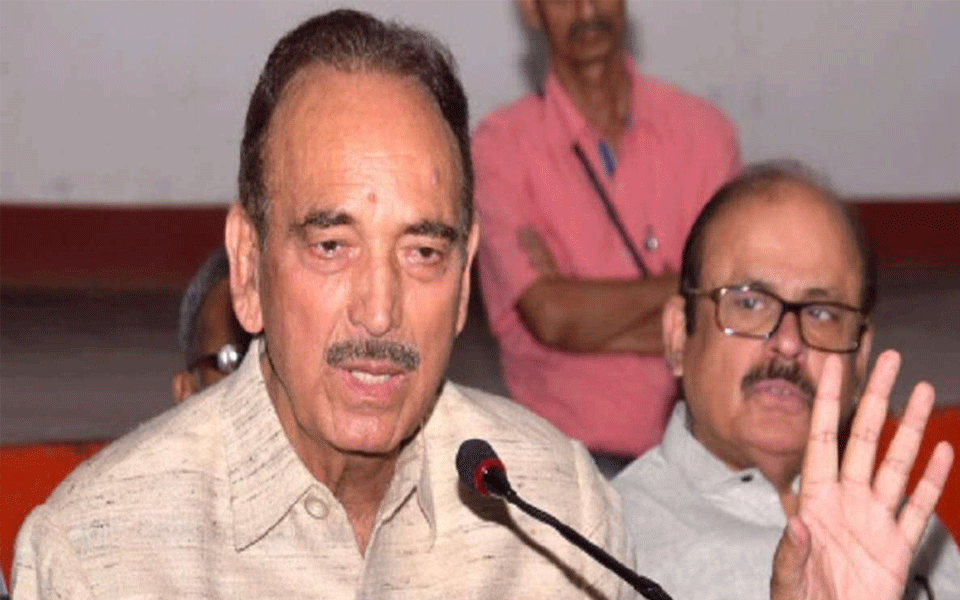
Shimla/New Delhi, May 16: The Congress is not averse to supporting any regional party leader for the Prime Minister's post even if it emerges as the single largest party, Congress leader Gulam Nabi Azad said on Thursday.
"My party high command has already made it clear that the Congress is not averse to making a prime minister from any regional party," Azad told reporters in Shimla.
He was asked if the Congress will be ready to support any regional party leader for the PM's post even if it emerges as the largest party in a hung Parliament.
Speaking in the same vein in Patna on Wednesday, Azad had said the Congress will not make it an issue if the PM's post is not offered to it.
Azad's remarks assume significance as the Congress has been asserting that it would be the fulcrum of any non-NDA government, which was seen as its claim for the PM's post and had led some major regional parties to maintain a distance from it.
Congress chief spokesperson Randeep Surjewala, however, seemed not to agree with Azad.
He said the Congress believes it will be the single largest party in the country, subject to final outcome on May 23. "Naturally, the biggest political party should get a chance to lead," he told reporters here.
"All Congressmen believe that we will be the biggest political party and as the biggest political party, we should be leading this country holding hands with all other like-minded political parties interested in giving a stable democratic, liberal and secular government to the country," he added.
On the question that in the event of no party getting simple majority in Lok Sabha polls, whom should the President call, Surjewala said, "I think the norm on that is fairly established by the Supreme Court...and the norm as I understand is whoever has the largest number in pre-poll alliance is normally called first. And that is the settled principle as laid down by the Supreme Court."
Earlier, Azad in an apparent mellowing of Congress' stand on the PM's post, had said in Patna, "It will be good if there is a consensus on Congress leader's name for heading the government at the Centre after the Lok Sabha election results are out. But we are not going to make it an issue that we (Congress) will not let any other (leader) to become the PM, if it is not offered to us (Congress)."
The Leader of Opposition in Rajya Sabha had said the sole objective of the Congress is to stop the NDA from forming the government at the Centre.
Asked about Modi's assurance of constructing a 'grand statue' of 19th century reformer Ishwar Chandra Vidyasagar at the same spot where his bust was vandalised in Kolkata, the Congress leader replied, "Now he should prepare for installing his own statute."
Azad, however, was quick to add that "some alive persons also erect their statutes as BSP supremo Mayawati had done in UP".
Let the Truth be known. If you read VB and like VB, please be a VB Supporter and Help us deliver the Truth to one and all.
Marxism will remain relevant despite Left electoral's losses, says general secretary M A Baby
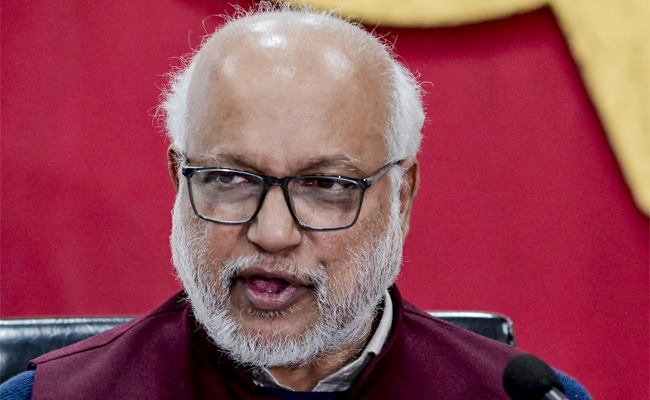
New Delhi (PTI): CPI(M) General Secretary M A Baby on Thursday asserted that the Left movement would remain relevant despite not being in power in any state, saying the ideology would continue to endure as long as social and economic inequalities persist.
Hitting back at BJP leader Rajeev Chandrasekhar over his reported remarks that Marxism had become irrelevant, Baby, in an interview with PTI Videos, said, "So long as there is division in society, so long as there is exploitation of the majority of workers, peasants and ordinary masses by a handful of billionaires, Marxism will remain relevant."
"That perhaps Mr Rajeev Chandrasekhar may not be able to understand, but this is the fact of the matter," he said.
Baby acknowledged that the CPI(M)-led Left was currently without an elected government in any state, but maintained that electoral setbacks would not diminish the movement's role.
"We may not have an elected government in any state. There were occasions when we didn't have a government. But the red flag and the commitment to organise and struggle for the rights of the dispossessed, marginalised and exploited will always be upheld by CPI(M) and the Left movement," he said.
He said the Left continued to enjoy support among workers, peasants, agricultural labourers, youth, students and women, and argued that the movement remained necessary because "oppression and assault" continued in society.
"So long as such problems exist in society, the red flag and the working class movement will continue to work among the masses," the Left leader said.
Exuding confidence on the Left's revival, Baby said the party would reflect on the reasons behind its electoral loss.
"We may be rejected in one election, but we will stage our comeback by understanding what went wrong with us," he said, adding, "We will listen to people and we will come back with higher strength."
Baby also criticised the Congress over reported factional tensions in Kerala after the Congress-led United Democratic Front's victory in the state.
"The way they are behaving is being watched by the people of Kerala," he said, referring to infighting within the Congress.
"Those who have given a massive majority to Congress and UDF would be watching all this," he added, while urging party leaders to "settle the problem in an amicable, democratic manner".
Referring to West Bengal, Baby alleged that violence had escalated following the BJP's victory in the state assembly polls.
"It is quite unfortunate that the moment BJP snatched a massive victory in West Bengal, violence has also started on a big scale," he said.
He also accused the Trinamool Congress of being "notorious for violent activities" and alleged that the "RSS-controlled BJP" had "unleashed violence in many places" after the election results.
"This is not good for Bengal, not good for the country. We wish and hope that normalcy would be restored as soon as possible," he said.
Baby said the CPI(M) and the Left in West Bengal would continue efforts to "pacify people" and avoid violence and confrontation.
Asked about former Kerala chief minister Pinarayi Vijayan not reacting publicly to the election results, Baby said Vijayan would respond "at an appropriate time".