Cong reviews Bihar debacle; contestants flag Rs 10,000 transfer, delay in seat-sharing, 'vote chori'

New Delhi (PTI): Several of the Congress leaders who contested the recent Bihar assembly elections conveyed to the party's top brass on Thursday that the NDA government's Rs 10,000 transfer to women beneficiaries, delay in seat-sharing deal among the Mahagathbandhan allies, internal rift and "electoral malpractices" were among the reasons for the poll debacle.
Congress president Mallikarjun Kharge, former party chief Rahul Gandhi and AICC general secretary in-charge organisation K C Venugopal met the candidates to hold a review meeting with them days after the Bihar election defeat.
The three top leaders met the candidates in batches of 10.
Later, they also deliberated on the reasons for the massive defeat with senior state leaders, including Bihar Congress chief Rajesh Ram, AICC leader in-charge of Bihar Krishna Allavaru, Congress MPs Akhilesh Prasad Singh and Tariq Anwar, and Independent MP from Purnia Pappu Yadav.
There were some reports of an altercation between two candidates during the review meeting. However, Pappu Yadav refuted them and said these reports were "false".
After the meeting, Venugopal said the four-hour review meeting made one thing absolutely clear -- the Bihar election was not a genuine mandate; it was a grossly managed and fabricated outcome.
"They highlighted how SIR (Special Intensive Revision) enabled targeted voter deletions and dubious additions, how blatant cash bribery under the so-called MMRY (Mukhyamantri Mahila Rojgar Yojana) scheme was used to influence voters even at the polling stations and how identical margins across constituencies exposed a pattern that no independent election commission would ever overlook," Venugopal said on X.
"These issues point to organised electoral malpractices and brazen violations of the Model Code of Conduct, carried out under the watch of an ECI that has increasingly behaved like an active collaborator in BJP's election rigging," he said.
What happened in Bihar is nothing short of a direct assault on democracy, Venugopal alleged.
"The Congress Party will not allow this stolen mandate to become the new normal. The fight to protect India's democracy continues -- fearlessly, relentlessly, and with the people by our side," he said.
The Congress' Araria MLA, Abidur Rahman, said, "There were several reasons for the defeat. The first reason is that 10,000 rupees were given in violation of the model code of conduct. The alliance could not be formed at the right time. There was a friendly contest in 10-11 seats, which sent the wrong message to the public."
"The alliance should have been formed on time. The spread of religious and caste frenzy had an impact," he said, and also cited AIMIM's strong performance in the Seemanchal belt of Bihar.
The situation was such that if a man voted for the Congress, his wife voted for the NDA, Rahman said, elaborating on the impact of the transfer of Rs 10,000 to women beneficiaries.
There was discord between the old and young party leaders, Rahman claimed.
Another contestant Tauqeer Alam said that the leadership met the candidates in groups of 10 and held a discussion on the reasons for the defeat.
The Congress won only six of the 61 seats it contested in the Bihar Assembly elections.
Its state unit president Rajesh Kumar lost from the Kutumba seat, legislature party leader in the outgoing Assembly, Shakeel Ahmed Khan, was defeated by JD(U) candidate Dulal Chandra Goswami from the Kadwa seat by a margin of 18,368 votes.
The six Congress candidates who won are Surendra Prasad (Valmiki Nagar), Abhisekh Ranjan (Chanpatia), Manoj Bishwas (Forbesganj), Abidur Rahman (Araria), Mohd Qamrul Hoda (Kishanganj) and Manohar Prasad Singh (Manihari).
Let the Truth be known. If you read VB and like VB, please be a VB Supporter and Help us deliver the Truth to one and all.
Kulkarni became victim of BJP conspiracy as he grew politically in North Karnataka: Shivakumar
_vb_59.jpeg)
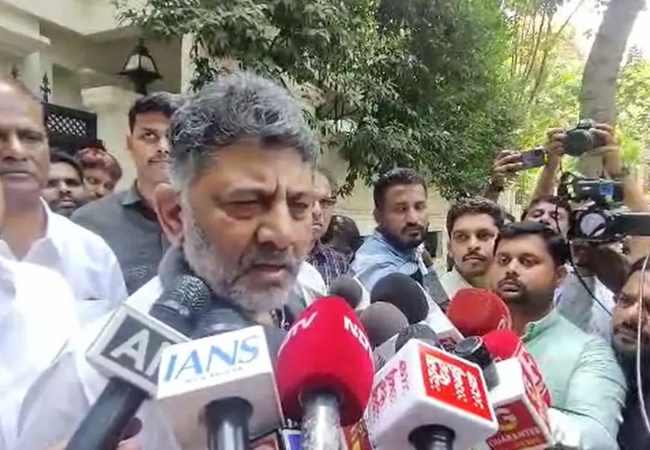
Bengaluru (PTI): Deputy Chief Minister D K Shivakumar claimed on Friday that Congress MLA Vinay Kulkarni, who was sentenced to life imprisonment in a murder case, has become a victim of a BJP conspiracy because he was growing politically in the north Karnataka region.
Stating that he has faith in Kulkarni and believes he has done nothing wrong, he said the former minister will fight the case legally by filing an appeal.
A Bengaluru court on Friday sentenced Kulkarni and fifteen others to life imprisonment in the BJP leader Yogeshgouda Goudar murder case.
On Wednesday, Santhosh Gajanan Bhat, Judge of the Special Court for cases involving elected representatives, convicted Kulkarni and others under various IPC sections, including criminal conspiracy and murder.
“I respect the court. But there was a big conspiracy in this case. When the police were about to file a B-report, the CBI was given the case to harass him (Kulkarni). Vinay Kulkarni has become a victim of a BJP conspiracy as he was growing politically in north Karnataka,” Shivakumar said.
Speaking to reporters in New Delhi, he said Kulkarni has several legal options.
“I have spoken to his family. He swore on God and told me that he had not done anything wrong. I still have faith in him. I feel that he has not done anything wrong. He has an opportunity to file an appeal,” he said, adding that he stands with Kulkarni’s family and supporters and believes he will get justice.
The case pertains to the killing of Goudar, a BJP zilla panchayat member, in Dharwad on June 15, 2016. Kulkarni was a minister at the time. Hired assailants allegedly attacked and hacked Goudar to death in his gym in Saptapur, Dharwad.
Following demands from Goudar’s family and others, the then-BJP government transferred the case to the CBI in 2019.
Veteran BJP leader and former Chief Minister B S Yeddyurappa, under whose tenure the case was handed over to the CBI, told reporters in Chikkamagaluru, “I said what I needed to say when the crime happened, and what I said—that the guilty should be punished and justice should be served—has proven true.”
Speaking to reporters in Bengaluru, BJP leader and MLC C T Ravi, reacting to the court order, said, “Justice delayed, but not denied.”