Congress accuses Modi govt of 'systematically killing', 'weakening' RTI Act
New Delhi (PTI): The Congress on Sunday accused the Modi government of “systematically killing” and “weakening” the Right to Information Act, which was brought by its UPA government two decades ago with an aim to bring in transparency and accountability in governance.
On the 20th anniversary of Right to Information (RTI) Act, the Congress alleged that for the BJP, RTI means "Right to Intimidate", and claimed that the ruling dispensation also made the Central Information Commission a "toothless" body with its top post as well as posts of seven information commissioners lying vacant for a longtime.
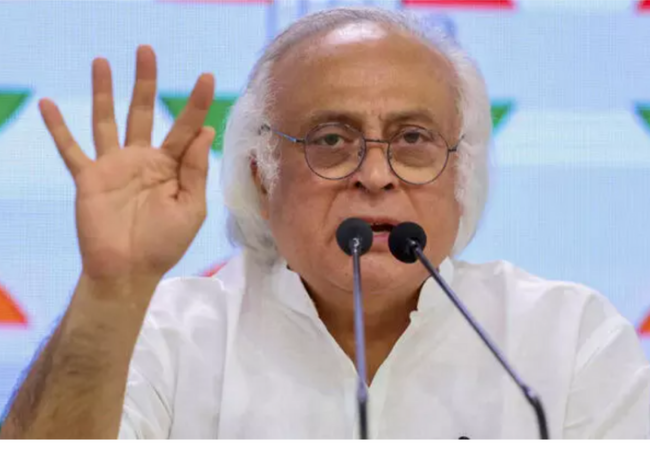
"For the BJP, RTI means Right to Intimidate,” AICC general secretary (communications), Jairam Ramesh, said at a press conference to mark the 20th anniversary of the Act, which was introduced on October 12, 2005.
Ramesh said the purpose and intention behind the revolutionary law was to bring transparency in the functioning of the government and make it accountable.
However, the Modi government brought amendments to the Act in 2019 to weaken it and turn the CIC into a "toothless organisation", he alleged.
He also claimed the Modi government brought the Digital Personal Data Protection Act to amend the provisions of the RTI Act to effectively dismantle the RTI.
The CIC is being run by just two members and the post of chief information commissioner and seven other commissioners in the body are lying vacant for the past two years, Ramesh said.
"The CIC headquarter looks like a ghost house," Ramesh said, referring to the “deep aversion” of the Modi government towards the RTI.
Ramesh also listed five reasons behind the Modi government acting against the RTI Act to weaken it.
He said an order by the chief information commissioner to provide information about Prime Minister Narendra Modi’s MA degree in "entire political science" under the RTI Act was the first reason, while the second was RTI information proving the prime minister wrong when he claimed that there were crores of fake ration cards in the country.
The information obtained through the RTI Act revealed that Modi’s claims were wrong, he said.
The third reason, Ramesh said, was the information revealed through RTI that just four hours prior to the demonetisation announcement by Prime Minister Modi, the Central Board of the Reserve Bank of India concluded that the move will not help curb black money or fake currency.
Citing the fourth reason, Ramesh said that under the RTI Act, somebody sought the list of 20 top willful loan defaulters of the country, and the CIC said the list had been submitted by the then-RBI governor to the Prime Minister’s Office (PMO).
The fifth reason, the Congress leader claimed, was the revelation through RTI that no black money had come back from abroad as had been promised by Prime Minister Modi ahead of the 2014 Lok Sabha elections.
The Congress leader also warned that the Digital Personal Data Protection Act, if implemented in its current form, will prove to be the final death knell for the RTI.
Section 44(3) of the Act says that no personal information of any individual will be accessible under the RTI Act, Ramesh said.
"This provision can be misused to deny important information on the pretext of it being 'personal information'. People holding public offices and public positions cannot hold back information on this pretext," he asserted.
Ramesh also said that he had written to the information technology minister, seeking an amendment to the Digital Personal Data Protection Act, lest it can become the final death knell for the RTI.
“What is personal about activities conducted in public life,” he asked.
Ramesh recalled that RTI was the first of the several “transformative rights-based legislations” by the Congress-led UPA government headed by Manmohan Singh, which included bringing in MGNREGA, Forest Rights Act 2006, Right to Education 2009, Food Security Act 2013, and the Land Acquisition Act 2013.
The senior Congress leader claimed that even though he challenged the amendments to the RTI Act on December 17, 2019, in the Supreme Court, the matter is still pending in the apex court even after the passage of about six years.
Let the Truth be known. If you read VB and like VB, please be a VB Supporter and Help us deliver the Truth to one and all.
AAP activists detained during Mumbai protest against Raghav Chadha
_vb_69.jpeg)
Mumbai (PTI): Police on Sunday detained some Aam Aadmi Party activists in Mumbai after they staged a demonstration against Rajya Sabha member Raghav Chadha, who has crossed over to the BJP, in Khar area.
Aam Aadmi Party's Mumbai unit president Preeti Sharma Menon claimed the police prevented AAP workers from protesting peacefully against "traitor" Chadha and detained local leader Ruben Mascharanhas.
A Khar Police official confirmed that Mascharanhas and some other activists have been taken to the police station, without elaborating.
"@CPMumbaiPolice @mumbaipolice has no other work but to guard Raghav Chaddha’s Mumbai residence. @aapmumbai volunteers were prevented from protesting peacefully against the GADDAR. Ruben has been detained at the Khar Police Station. But BJP is allowed to block roads at their whim," Menon stated.
The AAP's Mumbai unit had planned a protest in the Khar area against Chadha and six other Rajya Sabha MPs of the party who recently joined the BJP.
"Without any detention order or any written communication, I have been taken to the Khar Police Station. Why is @MumbaiPolice so scared of @AAPMumbai's peaceful protest against 'Gaddar' Raghav Chaddha and Sandeep Pathak? We are @ArvindKejriwal's soldiers, we are not going to be cowed down," Mascharanhas said in another post.
The AAP suffered a jolt on Friday when seven of its Rajya Sabha members, including Chadha, Ashok Mittal and Sandeep Pathak, quit the party, with Chadha saying all of them have merged with the BJP, asserting that the Arvind Kejriwal-led party had strayed from its principles, values and core morals.
VIDEO | Mumbai: AAP workers protest outside Rajya Sabha MP Raghav Chadha’s residence.
— Press Trust of India (@PTI_News) April 26, 2026
On Friday, the AAP suffered a jolt when seven of its Rajya Sabha MPs Raghav Chadha, Ashok Mittal, Sandeep Pathak, Harbhajan Singh, Rajendra Gupta, Vikram Sahni and Swati Maliwal quit and merged… pic.twitter.com/GWKCSvDrOJ