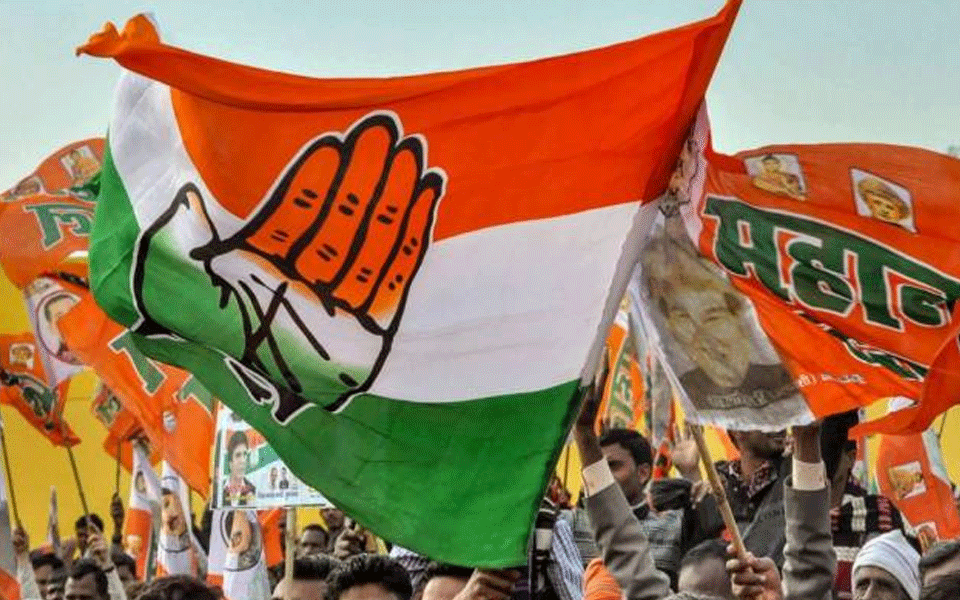
Congress congratulates ISRO and govt, credits Nehru and Indira Gandhi for space achievements
New Delhi: The Congress on Wednesday congratulated ISRO and the government for acquiring anti-satellite missile capability but extended credit to former prime minister’s Jawaharlal Nehru and Indira Gandhi, while a senior party leader said the 'ASAT' programme was initiated during UPA rule.
Deflecting attention from Prime Minister Narendra Modi, who announced in an address to the nation that India had demonstrated anti-satellite missile capability by shooting down a live satellite, the Congress and several of its leaders focused on giving credit to India's space scientists.
"We congratulate @isro & the Govt on the latest achievement for India. The Indian Space Programme established in 1961 by Pt. Jawaharlal Nehru & the Indian Space Research Organisation set up under Smt. Indira Gandhi has always made India proud with its groundbreaking achievements," the party tweeted from its official handle shortly after Modi's announcement.
We congratulate @isro @DRDO_India & the Govt on the latest achievement for India. The Indian Space Programme established in 1962 by Pt. Jawaharlal Nehru & the Indian Space Research Organisation set up under Smt. Indira Gandhi has always made India proud through its achievements.
— Congress (@INCIndia) March 27, 2019
Senior Congress leader Ahmed Patel credited the United Progressive Alliance government for initiating the ASAT (Anti-Satellite) programme and lauded then prime minister Manmohan Singh's leadership.
"The UPA government had initiated the ASAT program which has reached fruition today. I congratulate our space scientists & the visionary leadership of Dr Manmohan Singh," Patel tweeted.
His colleague, party spokesperson Priyanka Chaturvedi, also praised the country's scientists while taking a dig at detractors of Nehru and eminent scientist Dr Homi Bhabha.
"I congratulate our space scientists in ensuring that we continue to reach new heights in space missions! Burn moment for bhakts who keep cursing Pt. Nehru,it was his & Dr.Homi Bhabha's farsightedness that has got us where we are today,in a shorter span of time than any other nation," she said in a tweet.
She also acknowledged the role of scientist Vikram Sarabhai in India's achievements in the field of space.
"India has successfully tested the Anti-Satellite (ASAT) Missile. Congratulations to everyone on the success of #MissionShakti," the prime minister said.
He described it as a rare achievement that puts the country in an exclusive club of space super powers.
He said the action was not directed against any country and the satellite was a predetermined target orbiting at an altitude of 300 km.
Let the Truth be known. If you read VB and like VB, please be a VB Supporter and Help us deliver the Truth to one and all.
Maharashtra sets up state vaccination task force to strengthen immunisation programme

Mumbai (PTI): The Maharashtra government has set up a State Vaccination Task Force to strengthen the regular immunisation programme and review the progress of related campaigns, a health department official said on Monday.
The State Vaccination Task Force will comprise at least 29 members and will be headed by the administrative head of the health department, he informed.
The government has also constituted separate district-level and municipal vaccination task forces to improve implementation and address challenges at the grassroots level, he said.
Municipal task forces, chaired by respective civic commissioners, have been constituted in view of the vast urban population in Maharashtra and the role of civic bodies in implementing different health programmes.
The district-level task forces will function under the chairmanship of collectors.
"Complete immunisation of children at the appropriate age is an extremely simple, cost-effective and highly effective measure to reduce child mortality and the prevalence of diseases among kids. Immunisation is a powerful tool for reducing illness in children," maintained the official.
To ensure full vaccination of all children, the state government implements various campaigns from time to time as per the central government guidelines, he pointed out.
"Active participation and cooperation of other relevant government departments are essential (in making these campaigns successful)," according to the official.
The state-level body will review the regular immunisation programme, associated campaigns and vaccine-preventable diseases in detail. It will also conduct focused assessments of high-risk districts and municipal corporations, including vacancies at district, municipal and sub-district levels, availability of cold chain equipment, resource gaps and training requirements, he noted.
The state task force will review allocation and utilisation of funds for immunisation and ensure timely action by officers concerned based on reports from district and municipal task forces and state-level monitoring mechanisms, the official said.
It will also ensure active coordination and participation of other government departments in immunisation drives, while district and municipal task forces will carry out similar functions at their respective levels, the official added.