Congress gets 9 LS seats in TN, one in Puducherry under DMK-led

Chennai : The DMK Wednesday finalised the seat sharing exercise with key ally Congress for the coming Lok Sabha elections, allotting it nine seats in Tamil Nadu and one in neighbouring Puducherry, a day after arch rival AIADMK cobbled up an alliance with the BJP and PMK.
Announcing the pact at the party headquarters 'Anna Arivalayam' here, DMK president M K Stalin said the constituencies to be contested by the Congress will be announced later on conclusion of seat sharing exercise with other allies.
DMK had already appointed committees to steer the alliance process, Stalin said flanked by All India Congress Committee general secretaries Mukul Wasnik, incharge of Tamil Nadu and Puducherry, K C Venugopal, state unit party chief K S Alagiri.
The work on seat sharing with other allies will begin from tomorrow, he told reporters.
There are a total of 39 Lok Sabha constituencies in Tamil Nadu and one in the union territory of Puducherry, ruled by the Congress.
In the 2014 elections, the Congress went alone but failed to win none so as the DMK which had led an alliance with some smaller parties.
The AIADMK won 37 seats while the BJP and PMK one each in Tamil Nadu with the lone Puducherry seat going to AINRC.
Describing the alliance between Congress and DMK as a long term relationship since the days of late Dravidian patriarch M Karunanidhi, Venugopal said "we are very happy," about the seat sharing agreement.
"The country very much needs this alliance, the entire country is disappointed with the Narendra Modi government," he said.
Asked about the other parties with which the alliance will be firmed up, Stalin said DMK has "decided to hold talks with "friendly outfits" which have been working together with it "on people's issues" for the past about two years.
He was obviously referring to parties, including Vaiko-led MDMK, CPI and CPI(M).
Also, the IUML, a long-time ally of the DMK, and VCK, which fought the 2014 Lok Sabha polls with it, are all set to be part of the alliance being put in place by the Dravidian outfit.
Asked if DMDK led by actor-turned politician Vijaykant would be a part of the alliance, he said if that happened it will be informed to the media.
DMDK is in talks with the AIADMK for an alliance but a deal has been delayed with reports suggesting some differences over the number seats to be alloted to it.
The AIADMK Tuesday sealed the electoral pacts with the BJP and PMK allotting them seven and five Lok Sabha seats respectively, while indicating more parties might join the front.
After conclusion of seat sharing with allies, the DMK will contest in rest of the constituencies, Stalin said.
"We did not hold talks secretly in a hotel, but it was conducted in a transparent manner at our party headquarters here," he said taking a dig at AIADMK which concluded talks with allies in a star hotel here
To a question on the AIADMK-led alliance describing itself as "people's welfare coalition," he alleged that "people call it as an alliance for money."
The DMK-Congress pact came after conclusion of final round of talks Wednesday preceded by parleys between the top leadership of the two parties.
DMK Rajya Sabha MP Kanimozhi held talks with Congress president Rahul Gandhi days ago in Delhi on seat sharing.
"It was decided during talks between the leadership of both the parties to allot nine seats in Tamil Nadu and one in Pudhcherry to Congress," Stalin told reporters here.
Asked if the alliance will cover the bypolls expected to the 21 assembly seats as well, he said "let the byelections be announced in the first place."
At the talks Wednesday, the Congress side was represented by Wasnik, Venugopal and legislature party leader K R Ramasamy. Besides Stalin, DMK treasurer Duraimurugan and principal secretary T R Baalu were also present.
After the DMK quit the UPA in 2013, the Congress had to face the 2014 Lok Sabha polls alone in Tamil Nadu. DMK, which had faced the polls in alliance with smaller outfits, drew a blank despite contesting 35 seats.
Congress had lost deposits in 38 constituencies.
In 2009, the Congress had won eight seats in alliance with DMK after contesting 16 seats.
Let the Truth be known. If you read VB and like VB, please be a VB Supporter and Help us deliver the Truth to one and all.
Representative of Iran's Supreme Leader in India calls current situation 'no war, no peace'
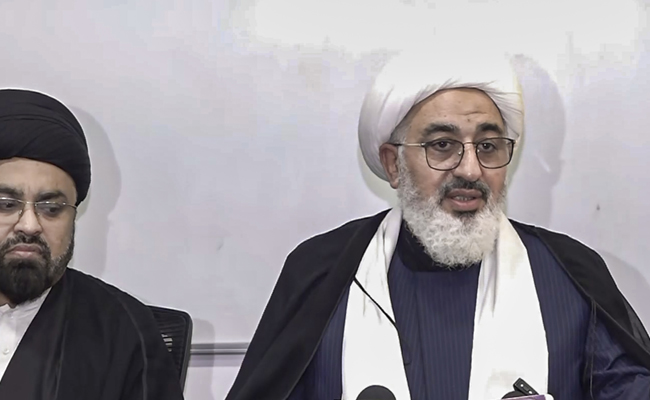
Bengaluru (PTI): Representative of Iran's Supreme Leader in India, Abdul Majeed Hakeem Ilahi on Saturday characterised the ongoing tensions between his country and the Israel-US alliance as a state of “no war, no peace”.
Calling for an immediate halt to the conflict, he said the global stability hinges on those who initiated the war.
He questioned why countries affected by the war and suffering from the energy crisis are not pressuring the US and Israel to stop the aggression.
Addressing a press conference here, Ilahi said Iran did not want the conflict, but was compelled to respond amid continued attacks, even as negotiations were expected to continue.
"Iran didn't want this war, but Iran was forced by the war and several times Iran tried to avoid this war... I don't know what is the condition of these people and these countries (US-Israel)... they want to impose on other countries what they want, and who gave them this authority?" he questioned.
Recalling the negotiations Iran held in Oman, he said talks later moved to Geneva and made progress before being disrupted by sudden attacks.
Ilahi claimed that airstrikes and missile attacks led to the deaths of Iran’s supreme leader Ayatollah Ali Khamenei, ministers, commanders and civilians.
"They killed a lot of civilians… They attacked a primary school, and they killed 175 innocent girls," he said, claiming over 4,000 deaths, more than 40,000 injuries, and widespread damage to houses, hospitals, universities and public infrastructure.
Despite these losses, he said Iran resisted calls for “unconditional surrender” and stood firm and defended itself.
"They wanted unconditional surrender. Which no one—no one can accept it. Iran said, 'Okay, we are ready to be sacrificed,' but we are not ready to submit ourselves," he added.
He argued that they (US-Israel) proposed the current ceasefire only after realising that they could not achieve any of their objectives after 40 days of conflict.
The envoy further claimed that the ceasefire is not an actual ceasefire, but a “no war, no peace” situation.
Explaining the current situation in Iran, he said conditions remain stable and people are going about their daily lives.
"They are working ....(leading) their ordinary life. They are working—they're going farming and they do everything....and they aren't scared of anything. And they are ready to defend themselves," he added.
Addressing the crisis in the Strait of Hormuz, he said the situation was stable before February 28 and all countries benefited from it.
"(For) 10,000 years, the Strait of Hormuz was open...and Iran daily yearly spent a lot for providing security in the Strait of Hormuz... so no one even complained anything about the Strait of Hormuz. Everyone was free...and even our enemies their warship was passing through the Strait of Hormuz," he said.
However, he linked the current maritime instability to the actions of the US and Israel.
"So Iran cannot do anything. Those people who initiated, created and started this war, they have to stop it. And everything will go back to normal," he said.
Criticising the mentality of the "great powerful country", Ilahi said, "they think they have the right to do whatever they want. It should change."
He sought to know why the countries affected by the conflict are not exerting pressure on the US and the "Zionist" regime to halt the war.
"Why are they not asking them? This crisis and problem by which a lot of countries are affected was created by them. A lot of factories are closed and even working days in some countries reduced... A lot of restaurants are closed," he said.
Seeking fairness and justice, Ilahi said instead of asking Iran, all those nations should ask those who initiated this war to stop it, by telling them, "we are suffering."
To a query on international mediation, Ilahi, referring to the US, asked, "Is it acceptable and reasonable that one country orders all countries -- you should not deal with this country, You should not purchase from this country. You should not have business with this country. You should not buy from this country."
Ilahi also highlighted Iran's long-standing ties with India and said, "It is a great country and we respect India and Indians."
"We have 5,000 years relationship and friendship. We are connected to India by education, by philosophy, by culture, by civilisation and by the economy," he said.
According to him, the bilateral cooperation remains strong, citing diplomatic engagement.
"At the moment also, our relationship, collaboration, cooperation with India is very good," he said, adding Iran allowing Indian ships to pass through Strait of Hormuz reflects the ties.
"Iran allowed Indian ships to pass through the Strait of Hormuz. Why? A lot of countries couldn't get this permission?... The relationship between Iran and India is very good," he added.
He expressed confidence that in future too, the ties between Iran and India will be strong.