Congress government trying to delay Punjab AIIMS project
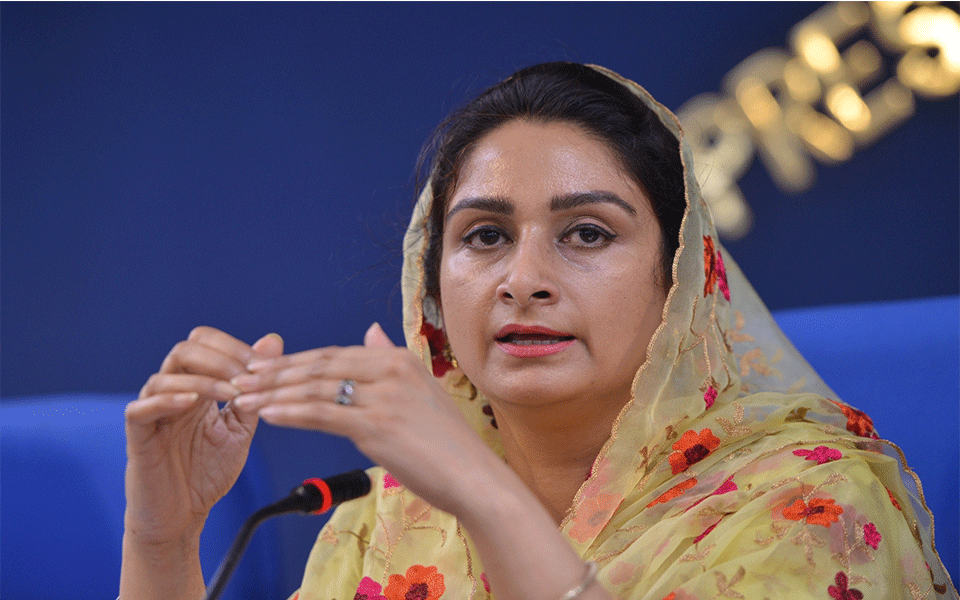
Chandigarh, Aug 4 : Union Food Processing Minister Harsimrat Kaur Badal on Saturday said the Congress government in Punjab was deliberately delaying commissioning of the Rs 925 crore AIIMS project at Bathinda by refusing to give statutory approvals and making the site encumbrance free only because of petty political considerations.
In a statement here, the Union Minister said the Congress government, led by Chief Minister Amarinder Singh, got jittery when the Union Health Ministry recently announced that it would start construction on the site in June this year and start an OPD (out patient department) for diagnostics in February, 2019.
"It seems start of medical facilities for the people of the region was not to the liking of the Congress government which felt the SAD-BJP alliance would get political credit for the same (before the 2019 general elections). It is a shame that the people of the Malwa region are being denied advanced medical care, including much needed cancer treatment, because of such despicable anti-people thinking of the Congress party," Badal, who is the Lok Sabha MP from Bathinda constituency, said.
The centre had earlier sanctioned the All India Institute of Medical Sciences (AIIMS) for Bathinda, around 230 km from here.
"There could be no other reason for the deliberate go-slow tactic of the Congress government despite the fact that I had repeatedly written letters detailing approvals and civil works needed to start construction on the 177 acre AIIMS project site. Now, Union Health Minister J.P. Nadda has also again written a letter to Chief Minister Amarinder Singh asking him to personally intervene to make the AIIMS project a reality," she pointed out.
Badal said that despite the follow-up by the health ministry, the Punjab government was not according the necessary approvals which would lead to delay in completion of the prestigious project for the Malwa belt, which was affected by cancer and other diseases.
Let the Truth be known. If you read VB and like VB, please be a VB Supporter and Help us deliver the Truth to one and all.
Over 1 lakh students appear for NEET across TN
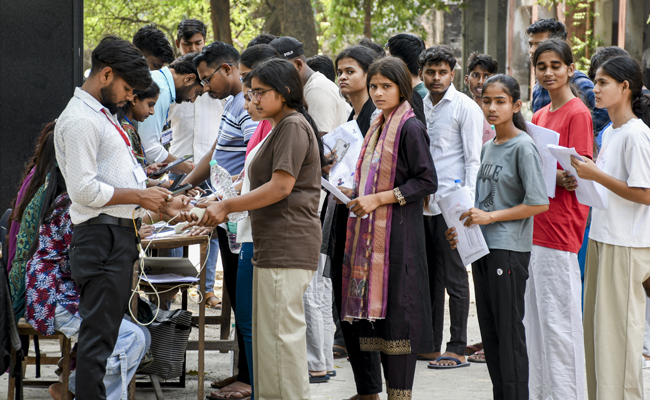
Chennai (PTI): About 1.4 lakh students appeared for the NEET 2026 exam for admission to medical degree courses across 31 centres in Tamil Nadu on Sunday.
Students claimed that the exam paper was easier than the previous year.
Organised by the National Testing Agency (NTA), 22.80 lakh students had registered for the National Eligibility cum Entrance Test (NEET) undergraduate exam nationwide.
NTA sources said that CCTV surveillance was installed at all examination centres, with feeds linked to centralised control rooms.
In view of the large candidate volume and prevailing summer conditions, the NTA ensured reliable power back-up, including generators at all centres, to ensure candidate comfort during the exam. Also, drinking water and on-site medical support were provided to students.
The sources further said that no malpractices were reported, especially in Chennai. The results of NEET are expected to be declared in June, 2026.