Congress leader Digvijaya Singh questions surgical strikes, accuses govt of ruling through lies
Cong distances itself from Digvijaya's remarks on surgical strikes
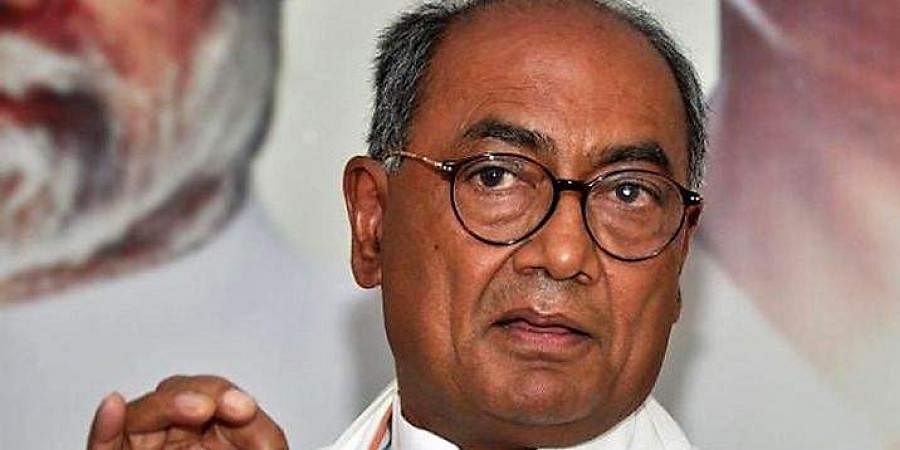
Jammu/New Delhi, Jan 23: Congress leader Digvijaya Singh on Monday questioned the surgical strikes and accused the government of peddling lies, drawing furious reaction from the BJP which said the opposition party was blinded by its "hate" for Prime Minister Narendra Modi and has "insulted" the armed forces.
As his comments stoke a major political row, the Congress distanced itself from them, saying they are "his own" and do not reflect the party's position.
Addressing a public meeting during the Bharat Jodo Yatra in Jammu and Kashmir, Singh alleged that the government did not agree to the CRPF request of flying its personnel from Srinagar to Delhi and 40 soldiers sacrificed their lives in Pulwama in 2019 to a terror attack.
"They talk of surgical strikes. They claim to have killed so many people but no proof is given. They are ruling by peddling a bundle of lies," the former Madhya Pradesh chief minister, who has often courted controversy with his comments, said.
The BJP launched a sharp attack on the Congress, saying that such comments show that the Rahul Gandhi-led foot march across the country is Bharat Jodo Yatra only in name while he and his party colleagues are working to "break" the country. It is essentially "Bharat todo yatra", BJP spokesperson Gaurav Bhatia said.
He said, "India will not tolerate if they speak against armed forces. Rahul Gandhi and the Congress hate PM Modi but it seems they have been blinded by the hate to an extent that their dedication to the country has withered away."
He said Congress leaders had raised questions about the surgical strikes soon after the Indian Air Force said it hit terror camps in Balakot in Pakistan in retaliation to the Pulwama terror attack.
"Gandhi and the Congress do not have trust in our brave armed forces. They repeatedly raise questions and insult the citizens of India and our armed forces," Bhatia claimed.
With the BJP seizing the issue to corner the Congress over its key plank of national security, the opposition party swung into damage-control.
AICC general secretary communications Jairam Ramesh said on Twitter, "The views expressed by senior leader Digvijaya Singh are his own and do not reflect the position of Congress. Surgical strikes were carried out before 2014 by UPA government. Congress has supported and will continue to support all military actions that are in the national interest."
An unfazed Singh, however, kept up his line of attack.
In a tweet in Hindi, he said, "From where did the terrorists get 300 kg of RDX in Pulwama incident? DSP Davinder Singh was caught with terrorists but then why was he released? We also want to know about the friendship between the prime ministers of Pakistan and India."
In his video message attached to the tweet, Singh said 40 CRPF personnel sacrificed their lives in Pulwama, but this government has not been able to reveal from where three quintals of RDX came.
"Besides, the government has not been able to answer where is DSP Davinder Singh, who was caught involved with terrorists. Why was he let free and why was a case of treason not registered against him?
"We would also like to know from the prime minister as to what kind of relations he has with Pakistani prime minister that both are praising each other. At least, he should answer these questions," the Congress leader said in a video message.
Attacking the Congress, Bhatia said its leaders had tried to deflect attention from Pakistan after the Pulwama terror attack as well. Randeep Singh Surjewala had then blamed "home-grown terrorism", he claimed, alleging that the opposition party tried to give a clean chit to Pakistan.
Pakistan is in a lot of pain when our armed forces strike terrorists, while in India it is the Congress which is in anguish, he said.
With the Pulwama terror attack and surgical strikes taking place in the run-up to the 2019 Lok Sabha polls, the issues had captured popular imagination as the BJP retained power at the Centre with a bigger mandate than 2014 by winning over 300 seats out of 543.
"Nothing is bigger than people's blessings in democracy. In the 2019 polls, it became clear that people stand with the BJP and the armed forces. While those who raised questions are facing existential crisis," Bhatia said.
Bhatia claimed that the then Congress-led UPA government in 2008 did not allow the armed forces to target Pakistan after the 26/11 terror attacks in Mumbai. "There was zero response as it lacked courage. That corrupt and incompetent Congress government had no will," he said.
On the other hand the Modi government targeted camps of terrorists in Pakistan after terror attacks in Uri and Pulwama, he said.
The BJP spokesperson also asked Rahul Gandhi to iterate his stand on Article 370, which gave special rights to Jammu and Kashmir and was repealed by the government in 2019.
Supporting his party colleague Digvijaya Singh, Congress spokesperson Pawan Khera shared his tweet and video message and said Prime Minister Modi should answer questions on Pulwama and not hide behind the armed forces.
"The question is from the Modi government. Without hiding behind our brave army, Modi ji should answer: How did RDX reach Pulwama? Why was DSP Davinder Singh released without investigation? What kind of relation does Modi ji have with Pakistan that you call ISI to Pathankot," Khera said.
Let the Truth be known. If you read VB and like VB, please be a VB Supporter and Help us deliver the Truth to one and all.
4 held for sexually assaulting woman, girl on moving bus after social media alert in UP's Agra
Agra (UP) (PTI): Four people were arrested, after a prompt response by police following a social media alert, for allegedly sexually assaulting a woman and a girl inside a moving bus here, officials said on Tuesday.
According to an official police statement, at 12:27 am on April 27, information was received on the social media platform X about an incident of sexual assault on a bus travelling from Kanpur to Ahmedabad, which was approaching Namner crossing in Agra.
Acting under the direction of Police Commissioner Deepak Kumar, the Agra Police social media team immediately alerted the Rakabganj police station within minutes and coordinated with the victims to confirm the incident and obtain the exact location, it stated.
Police teams launched intensive checking at Namner crossing and intercepted the bus as it reached the spot. The four accused involved in the incident were apprehended on the spot, and legal action was initiated against them, the statement said.
The police said the swift response and coordination between the social media team and field units ensured timely action, bringing relief to the victims and other passengers, who expressed gratitude towards the police, it added.