Congress slams Modi regime over Rs 70,000 cr bank scams, IDBI sale
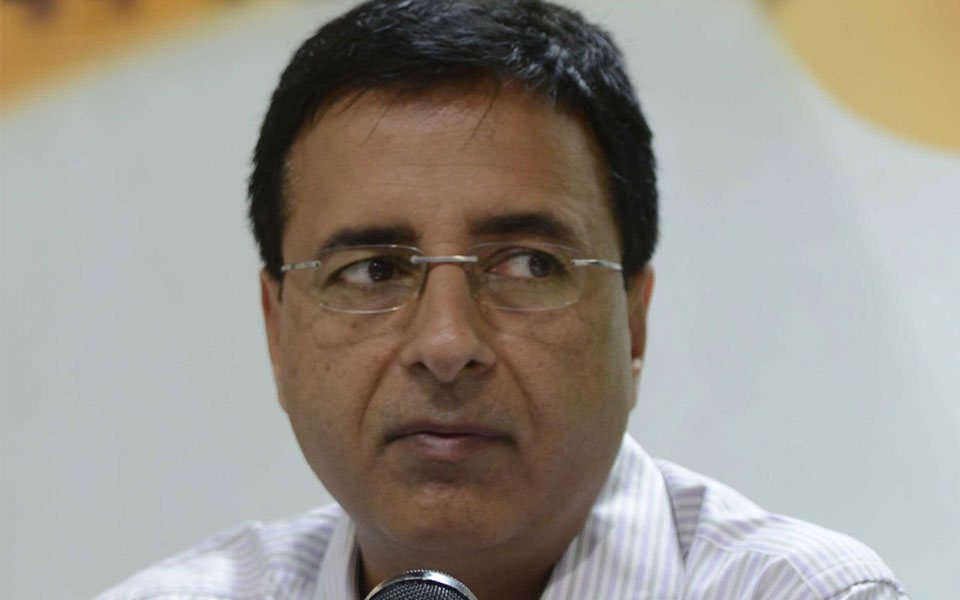
New Delhi, June 25: Congress on Monday launched a scathing attack on the Narendra Modi government for leading India into "financial anarchy" with its "utter economic mismanagement" that has led to bank scams over Rs 70,000 crore, and now forcing LIC to buy the sinking IDBI Bank to "hide its failures".
"Post the numerous bank loot scams that have plunged the banking sector in deep crises, one more mega scam worth Rs 6,978 crore has been uncovered taking the total value of 13 bank loot scams to Rs 70,014 crore," said Congress spokesperson Randeep Singh Surjewala.
He alleged that the Faridabad-based SRS Group, a diversified company, engaged in criminal conspiracy, cheating and frauds of Rs 6,978.72 crore reportedly using hundreds of shell companies defrauding 17 banks. It also laundered money and duped thousands of home buyers.
Citing Indian banks' Q4 losses for 2017-18 that touched an "astronomical" Rs 90,000 crore, Surjewala said Modi government's financial anarchy continues unabated as the NPAs which were Rs 2,63,000 crore in fiscal 2013-14 is now hovering around Rs 10,30,000 crore.
IDBI Bank is the worst performing public sector bank whose Q4 losses have swollen to Rs 5,663 crore and gross NPA has risen to a whopping Rs 55,588.26 crore, he said and added the bank has a bad loan ratio of close to 28 per cent.
"Utter economic mismanagement of Modi government and its Finance Ministry is writ large. To cover up its mess, it is now jeopardizing the hard-earned money of 38 crore LIC policy holders by forcing it to purchase the rapidly sinking IDBI Bank.
"It's a classic case of selling family silver of 38 crore LIC policy holders to hide the economic mayhem of failed 'Modinomics-Jaitleynomics'," he said.
Surjewala said the the Prime Minister's Office, Finance Ministry, the Reserve Bank of India, the Central Vigilance Commission, the Central Bureau of Investigation, the Securities and Exchange Board of India, the Serious Fraud Investigation office, the Enforcement Directorate, the Corporate Affairs Ministry/the Registrar of Companies and the BJP government in Haryana are completely silent even after a series of complaints filed against the SRS Group as early as August 2017.
Thousands of people have been duped in the name of public deposits received by SRS Ltd, one of the SRS Group companies, he said, claiming that repayments of about Rs 90 crore have been denied despite various order from National Company Law Tribunal.
Surjewala said thousands of people have also been duped in the name of booking flats, homes, plots, floors and other deposits, with as much as 80 per cent advance as payments, but no delivery of the said land or flat allotments was done to the investors in these projects.
"In one of the glaring examples, the bank has served notices to 1,200 flat owners in SRS Royal Hills, Sector 87, Faridabad to vacate the flats to recover the loan," he said, adding that the residents had been staying for years without even a registry.
Let the Truth be known. If you read VB and like VB, please be a VB Supporter and Help us deliver the Truth to one and all.
AIITA welcomes Karnataka’s ban on obscene songs in school events
Bhatkal: The Karnataka unit of the All India Ideal Teachers Association (AIITA) has welcomed the Karnataka government’s decision to strictly ban school children from dancing to obscene songs during educational and cultural programmes in government, aided, and private schools across the state.
AIITA Karnataka State President M. R. Manvi congratulated the government for taking what he termed an important step to preserve the sanctity of education.
“Such decisions to safeguard the dignity of school children and uphold the values of education are the need of the hour. This rule should not be limited to government schools alone but must be strictly implemented in all private educational institutions as well,” he said.
He further urged the government to address other concerns within school programmes.
“The government should not only prohibit obscene dances in the name of school anniversaries, but also ensure that plays and dialogues that incite religious hatred are avoided. Schools should be centres of harmony, not platforms for spreading hatred,” he added.
According to a recent circular issued by the Department of School Education and Literacy, obscene dances are adversely affecting the mental health and moral values of students.
In this regard, schools have been advised to use songs that promote nationalism, positive thinking, the greatness of Kannada culture, and value-based traditions instead of inappropriate content during programmes.
The circular also emphasises that students should be dressed in decent attire.
AIITA also backed the department’s warning that disciplinary action would be taken against head teachers if such guidelines are violated. The association has further demanded that district Deputy Directors of Public Instruction strictly monitor the implementation of these rules.