Constitutional rights define life of citizens, societies: CJI
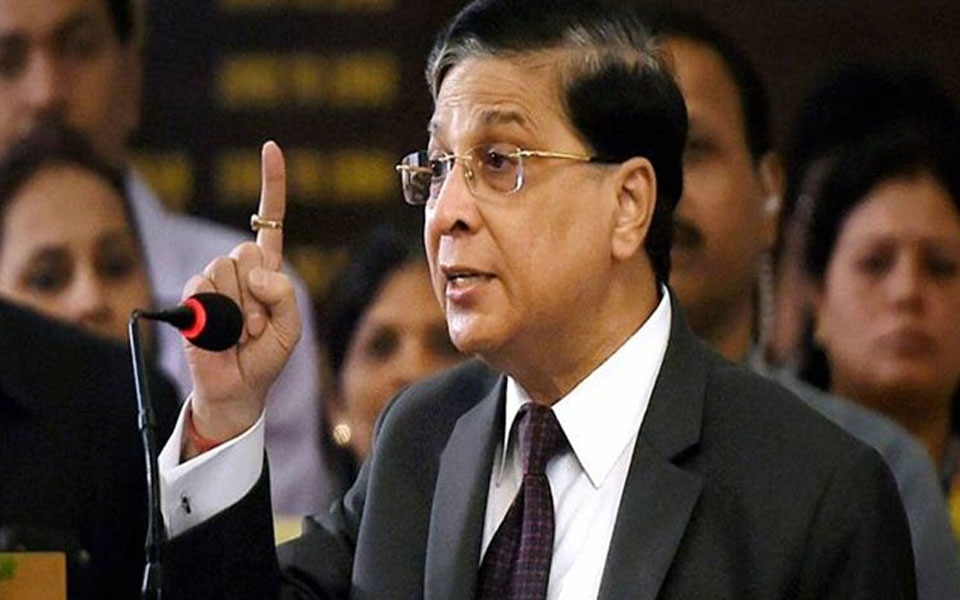
New Delhi, July 26 : Constitutional rights define and shape the life of citizens and societies and have to be construed and developed in such a manner that their real intent and existence percolates to the lowest rungs in the society, said Chief Justice of India Dipak Misra.
Delivering the M.C. Setalvad Memorial Lecture, for the first and longest serving Attorney General of India, he said Constitutional rights' positive exposition and assertive and energetic appreciation constitute the "lifeblood of progressive societies".
"These rights would become a dead letter without their dynamic, vibrant and pragmatic interpretation. That is the raison d'etre for the Constitution and the constitutional rights. This also gives birth to an equally important role of the state to implement the constitutional rights effectively.
"The state action has to be concrete and not such that its effects leak into so many rivulets that they dissipate. Mere rhetoric and passivity by the state without reflection of serious commitment will only result in reducing the solemn duty of the state to that of a feigned act of affectation," Justice Misra said.
He said the judiciary has always remained alive to its solemn duty placed upon its shoulders by the Constitution, that is, to protect the constitutional rights of the citizens of the country.
Seaking on "Dynamic Ascendance of Constitutional Rights: A Progressive Approach", Misra stressed that it is a Constitution made for a progressive society and its working depends upon prevalent atmosphere and conditions.
Since the Constitution is itself a "dynamic and forward spirited document", then it would be fallacy to think that the constitutional rights guaranteed therein will remain static, he said.
"The constitutional rights also being dynamic, were on the ascendance in the past, are on the ascendance in the present and will always remain in the ascendance in the future, as well.
"Constitutional rights cannot and should not, for the sake of democracy, stop growing and this I say with a certain degree of confidence as perpetually expanding constitutional rights will only contribute towards strengthening of a constitutional democratic set up like ours," Justice Misra said.
He also said that gender equality has been an important issue before courts.
Justice Misra said in Madhya Pradesh women reservation for panchayat case, "argument is that women cannot administer and will depend on their husbands. This is preposterous. The case is before Supreme Court but I will not hear the matter".
"It's a judge's duty to see that the right you have created and recognised is also implemented," he said.
Acting Chief Justice of Delhi High Court Gita Mittal, who was also present at the gathering, said that public faith in judiciary should never be compromised.
"Strength and resilience of the judiciary lies in the confidence and faith of the people in it," she said at the memorial lecture organised by the Bar Association of India.
Let the Truth be known. If you read VB and like VB, please be a VB Supporter and Help us deliver the Truth to one and all.
4 workers die after being buried under coal slurry in Jharkhand's Dhanbad

Dhanbad (Jharkhand) (PTI): At least four workers died after being buried under coal slurry in Jharkhand's Dhanbad district on Saturday, a police official said.
The incident took place at Moonidih coal washery in the command area of Bharat Coking Coal Limited (BCCL).
"Bodies of all four workers were dug out of debris during a rescue operation," Putki police station in-charge Waqar Hussain told PTI.
The incident took place when coal slurry was being loaded into trucks by workers, during which a large chunk of slurry fell and trapped several workers underneath, officials said.
The deceased have been identified as Manik Bauri, Dinesh Bauri, Deepak Bauri, and Hemlal Gope.
Meanwhile, the family members of the deceased and local villagers placed the bodies in front of the washery gate and began a protest.
They demanded compensation, jobs for dependents and action against those responsible for the incident.
Police and administration officials are trying to pacify the protesters, an official said.