Contempt plea in Delhi HC against govt for not publishing draft EIA in 22 Indian languages
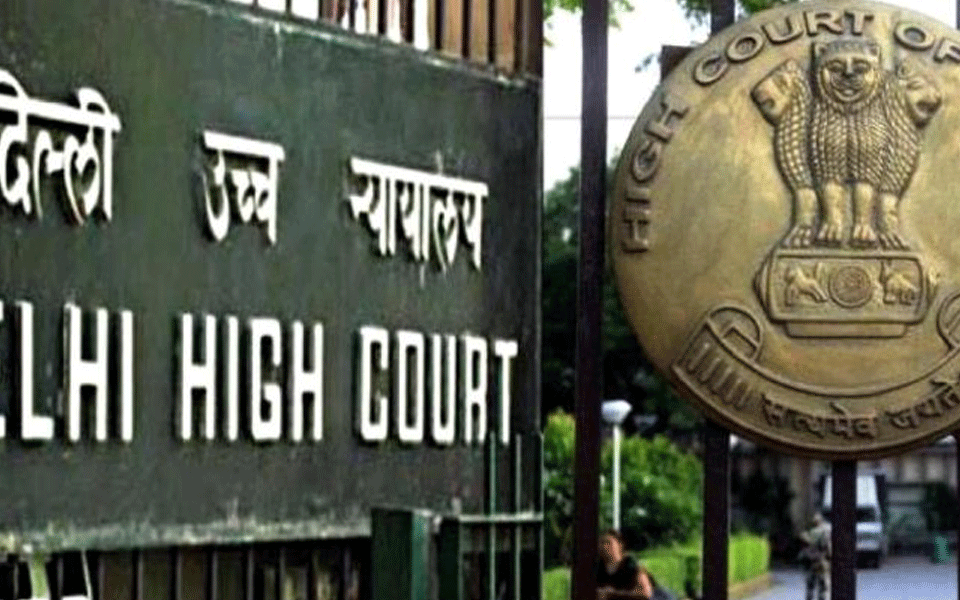
New Delhi: The Delhi High Court asked the Centre on Tuesday to reply to a plea seeking contempt action against it for alleged "wilful disobedience" of a judicial order to ensure the draft Environment Impact Assessment (EIA) notification of 2020 is published in all the 22 languages in the Eighth Schedule of the Constitution within 10 days from June 30.
Justice Sanjeev Sachdeva issued notice to the Environment Ministry, which was directed by the high court on June 30 to ensure the draft EIA 2020 is published in all 22 Indian languages within 10 days, and sought its response to the contempt plea by August 17.
The order came on the plea by environmental conservationist Vikrant Tongad who has alleged "wilful disobedience and deliberate defiance" by the ministry as it neither published the translated versions of the draft EIA nor did it seek more time from the court to do so.
Senior advocate Gopal Sankaranarayanan, appearing for Tongad, said the high court, by its June 30 order, had also extended till August 11 the date for giving comments or objections to the draft EIA and for this purpose it had asked the ministry to publish the translated versions to enable the public to respond to the same.
The draft EIA 2020, according to the plea, provides for post facto approval of projects and does away with public consultation in some cases.
A division bench of the high court said in the June 30 order that looking at the far reaching consequences of the public consultation process for which the draft notification has been published, "we are of the view that it would be in aid of effective dissemination of the proposed notification if arrangements are made for its translation into other languages as well, at least those mentioned in the Eighth Schedule to the Constitution".
The translation may be undertaken by the Centre itself or with the assistance of the state governments, where applicable, it said.
"Such translations should also be published through the website of the Ministry of Environment, Forest and Climate Change, Government of India as well as on websites of environment ministries of all states as well as those of state pollution control boards, within 10 days from today," the court had said.
The publishing the translated versions within 10 days "would further enable the public to respond to the draft within the period stipulated in this judgment", it had stated.
The order had come on Tongad'' plea seeking extension of the time to respond to the draft EIA 2020 till September or till the COVID-19 pandemic subsists.
The petition had claimed that the draft EIA 2020 completely supersedes and replaces the existing environmental norms.
"This draft notification proposes significant changes to the existing regime, including removing public consultation entirely in certain instances, reducing the time for public consultation from 45 days to 40 days, and allowing post facto approvals for projects," it had said.
Let the Truth be known. If you read VB and like VB, please be a VB Supporter and Help us deliver the Truth to one and all.
Mizoram class 12 results out, pass percentage at 87.67

Aizawl (PTI): Mizoram recorded a pass percentage of 87.67 in the class 12 board examinations on Wednesday, with boys scoring marginally higher than girls,
Across the Arts, Science, and Commerce streams, boys secured an 87.7 per cent success rate, while girls followed closely at 87.66 per cent, according to the results published by the Mizoram Board of School Education (MBSE).
Of the 12,243 students who sat for the examinations held between February and March, 10,734 passed, 1,394 could not, and 115 qualified for compartmental examinations.
Academic performance was strongest in the Commerce stream, which saw a 90.51 per cent success rate among 759 candidates.
The Science stream followed with 89.24 per cent pass rate out of 2,770 students who appeared for the exam, while the Arts stream, with 87,14 students, recorded a pass percentage of 86.93.
In terms of institutional performance, the results revealed that deficit schools, which receive regular government grants, maintained their status as top performers with an average 93.80 per cent pass rate across all streams, followed by private schools at 91.55 per cent, while state-run schools recorded a success rate 83.13 per cent.