Cop among six injured in clash in Jharkhand's Sahibganj
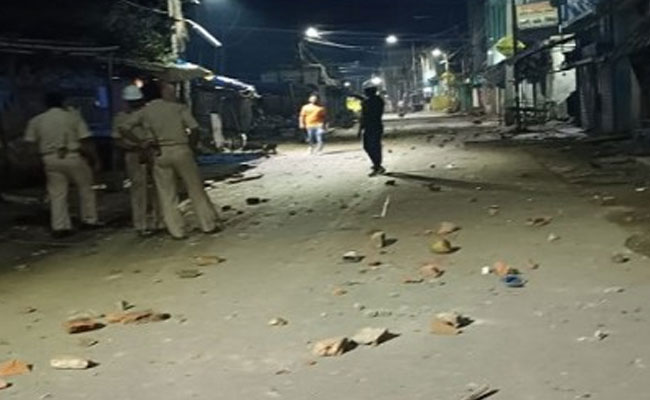
Sahibganj (Jharkhand) (PTI): A senior police officer was among six people who were injured in a stone-pelting incident that took place during idol immersion in Jharkhand's Sahibganj district, an official said on Sunday.
Several shops and vehicles were also damaged in the clash between two communities on Saturday night.
The incident took place when a Durga idol immersion procession was taken out in Sahibganj town, around 400 km from state capital Ranchi, Deputy Commissioner Ramniwas Yadav said.
Bricks were hurled in the clash that happened in Kulipara area, he said.
Sahibganj Sub-divisional Police Officer Rajendra Kumar Dubey received head injuries but his condition is stable now after treatment, the DC said, adding a few others were also injured and are they are also undergoing treatment.
"The situation is well under control now. Security forces have been deployed to prevent further clashes," Yadav told PTI.
"We are trying to identify those involved in the incident. Strict action will be taken against them. Besides, an investigation is underway to ascertain what triggered the clash," he added.
Let the Truth be known. If you read VB and like VB, please be a VB Supporter and Help us deliver the Truth to one and all.
Two arrested in K'taka for assaulting minors, uploading CSAM content

Bengaluru (PTI): Two men were arrested for allegedly sexually assaulting two minor girls, recording the acts on mobile phones and uploading the videos online as child sexual abuse material, police said on Thursday.
The accused have been identified as Kiran Kumar (29), hailing from Chitradurga district, and Aditya M K (20), hailing from Shivamogga district, they said.
A probe was initiated after information was received from the NCRP portal regarding a suspected instance of creation of Child Sexual Abuse Material (CSAM) for online dissemination, police said.
Accordingly, a case was registered at Kaggalipura Police Station under relevant sections of the IT Act on May 10, they added.
Investigation revealed that two minor girl victims were exploited and videos were created and uploaded to the internet. The child victims have subsequently recorded their statements as per procedure and further necessary legal steps have been taken, Pronab Mohanty Director General of Police, Cyber Command, said in a statement.
Based on the statements of the victims, the accused persons, who allegedly assaulted the minors, recorded the acts on mobile phones and uploaded the videos online, were arrested, he said.
Following the probe, sections 65(2) (rape) and 70 (gangrape) of the Bharatiya Nyaya Sanhita, along with relevant sections of the POCSO Act, have been added to the FIR, police said.
Officials collected relevant information and on May 12, arrested the accused persons and seized three mobile phones belonging to them, in which the videos had allegedly been recorded, he said.
The accused were later produced before the court and taken into police custody for further investigation, he added.
According to him, in CSAM cases, police usually apprehend offenders who have downloaded such content or have kept them in their possession after obtaining them from elsewhere, usually the internet.
"The present case is one of the very few instances where content creators and uploaders have been apprehended," Mohanty added.