Courts can't allow inadequate prison to violate inmate's right: HC
_vb_64.jpeg)
New Delhi (PTI): Courts cannot allow an inadequate prison healthcare system to violate an inmate's right to timely medical care, the Delhi High Court held while directing the city government to ensure that proper medical infrastructure is maintained in jails here.
Observing that the Delhi government is responsible for the management and maintenance of prison premises here, the high court directed authorities to ensure that healthcare requirements of jail inmates are met.
The court also directed the secretary of the Delhi government's health and family welfare department to constitute a committee, which, apart from him, will include the director general (prisons), chief medical officer (CMO) of Delhi Prisons, two senior jail visiting judges of district courts to be nominated by the principal district and sessions judge (central district), secretary of the DSLSA and two advocates.
The committee, the high court said, will give suggestions to it within one month regarding improving healthcare facilities in prisons and ways to promote equal healthcare to all prisoners.
"The committee will also specifically inform the court as to whether facilities are available in the jail hospital to deal with emergency situations such as cardiac arrest, hemorrhage etc. as the first few minutes in such an eventuality are crucial to save the life of a person," Justice Swarana Kanta Sharma said.
The court's order came while dealing with two applications filed by city-based businessman Amandeep Singh Dhall, arrested by the CBI and the ED in separate cases lodged by them in connection with alleged irregularities in the now-scrapped Delhi excise policy. Dhall in the applications has sought an interim bail for 12 weeks on medical grounds.
The accused has said that the medical staff at the jail hospital was not able to provide physiotherapy sessions and epidural steroid injection for C3-C4 joints prescribed by his treating doctor after his surgery.
The court directed that he be admitted to the Safdarjung Hospital, which is a referral hospital according to the Jail Referral Policy, for two weeks.
"However, the applicant shall continue to be in the custody of the superintendent of jail concerned, and the jail superintendent concerned shall ensure that appropriate and adequate security is provided/deputed at the hospital since the accused will continue to remain in judicial custody though under treatment in the hospital," the court said.
Regarding the issue of lack of appropriate medical facilities in Delhi prisons, the high court said this case has brought to light a critical issue concerning the standard of medical treatment within correctional facilities, shedding light on the alarming inadequacies in the healthcare infrastructure for prison inmates.
It noted that the report submitted by the prison dispensary in this case pointed to a distressing reality about the lack of proper medical care facilities, that is, physiotherapy equipment.
The absence of these essential equipment not only signifies lack of adequate medical infrastructure in prisons, but also its direct repercussion on the health of inmates requiring physiotherapy, the court said.
The basic right of a citizen to healthcare, while being incarcerated, is not obliterated or surrendered to the State, and prisoners are also human beings and they retain some undeniable human rights which have to be acknowledged by every court of law and the State, it said.
"Courts cannot allow an inadequate prison healthcare system to violate a prisoner's right to timely and adequate medical healthcare. Preserving the health of prisoners would require a mechanism to monitor and promote the healthcare system available in prisons," it said.
The court acknowledged that it is not possible for jail authorities, through the State, to have every kind of advanced medical equipment in the jail medical set up to meet the requirements of some prisoners and directed that a high attainable standard of healthcare be ensured in prisons.
"In a just and equitable legal system, the principle of equality before the law is paramount. This means that every individual, regardless of their wealth or social status, is subject to the same legal standards and protections," the high court made clear.
It also directed that doctors in-charge of jail dispensaries shall furnish to CMOs a list of requirements of medical equipment essential for medical care of jail inmates.
CMOs shall communicate the inadequacies and requirements to jail visiting judicial officers and a weekly report shall be prepared and sent to the secretary (home) of the Delhi government and the issues should be addressed within two days, it said.
Regarding the criminal case, it is claimed by the probe agencies that Dhall allegedly conspired with other accused and was "actively" involved in the formulation of the liquor policy and facilitating kickbacks to the Aam Aadmi Party (AAP) and its recoupment by the "South Group" through various means.
The Enforcement Directorate's (ED) money laundering case stems from an FIR of the Central Bureau of Investigation (CBI).
According to the CBI and the ED, irregularities were committed while modifying the excise policy and undue favours extended to licence holders.
The Delhi government implemented the policy on November 17, 2021, but scrapped it at the end of September 2022 amid allegations of corruption. Former Delhi deputy chief minister Manish Sisodia is also an accused in the matter.
Let the Truth be known. If you read VB and like VB, please be a VB Supporter and Help us deliver the Truth to one and all.
Putin meets Iran's FM Araghchi, says Russia ready to do its best to help bring peace to West Asia
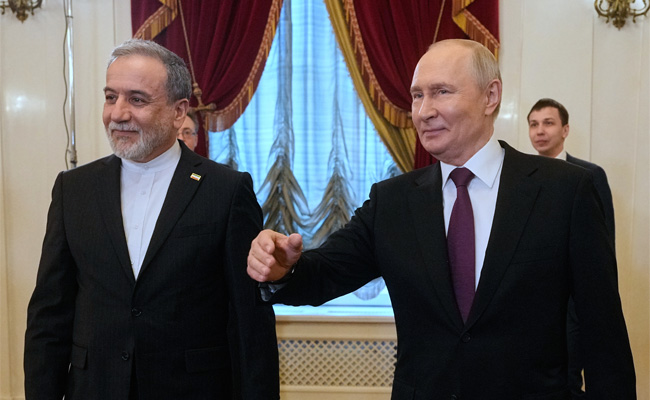
Moscow (PTI): Iran's Foreign Minister Abbas Araghchi on Monday met Russian President Vladimir Putin, who hailed the Iranian people for fighting bravely and heroically for their sovereignty and said Moscow is ready to do its best to help bring peace to West Asia as soon as possible.
Araghchi, who held talks with Omani and Pakistani leadership before arriving in Russia, met Putin in St. Petersburg and thanked him for supporting Iran, state-owned TASS news agency reported.
"Russia is ready to do everything in its power to ensure that peace in the Middle East is achieved as soon as possible," Putin said during his meeting with Araghchi, which was also attended by Russian Foreign Minister Sergey Lavrov.
Revealing that he received a message from Iranian Supreme Leader Mojtaba Khamenei last week, Putin asked Araghchi to convey his "gratitude for this message and best wishes for his health and well-being."
He praised the Iranian people for fighting "bravely and heroically" for their sovereignty, Iran's state-run PRESS TV reported.
"We really hope that, based on the courage and desire for independence, the Iranian people, under the guidance of the new leader, will weather this difficult period of trials and peace will come,” Putin said.
He also stressed that Russia “intends to maintain” its strategic relations with Iran.
Araghchi said that the world witnessed Iran’s strength in countering the US during the recent war, and that the Islamic Republic is a "stable and powerful establishment."
"With their courage, the Iranian people succeeded in resisting the US aggression and will be able to endure it,” he said.
He said that it became clear that Iran has “great friends and allies” like Russia, and conveyed “warmest greetings” from Supreme Leader Mojtaba Khamenei and President Masoud Pezeshkian to the Russian leader.
Araghchi said relations between Moscow and Tehran represent a “strategic partnership at the highest level” and will continue to develop "regardless of circumstances."
"We are grateful to you for the solid and strong positions in support of the Islamic Republic of Iran," he said.
Foreign Minister Lavrov said that the talks between President Putin and the Iranian Foreign Minister were "useful and constructive."
Kremlin Spokesman Dmitry Peskov later said that Russia is "ready to provide any good offices, any mediation services that are acceptable to the parties."
"We will be ready to do everything so that ultimately peace ensues, guaranteed peace, and that there is no return to hostilities," Peskov was quoted as saying by TASS.
He was asked how Moscow can assist in future negotiations on the Iranian settlement.
Araghchi arrived in Russia after his whirlwind trip to Islamabad, which, according to him, was “very productive” and involved “good consultations" with Pakistan's Army Chief Field Marshal Asim Munir, amid uncertainty over the second round of peace talks to resolve the war in West Asia.
"We held good consultations with our friends in Pakistan. The trip was successful. We assessed the outcome of our recent (meetings) and discussed in what direction and under what conditions talks can move on,” Araghchi said in a video posted on his Telegram channel upon his arrival in St Petersburg.
Referring to the second round of talks between the US and Iran to resolve the conflict in West Asia, Araghchi said: "Developments have taken place in the negotiations."
"Despite some progress in earlier rounds, the talks failed to reach their objectives due to the Americans' approach, the excessive demands they made, and the wrong approaches they adopted. Therefore, it was necessary to consult with our friends in Pakistan to review the latest situation,” Iran's official news agency IRNA quoted him as saying.
He said that the trip to Pakistan was a good opportunity to review developments related to the US-Israeli war against Iran, expressing confidence that “these consultations and coordination between the two countries will be highly significant.”
Araghchi arrived at St. Petersburg's Pulkovo Airport early Monday, where he was welcomed by Russian officials and Iran’s ambassador to Russia, Kazem Jalali, the report said.
The first round of peace talks between Iran and the US, held on April 11 and 12, failed to bring the desired result for the parties to the conflict.
The Iranian minister arrived in Islamabad for the second time on Sunday after a short visit to Oman, where he held talks with Sultan Haitham bin Tariq al-Said on security in the Strait of Hormuz and diplomatic efforts to end the Iran-US conflict.
After Araghchi left Pakistan for Oman on Saturday, President Donald Trump announced that US negotiators Steve Witkoff and Jared Kushner would no longer be going to Islamabad for talks with Iran, contending that Washington held all the cards on the matter.
Trump on Sunday reiterated that the US and Iranian officials can talk by phone for a peace solution to the conflict.
On Tuesday, Trump extended the two-week ceasefire with Iran indefinitely to give Tehran more time to prepare a unified proposal to end the war, just hours before the truce was set to expire.
The war began when the US and Israel jointly attacked Iran on February 28, killing Iranian Supreme Leader Ayatollah Ali Khamenei and several top commanders. The retaliation by the Islamic Republic extended the war to the entire Gulf region.