Court's opinion v. legislative power: SC on CEC, election commissioners selection
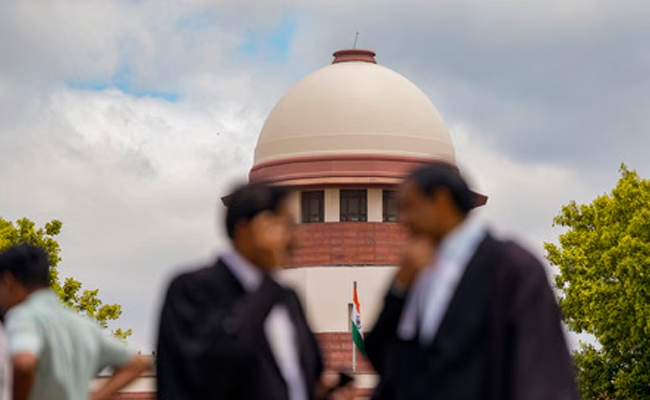
New Delhi (PTI): It will be court's opinion versus the legislative power to enact law, the Supreme Court on Wednesday said as it posted the pleas challenging the appointment of the chief election commissioner and election commissioners under the 2023 law on February 4.
A bench of Justices Surya Kant, Dipankar Datta and Ujjal Bhuyan was informed by advocate Prashant Bhushan, representing an NGO, the incumbent Chief Election Commissioner (CEC) Rajiv Kumar was set to superannuate on February 18, and a new CEC would be appointed under the new law, if the court didn't intervene.
Bhushan said the top court in its the March 2 2023 verdict set up a panel comprising the Prime Minister, the Leader of Opposition and the CJI to appoint the CEC and election commissioners (EC).
"However, under the new law the selection committee will comprise the Prime Minister, a union cabinet minister, the Leader of Opposition or the leader of the largest opposition party in Lok Sabha. They have removed CJI from the selection committee," submitted Bhushan.
While posting the hearing on February 4, the bench said it would see whose views had supremacy.
"It will be the opinion of the court under Article 141 versus legislative power to enact law," it underscored.
Senior advocate Gopal Sankaranarayanan, appearing for one of the petitioners, said the government did not remove the basis of the March 2, 2023 judgement, and enacted a new law.
Bhushan said the government couldn't control the appointment of election commissioners as it would be a threat to democracy.
"We are of the view that the government cannot remove the CJI from the selection panel which was directed to be formed by the Supreme Court on March 2, 2023," he said.
Sankaranarayanan said the only way the Centre could have got around the judgement was by amending the Constitution and not enacting a law.
The bench asked Bhushan and Sankaranarayanan to remind the judges on February 3 for the matter to be taken up the following day.
On March 15, 2024, the top court refused to stay the appointments of new ECs under a 2023 law which excluded the CJI from the selection panel and deferred the hearing on a batch of pleas challenging the appointments.
The top court told the petitioners the March 2, 2023 verdict directed for the three-member panel comprising the Prime Minister, Leader of Opposition and the CJI to operate till Parliament enacted a law.
Bhushan, who appeared for the petitioner Association for Democratic Reforms (ADR), challenged the CJI's exclusion and contended the Election Commission should be insulated from "political" and "executive interference" for maintaining a healthy democracy.
ADR's plea alleged the verdict was overruled by the Centre without removing its basis and the composition of the selection committee under the new law which amounted to excessive interference of the executive in the appointments and was detrimental to the independence of the poll panel.
Former IAS officers Gyanesh Kumar and Sukhbir Sandhu were recommended to be appointed as ECs in 2024 by a selection panel chaired by Prime Minister Narendra Modi under the new law.
The NGO challenged the validity and sought a stay on the operation of Section 7 of the Chief Election Commissioner and Other Election Commissioners Act, 2023, which excluded the CJI.
The apex court's March 2, 2023 verdict held leaving the appointment of the ECs and CEC in the hands of the executive would be detrimental to the health of the country's democracy and the holding of free and fair elections, it said.
Another petitioner, Congress leader Jaya Thakur from Madhya Pradesh, sought to restrain the Centre from appointing new ECs under the 2023 law while challenging its provisions.
The Constitution bench on March 2, 2023, ruled, "As far as appointments to the posts of chief election commissioner and election commissioners are concerned, the same shall be done by the president of India on the basis of the advice tendered by a committee consisting of the Prime Minister of India, the Leader of Opposition in the Lok Sabha and, in case there is no such leader, the leader of the largest party in the opposition in the Lok Sabha and the chief justice of India."
"This norm will continue to hold good till a law is made by Parliament," it further held.
Let the Truth be known. If you read VB and like VB, please be a VB Supporter and Help us deliver the Truth to one and all.
Bengaluru jail introduces biometric tracking system for prisoners

Bengaluru: In a bid to curb misconduct and illegal activities inside Parappana Agrahara Central Prison, prison authorities have introduced a new ‘Prisoners Tracking Movement System’ under which inmates will have to undergo biometric verification while entering every barrack.
According to jail officials, biometric systems have been installed across all major sections of the prison, including barracks, visitor rooms, hospital, canteen, kitchen, library, playground, handicraft units and bakery sections. Staff members have also been deployed at these locations.
Officials said inmates visiting the visitors’ room must now obtain a digital token after biometric verification. Details such as the prisoner’s name, identification number and entry time will be updated in the prison software system. This will help authorities maintain a complete digital record of inmates visiting and returning from meeting rooms.
Similar systems have also been introduced at entry points of the hospital, library and other barracks accessed for work-related purposes. Officials said the system will help identify prisoners involved in suspicious or illegal activities with other inmates and enable authorities to track how much time a prisoner spends at different locations inside the prison.
Authorities stated that AI-powered cameras were already being used inside the prison to monitor inmates as well as prison staff. Along with this, digital tracking of prisoner phone calls and a digital token system for visitor meetings have now been added to strengthen surveillance over inmate movement. Officials said the project has been implemented at a cost of around Rs 2.25 crore.
The prison department has also introduced a canteen usage tracking system to monitor prisoners’ spending patterns. Instead of direct cash payments, inmates can purchase bakery items and snacks using wallets or coupons issued within the prison system.
Officials said the digital system will record details including the buyer’s name, items purchased, quantity, date, time and remaining wallet balance. This will allow prison authorities to maintain complete expenditure records of inmates.