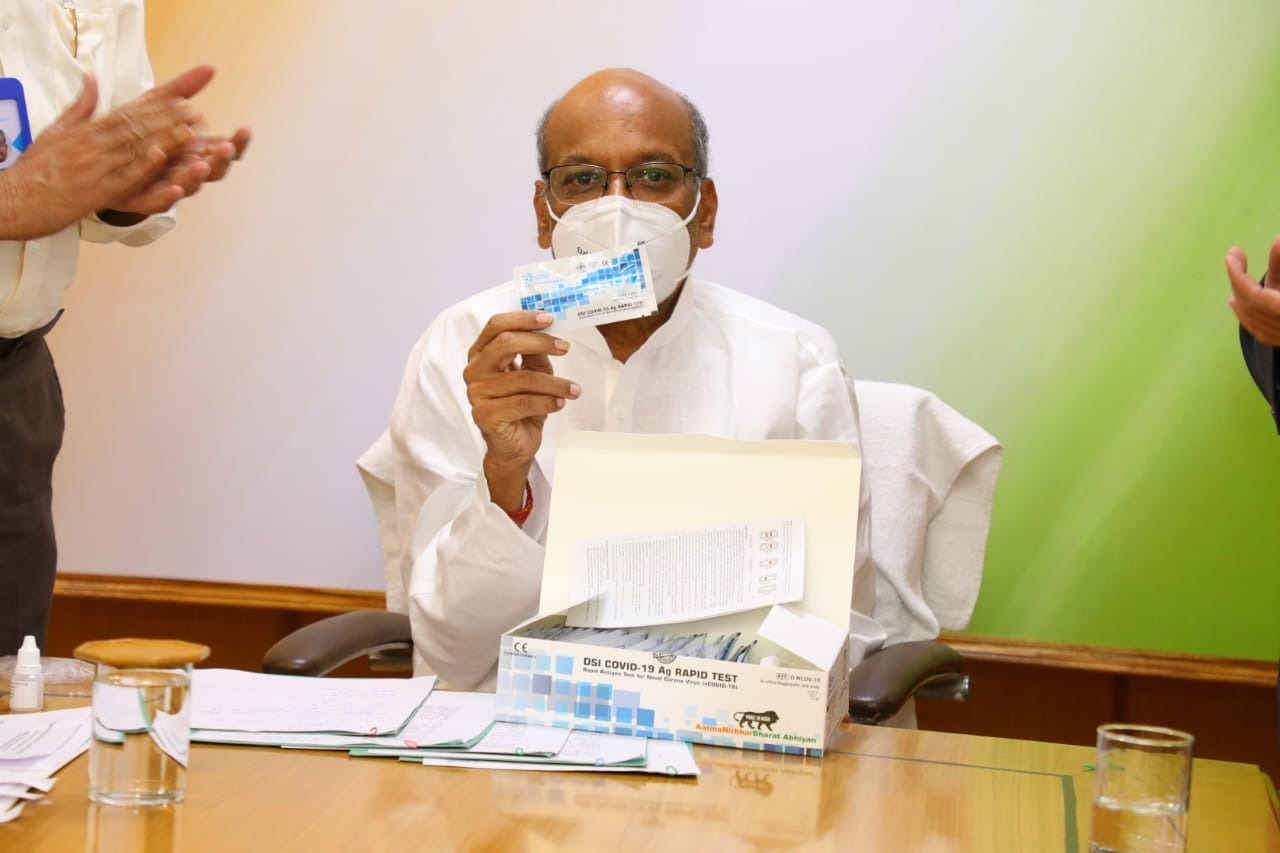
New Delhi, June 25: The Indian Institute of Technology (IIT), Delhi has come up with a rapid antigen test kit for Covid which is priced at Rs 50 and gives results within five minutes.
The ICMR approved test kit was launched by Union Minister of State for Education Sanjay Dhotre on Friday.
"I am confident that this technology will revolutionize the Covid test availability in the country. I am glad to know that the kit has been developed entirely using the internal resources at IIT-Delhi," Dhotre said during the launch.
The technology behind the test has been patented by IIT-Delhi. Professor Harpal Singh and his team from the Centre for Biomedical Engineering at the institute have developed the technology.
"This kit is used for in vitro qualitative detection of SARS-CoV-2 antigen meant for the qualitative determination in human nasal swabs, throat swabs and deep sputum samples. It is suitable for general population screening and diagnosis of COVID-19, Singh said.
"The identification is based on the monoclonal antibodies specific for the Coronavirus antigen. The results obtained are qualitative based and can be inferred visually with naked eye," he said.
The professor explained that the test is found to be suitable for early Ct values (Ct values between 14 to 32) with 90 per cent sensitivity, 100 per cent specificity and 98.99 pc accuracy.
The IIT has awarded licenses to two companies in the country for its commercial roll out.
Hon'ble Minister of State for Education Shri Sanjay Dhotre launched a Rapid Antigen Test kit for COVID-19 developed by IIT Delhi today.
— IIT Delhi (@iitdelhi) June 25, 2021
Read more: https://t.co/RMgX5x92nz pic.twitter.com/Ylgb92pTOD
Let the Truth be known. If you read VB and like VB, please be a VB Supporter and Help us deliver the Truth to one and all.
By Suman Rodrigues & Ismail Zaurez
Shiroor, Udupi: The Ministry of Road Transport and Highways had made it clear as far back as 1996. An order was issued by the ministry in 2016 that all speed breakers put up by local authorities on national highways must be removed. A similar order was again issued in 2021. The reason was simple. National highways are meant to allow smooth, uninterrupted movement of vehicles at higher speeds, and unscientific humps turn them into accident zones. Since then, the ministry has repeated this direction several times. Yet, nearly a decade later, the same warning appears to have been ignored on National Highway-66 in Udupi district.
At Shiroor Pette on the Byndoor–Karwar stretch of NH-66, the violation is hard to miss. Motorists encounter a sudden and poorly designed speed humps with on both sides of the highway, there are no reflectors installed, and no advance markings in place. A raised patch of road appears out of nowhere on a national highway where vehicles are legally moving at around 80 kmph. The danger increases at night, as this stretch has no streetlights, a problem seen across several National Highway sections along Karnataka’s coastline, where long patches remain unlit.
For those driving along the coast, the experience is jarring. One moment the road is smooth, the next the vehicle hits a hump so abrupt that drivers are forced to slam brakes or lose control. Motorists travelling regularly on this stretch say this is not an isolated issue but a pattern, with Shiroor emerging as a prime example of how unsafe interventions are creeping onto the national highway.
The concern is not just inconvenience. It is about safety. Rules framed by the Ministry of Road Transport and Highways clearly prohibit speed breakers on national highways. The ministry’s policy states that humps are a safety hazard and defeat the purpose of a high-speed corridor. Where speed control is unavoidable, such as at junctions or accident-prone locations, the prescribed alternative is properly designed rumble strips, not humps.
Despite this, NH-66 in Udupi has seen the appearance of multiple humps. At Gangoli Cross near Kundapura, there are three sets of four humps within a distance of just ten metres. What makes the situation more glaring is that similar stretches of NH-66 in neighbouring Dakshina Kannada and Uttara Kannada districts do not have such humps. The difference is not the highway. It is the administration.
When Vartha Bharati contacted officials linked to highway management and local administration, the response was a familiar one. Denial, deflection, and passing the blame.
The Project Director of the Honnavar Project Implementation Unit, Shivakumar said the humps were put up by the local police station after being identified as accident-prone spots by the Road Safety Committee, which is chaired by the Deputy Commissioner. He said humps are not allowed on national highways but claimed temporary measures may be taken in areas with repeated accidents. He added that if the humps were found hazardous or unscientific, they would be removed.
He also said MP Kota Srinivas Poojary had called and requested that the humps be implemented, and that after a letter from the police, permission is sought from safety consultants of the National Highways Authority of India. According to him, this was only a temporary safety measure.
However, the local police station flatly denied erecting the humps. The Byndoor Circle Inspector Shivakumar B, said the police only identify blackspots based on set criteria and do not construct humps. According to him, decisions on what action to take are left to the road safety committee.
Udupi Superintendent of Police Hariram Shankar said the matter would be conveyed to the highway authority. He stated that police generally suggest rumble strips and that in extreme accident cases, civil engineers of NHAI decide on measures, including humps.
An official at the Shiroor toll plaza that is barely a couple of kilometers from these humps said the humps had been erected about a month ago after an autorickshaw driver died at the spot in an accident.
When the Project Director was again asked whether any letter had been received from the Deputy Commissioner or other authorities directing the erection of humps, he said no such letter had come and asked this reporter to check with IRB.
Manoj Naik, an official of IRB Infrastructure Developers Ltd, which operates the Karwar–Kundapura stretch under a Build-Operate-Transfer contract, said the humps were erected following instructions from the police. He said the location had been marked as a blackspot.
When asked who permitted the humps, he said they would add bitumen, paint markings and install cat’s eyes, and that the hump would then be “fine”. He said the Deputy Commissioner’s office had asked for barricades and a hump, even though MoRTH rules do not allow humps on national highways.
More seriously, he alleged that the company was pressured to put them up. He said they were told that cases would be registered against them if accidents continued. According to him, these instructions were oral, while the official letters only spoke about “safety measures”.
When asked about the absence of reflectors and warning signs, he said they would be added later. He also blamed motorists, especially truck drivers, for overspeeding, and said even those who built the road found it difficult to cross because of speeding vehicles.
However, letters accessed by Vartha Bharati tell a different story. The communication from the Deputy Commissioner’s office to NHAI and IRB does not mention humps at all. It only asks for safety measures, including rumble strips. A letter from Theme Engineering Services Pvt. Ltd., the consultancy agency appointed as the Independent Engineer for consultancy services during the Operation and Maintenance of the stretch of the highway, states that safety measures had already been provided at the location.
When asked why these “measures” included humps, which are not permitted on national highways, officials from the consultancy avoided calls seeking clarification.
When contacted, Udupi Deputy Commissioner Swaroopa T.K. was completely unaware of the humps that were erected on the national highway supposedly by the committee that is chaired by her. She however, said the issue will be reviewed in the next road safety committee meeting.
“We will look into that. After removing the hump, as per NHAI codes, we will take appropriate action in this regard,” she added.
What emerges clearly is not a safety plan but a blame game. Every authority points fingers at another. No one takes responsibility. No one produces a clear written order authorising the humps.
This is despite clear guidelines and repeated judicial directions. Based on MoRTH policy and directions arising from road safety proceedings, including those monitored by the Supreme Court of India, speed breakers on national highways are strictly prohibited. The policy mandates removal of unscientific and unauthorised humps and requires that any rumble strips must be approved by the Chief Engineer or authorised officer of NHAI or NHIDCL, and must comply with Indian Road Congress standards. Even in recent years, the Supreme Court has continued to push for strict enforcement of these norms.
In the rush to show action after accidents, authorities in Shiroor appear to have created a new danger. A sudden hump on a high-speed highway does not just threaten motorists. When drivers lose control after hitting an unexpected obstacle, vehicles often swerve towards the very spot where pedestrians wait to cross.
What this really means is simple. In the name of pedestrian safety, an already risky stretch has been made more dangerous for everyone. Until accountability is fixed and rules are followed, NH-66 in Udupi will remain a highway where safety decisions are made in haste, without science, and without anyone willing to own them.