COVID-19 second wave in India may peak by mid-April, say scientists

New Delhi: Scientists have predicted using a mathematical model that the ongoing second-wave of COVID-19 pandemic across the country could peak by mid-April, following which the infections may see a steep decline by the end of May.
During the first wave of COVID-19 infections across India, the mathematical approach, named SUTRA, predicted that the initial surge of infections in August would peak by September and lower in February 2021.
Scientists, including Manindra Agrawal from Indian Institute of Technology (IIT) Kanpur, applied the model to predict the trajectory of the current surge in infections and found that the number of daily new infections is likely to peak in mid-April for this ongoing pandemic wave.
"For the last several days, we have found that there is a reasonable chance that the cases in India could peak sometime between 15-20 April. It is a sharp slope, but on the way down, it would likely be equally sharp, coming down very fast and by end of May may see a dramatic reduction," Agrawal told PTI.
"There is some uncertainty in predicting the peak value of daily new infections because of the sharp rise. Currently, it is coming to 1 lakh infections per day, but this can go up or down. But the timing remains the same between April 15-20," he added.
The scientists predict that in the current wave, the first state to peak could be Punjab in a few days, followed by Maharashtra.
However, the IIT Kanpur professor added that the model's prediction of the new peak is sensitive to the daily new infections data.
"Even a little bit of change each day causes the peak numbers to change by several thousand numbers. But the location of the peak has remained on mid-April," he added.
Independent calculations made by scientists, including Gautam Menon from Ashoka University in Haryana, have also predicted that the peak of the ongoing wave of infections could be between mid-April and mid-May.
However, Menon cautioned that such projections of COVID-19 cases should really be trusted only in the short term.
"Any excessively precise prediction, of a peak within just a 5-day window, would ignore the many uncertainties associated with the inputs to any such calculation," Menon, who was not involved in the SUTRA modelling, told PTI.
Agrawal noted that the model uses three main parameters to predict the course of the pandemic.
"The first is called Beta, or contact rate, which measures how many people an infected person infects per day. It is related to the R-naught value, which is the number of people an infected person spreads the virus to over the course of their infection," Agrawal explained.
The other two parameters, he explained are 'Reach', which is a measure of exposure level of the population to the pandemic, and 'Epsilon' which is the ratio of detected and undetected cases.
"The reason we had to introduce 'Reach' is that unlike earlier pandemics which start at a location and suddenly spread fast across a place, in COVID, the spread of the pandemic has been slower due to the many protective measures in place," Agrawal explained.
The mathematician said 'Epsilon' helps factor in the number of asymptomatic infections across the country.
"Since the detected cases are quarantined, we assume they no longer contribute to new infections. So a growing number of daily new cases, reflect larger undetected infections. By measuring the number of new cases each day, we try to estimate the undetected and asymptomatic infections," Agrawal explained.
He added that the model relies on inputs from daily reported new infections, based on which the value of the three main parameters are inferred.
"We learn everything from the daily-infections data. The beta value across India has gone up by 50 per cent in March, which indicates that a combination of factors -- people becoming more relaxed, and more infectious variants going around. But precisely what reason this could be is something biologists have to say," the scientist noted.
While the model did not previously predict a second-wave in India, he said it could have been due to a change in the parameters sometime between February and March 2021.
"So clearly during this time some parameters had changed. So we had to wait for some time to collect new data and see how the parameters had changed, which we now know," Agrawal said.
On Friday, India recorded 81,466 new infections in a span of 24 hours -- the highest single-day rise in cases since October 2, 2020 -- taking the COVID-19 tally of cases to 1,23,03,131, according to the Union Health Ministry data.
Let the Truth be known. If you read VB and like VB, please be a VB Supporter and Help us deliver the Truth to one and all.
CM Siddaramaiah alleges ‘criminal conspiracy’ in Sringeri recount, vows legal action
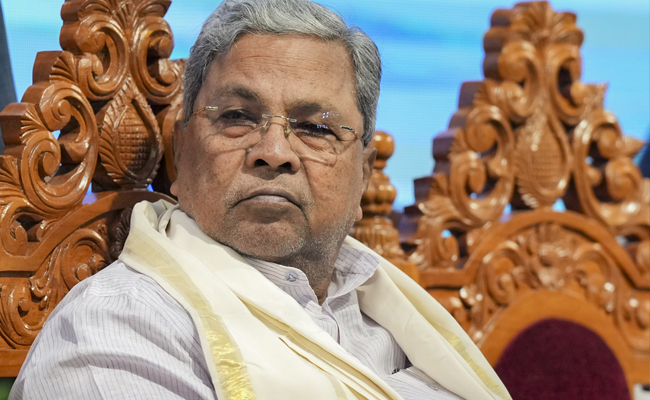
Bengaluru (PTI): Alleging a “criminal conspiracy” by BJP candidate D N Jeevaraj in the Sringeri Assembly poll recounting, Karnataka CM Siddaramaiah on Tuesday said the outcome was manipulated after valid postal ballot votes in favour of Congress leader T D Raje Gowda were tampered with during the recounting process.
Following a Karnataka High Court order on an election petition filed by Jeevaraj, challenging Raje Gowda’s election, the reverification and recounting were conducted on Saturday.
After the reverification and recount of postal ballots for the Sringeri Assembly constituency, votes polled in favour of Raje Gowda were reduced by 255, the returning officer said.
A report on the matter has been submitted to the Election Commission of India for further action, the officer added.
Congress leader Raje Gowda had won the 2023 Assembly polls from Sringeri by 201 votes, defeating his nearest rival Jeevaraj.
Addressing a press conference in Bengaluru, Siddaramaiah said the High Court had directed the recounting of postal ballots and that irregularities were noticed during the exercise conducted on May 2.
“This is a clear case of criminal conspiracy,” Siddaramaiah said, alleging that valid votes cast in favour of Raje Gowda were altered after being accepted by counting agents of all parties, including Congress, BJP, and JD(S).
He claimed that during the recounting of postal ballots, 255 votes were initially accepted as valid by all agents but were later tampered with by subordinate officials.
“There is a second mark on the votes polled in favour of Raje Gowda. They had accepted these as valid votes. Subsequently, another mark was made by officials. This is a clear case of criminal conspiracy,” he said.
When asked who was behind the alleged conspiracy, the CM replied, “It was hatched by Jeevaraj and others. It is planned.”
Siddaramaiah further alleged that the returning officer acted improperly by declaring the result despite the presence of an Election Commission observer during the recounting.
“Immediately after the counting, the returning officer announced the result. He should not have done so; this is against the law,” he said.
He pointed out that Raje Gowda had originally won by 201 votes, but after the recounting, the BJP candidate was declared the winner by 52 votes.
“The BJP has committed a criminal act of conspiracy. This is not vote chori but vote dacoity,” he alleged.
The CM said a police complaint had already been filed by Raje Gowda’s election agent, Sudhir Kumar, and emphasised the need for electoral integrity.
“We want transparency and free and fair elections. That is what our Constitution mandates,” he added.
Stating that the government would pursue legal remedies, Siddaramaiah said, “We are preparing an appeal challenging the returning officer’s announcement in a court of law.”
Responding to a separate query on elections in other states, the CM said there appeared to be an anti-incumbency factor in West Bengal, while results in Tamil Nadu were “surprising,” adding that Vijay’s party was emerging as the largest there.
Following the victory of party candidates in Bagalkote and Davanagere South, Siddaramaiah expressed confidence about future electoral prospects in Karnataka.
“Even in 2028, we will win the Assembly elections. We will come back,” the CM said.
Siddaramaiah added that he would order a forensic examination into the alleged tampering of postal ballots.