Covishield, Covaxin combination brings better immunogenicity than 2 doses of same vaccine: Study

New Delhi, Aug 8: A study by ICMR involving 98 people, 18 of whom had inadvertently received Covishield as first dose and Covaxin as the second in Uttar Pradesh, showed that combining these two COVID-19 vaccines elicited better immunogenicity than two doses of the same vaccine.
The study also found that immunisation with combination of Covishield and Covaxin was safe and the adverse effects were also found to be similar when compared to the same dose regimen.
The study titled Serendipitous COVID-19 Vaccine-Mix in Uttar Pradesh, India: Safety and Immunogenicity Assessment of a Heterologous Regime' has been uploaded on medRxiv, a preprint server and is yet to be peer reviewed.
"To the best of our knowledge, this is the first study which reports the effects of heterologous prime-boost vaccination with an adenovirus vectored vaccine followed by an inactivated whole virus vaccine," the researchers said.
The immunisation program against COVID-19 in India started with two vaccines--adenovirus vector platform-based vaccine Covishield and inactivated whole virion BBV152 -Covaxin--and homologous prime-boost approach was followed. However, 18 individuals, under the national program, in Siddarthnagar, Uttar Pradesh inadvertently received Covishield as the first jab and Covaxin as the second.
The nationwide vaccination program at this time had entered in its fourth month of its existence and the event of mixed dosing raised considerable anxiety in public domain with a potential to contributing to vaccine hesitancy.
The study was conducted against this backdrop.
So, including these 18 individuals who had received one dose of Covishield and second dose of Covaxin, 40 recipients of two doses of Covishield and 40 recipients of two doses of Covaxin, were recruited in the study. The study duration was from May to June 2021.
"We compared the safety and immunogenicity profile of them (18 individuals) against that of those receiving either Covishield or Covaxin. Lower and similar adverse events following immunisation in all three groups underlined the safety of the combination vaccine-regime.
"Immunogenicity profile against Alpha, Beta and Delta variants in the heterologous group was superior and IgG antibody and neutralising antibody response of the participants was also significantly higher compared to that in the homologous groups," the study stated.
"The findings suggest that immunisation with a combination of an adenovirus vector platform-based vaccine followed by an inactivated whole virus vaccine was not only safe but also elicited better immunogenicity," it said.
The reactogenicity analysis was carried out based on solicited local and systemic AEFIs reported in the three groups within seven days of immunisation. None of the participants enrolled in the study had any serious AEFI within 30 minutes of immunisation with the first or second dose.
The most common local AEFI reported after first and second dose was pain at injection site.
No other local AEFI such as erythema, induration, pruritis or pustule formation was recorded by any of the participants. Most commonly reported systemic AEFI were pyrexia and malaise.
No other systemic AEFIs like urticaria, nausea, vomiting, arthralgia or cough was reported. The pyrexia was of low to moderate grade and was managed by administration of paracetamol and subsided in all participants within three to four days post vaccination, according to the study.
"Despite the high median age of the participants of the heterologous group (62 years) in our study, the reactogenicity profile demonstrated that mixing of the two vaccines based on different platforms is safe," the study said.
The study demonstrates that immunisation with a heterologous combination of an adenovirus vector platform-based vaccine followed by an inactivated whole virus vaccine is safe and elicits better immunogenicity than two doses of homologous vaccination, using the same vaccines.
These findings have an important implication for the COVID-19 vaccination program wherein heterologous immunisation will pave the way for induction of improved and better protection against the variant strains of SARS-CoV-2.
Such mixed regimens will also help to overcome the challenges of shortfall of particular vaccines and remove hesitancy around vaccines in people's mind that could have genesis in programmatic 'errors' especially in settings where multiple COVID-19 vaccines are being used, the study highlighted.
However, to conclusively prove these findings a multicentre RCT needs to be carried out, the study underlined.
Let the Truth be known. If you read VB and like VB, please be a VB Supporter and Help us deliver the Truth to one and all.
Trump says EU has until July 4 to approve last year's trade deal or it will face higher tariffs
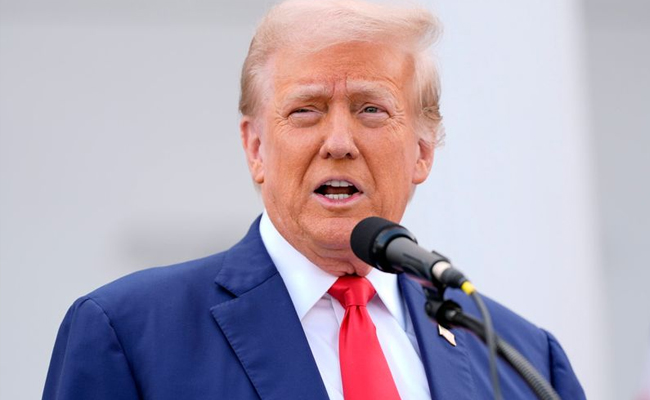
Washington (AP): President Donald Trump has said in a social media post that goods from the European Union would face higher tariff rates if the 27-member bloc fails to approve last year's trade framework by July 4.
The announcement on Thursday appeared to be a deadline extension after the president said last Friday that EU autos would face a higher 25 per cent tariff starting this week. Trump made the updated announcement after what he described as a "great call" with European Commission President Ursula von der Leyen.
Still, the US president was displeased that the European Parliament had yet to finalize the trade arrangement reached last year, which was further complicated in February by the US Supreme Court ruling that Trump lacked the legal authority to declare an economic emergency to impose the initial tariffs used to pressure the EU into talks.
"A promise was made that the EU would deliver their side of the Deal and, as per Agreement, cut their Tariffs to ZERO!" Trump posted. "I agreed to give her until our Country's 250th Birthday or, unfortunately, their Tariffs would immediately jump to much higher levels."
It was unclear from the post whether Trump was implying that the tariff rates would jump on all EU goods or the increase would only apply to autos.
His latest statement indicates he might be backing away from his earlier threat on EU autos by giving the European Parliament several more weeks to approve the agreement.
Under the original terms of the framework, the US would charge a 15 per cent tax on most goods imported from the EU.
But since the Supreme Court ruling, the administration has levied a 10 per cent tariff while investigating trade imbalances and national security issues, aiming to put in new tariffs to make up for lost revenues.