CPI(M) declines to label Modi Government as 'neo-fascist,' diverges from other left parties
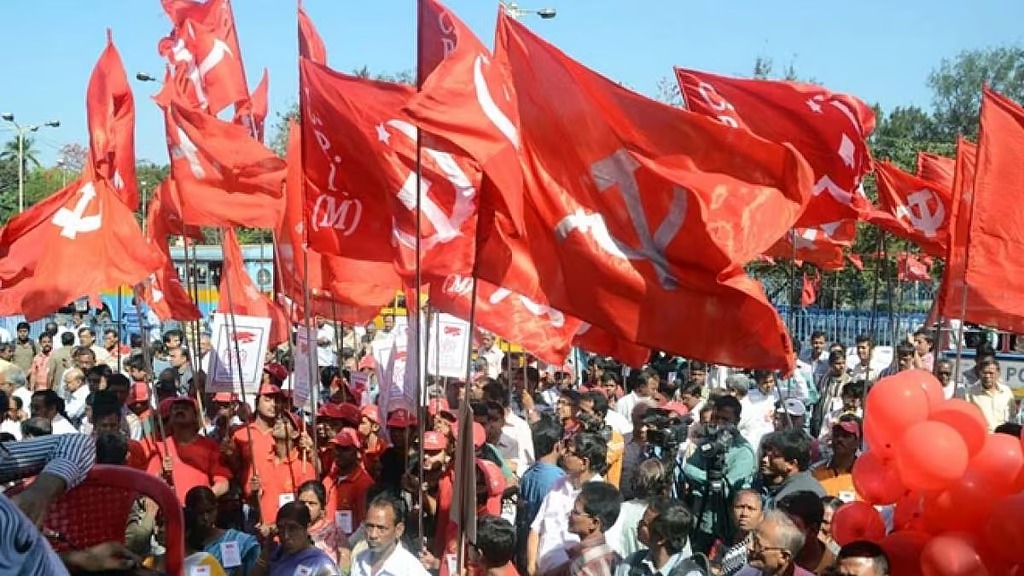
New Delhi: The Communist Party of India (Marxist) [CPI(M)] has clarified that it does not consider the Narendra Modi-led government or the Indian state as "fascist" or "neo-fascist," diverging from the positions of other Left parties like the Communist Party of India (CPI) and Communist Party of India (Marxist-Leninist) Liberation [CPI(ML)L].
In a note circulated among its state units ahead of its 24th Party Congress in April, the CPI(M) emphasized that while the Bharatiya Janata Party (BJP)-Rashtriya Swayamsevak Sangh (RSS) regime exhibits "neo-fascist characteristics", the political setup under Prime Minister Modi has not fully developed into a neo-fascist system.
Key differentiation from other left parties
The CPI, in contrast, has labeled the Modi government as a "fascist government", while CPI(ML)L claims that "Indian fascism" has already been established under BJP rule. This divergence from other leftist groups could lead to significant debate within the CPI(M), particularly as it prepares its strategy for the upcoming elections and alliances.
Hindutva corporate authoritarianism
The CPI(M) draft resolution warns of the "danger of Hindutva corporate authoritarianism" potentially evolving into neo-fascism if the BJP-RSS alliance remains unchecked. The party’s note describes the BJP as the "political front of the fascistic RSS" but stops short of categorizing the Indian state or government as fascist.
The leadership clarifies that while the BJP has consolidated political power over a decade of continuous rule, this has led only to the manifestation of "neo-fascist characteristics" rather than a fully developed neo-fascist government.
Internal debates and historical stances
The CPI(M) has faced internal debates over this characterisation. Former General Secretary Sitaram Yechury had previously described the BJP-RSS regime as "fascistic", while current Polit Bureau coordinator Prakash Karat argues that the regime should be described as "authoritarian" instead.
In previous political resolutions, the CPI(M) acknowledged the rise of "emerging fascistic trends" (2018) and described the Modi government as advancing the "fascistic agenda of the RSS" (2022). However, the current resolution marks the first official usage of the term "neo-fascist" by the party.
Distinction between classical fascism and neo-fascism
The party’s note distinguishes between classical fascism, which arose during the imperialist era, and neo-fascism, which has developed within neoliberal political frameworks. Unlike classical fascist regimes that rejected electoral systems, neo-fascist regimes participate in democratic elections while using authoritarian means to suppress opposition and subtly alter state structures from within.
Implications for alliances
Sources suggest that this nuanced stance could influence the CPI(M)’s political strategy, particularly its relationship with the Indian National Congress in the broader fight against the BJP. The outcome of the 24th Party Congress may set the tone for future opposition alliances ahead of the upcoming elections.
Let the Truth be known. If you read VB and like VB, please be a VB Supporter and Help us deliver the Truth to one and all.
No 'bacterial infection' found in bodies of 4 Mumbai family members who died after eating watermelon
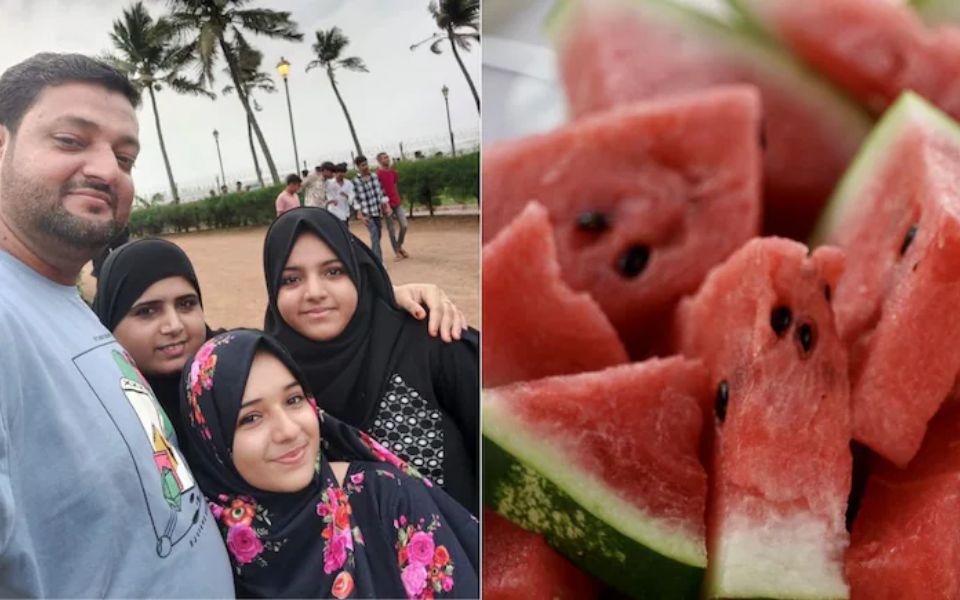
Mumbai (PTI): The initial report submitted by the microbiology department of a Mumbai-based state-run hospital has said no "bacterial infection" was detected in the bodies of four family members, who died after consuming watermelon recently, officials said on Wednesday.
The Dokadia family, residents of Ghari Mohalla on Ismail Kurte Road, had hosted a get-together of relatives on the night of April 25. At around 1 am (on April 26), hours after the guests had left, Abdullah Dokadia (40), his wife Nasreen (35), and daughters Ayesha (16) and Zaineb (13) ate pieces of a watermelon.
They suffered severe bouts of vomiting and diarrhoea in the early hours of April 26 and were rushed to a local hospital before being referred to the government-run J J Hospital where all four died during treatment.
After the incident, Mumbai police, forensic experts and Food and Drug Administration (FDA) officials visited the house and had collected samples of every food item that constituted the family's last meal, including 'chicken pulav', watermelon, water, and other foodstuffs, and sent them to the Forensic Science Laboratory for analysis.
After the post-mortem of the deceased, their viscera was preserved for chemical analysis.
As the probe is underway, the microbiology department of the state-run J J Hospital has submitted its initial report to the police.
"As per the report, no bacterial infection has been detected so far in the bodies of the victims. No bacteria was found in their blood," the official said.
The exact cause of the death will be known once the forensic science lab submits its report, he said.
"The report will also clarify whether any food items consumed by the family members during the day contained anything poisonous," the official said.