Crackdown on child marriage, proposed law to end major highlights in 2023
Guwahati (PTI): A crackdown on child marriage with most arrests made in minority-dominated districts, an initiative to enact a law in the assembly to end the practice of polygamy and a socio-economic survey of five indigenous Muslim communities dominated the headlines in Assam in 2023.
Chief Minister Himanta Biswa Sarma's initiatives kept him in the limelight, with him being the key campaigner for the BJP in the states that went to elections, as he pushed the party's core political agenda emphatically while continuing to consolidate its base among the majority indigenous population in his state.
The Assam government's crackdown, in two phases, on child marriage in February and October led to nearly 5,500 arrests, mostly in districts dominated by the minority community, with Sarma claiming that the social menace would be completely eliminated by 2026 and all gram panchayat secretaries would be designated as child marriage prevention officers.
Opposition parties, however, maintained that child marriage cannot be forcibly stopped by police intervention but would need a sustained campaign, involving all stakeholders.
Sarma asserted that maternal mortalities have decreased by over 33 per cent and child deaths by nearly 15 per cent in the state since the launch of the crackdown.
The state government also planned to bring a law to ban the practice of polygamy among Muslims as during the crackdown, it was found that many elderly men had married multiple times and their wives were mostly young women belonging to the poorer sections of the society.
Asserting that child marriage cannot be tackled completely unless there was a ban on polygamy, the government constituted a four-member expert committee of legal luminaries to scrutinise the legality of banning polygamy in the state by the assembly.
The committee scrutinised the provisions of the Muslim Personal Law (Shariat) Act, 1937 along with Article 25 of the Constitution in relation to the Directive Principles of State Policy for a Uniform Civil Code.
The panel unanimously agreed that the state can frame its own laws to end polygamy but the assent on the Bill has to be given by the President instead of the governor, who usually gives the final signature on state laws.
The opposition parties, however, slammed the government's plans to enact a law on polygamy, describing it as a diversionary and communal move and alleged that the ruling BJP was carrying forward its agenda against the minority community.
The chief minister, on the other hand, countered the opposition's allegations, stating that it is his government that has taken steps to improve the conditions of Muslims from both indigenous Assamese and Bengali-speaking communities.
He said that as a first step, a socio-economic survey of the state's five indigenous Muslim communities -- Goria, Moria, Deshi, Syed and Jolha -- will be conducted and its findings will guide the state government to take suitable measures for the comprehensive socio-political and educational uplift of the indigenous minorities.
Sarma said that for the remaining Muslims of migrant-origin, the state government has also taken steps to stop child marriage, along with setting up new schools, colleges and health institutions and improved connectivity to their habitations, besides ensuring electrification.
Another major development in the state during the year was the delimitation exercise carried out by the Election Commission of India, based on the 2001 Census, with the final report published on August 11, keeping intact the number of assembly constituencies at 126 and Lok Sabha seats at 14, while revising the nomenclature of one parliamentary and 19 assembly constituencies.
Altogether 19 assembly and two Lok Sabha constituencies have been reserved for Scheduled Tribes (STs), while one Lok Sabha and nine assembly constituencies have been reserved for Scheduled Castes (SCs).
Sarma claimed that the insurgency problem in the state was "almost finished" with the signing of peace accords with different militant outfits dominated by Bodo, Karbi and Dimasa tribes along with different Adivasi organisations while talks were also in progress with the pro-peace faction of ULFA and Kuki and Hmar groups.
The chief minister had sent out an olive branch to the anti-talk ULFA (Independent) faction on assuming office and the outfit responded by declaring a ceasefire, but recently it carried out three blasts in Tinsukia, Sivasagar and Jorhat which the insurgent group claimed was in response to the "arrogant" attitude of Director General of Police G P Singh.
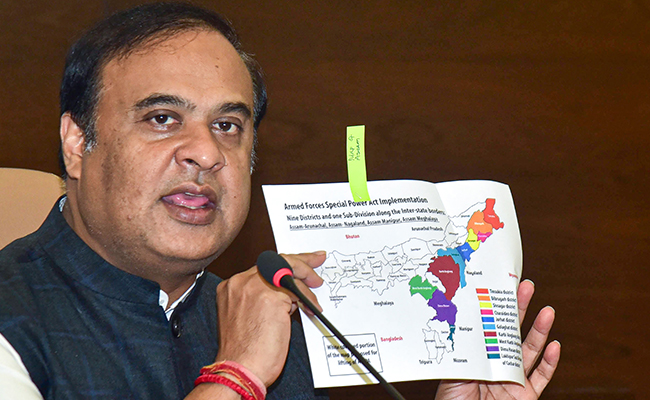
Sarma said that with the return of peace, stringent laws such as the Armed Forces (Special Powers) Act or AFSPA are being gradually withdrawn and are now in force in only four districts, namely Tinsukia, Dibrugarh, Charaideo and Sivasagar.
Assam, however, faced security concerns with Rohingya refugees from Myanmar reportedly using the state as a corridor to either go to Delhi or Jammu and Kashmir with the help of some brokers from Tripura. The Assam Police have arrested several persons, including a few Bangladesh nationals, for allegedly facilitating the movement of the Rohingyas.
Meanwhile, the crime rate in the state has decreased considerably with the total number of cognisable offences dipping by 48.26 per cent to nearly 69,000 cases in 2022, according to the latest report of the National Crime Records Bureau (NCRB).
Sarma claimed that strong and non-compromising policing along with development activities and providing jobs to the youth helped reduce the crime graph.
The state also created two Guinness World Records with over 11,304 dancers and drummers performing in the category of largest recital of Bihu dance and playing of 'Bihu dhol' at a single venue, with Prime Minister Narendra Modi also witnessing the performance.
The Assam government also received nine Guinness World Records certificates for a mega plantation drive in September and October under the 'Amrit Brikshya Andolan' campaign, with a total of 1,11,17,781 seedlings of commercially valuable tree species planted across the state on a single day on September 17.
Let the Truth be known. If you read VB and like VB, please be a VB Supporter and Help us deliver the Truth to one and all.
Putin meets Iran's FM Araghchi, says Russia ready to do its best to help bring peace to West Asia
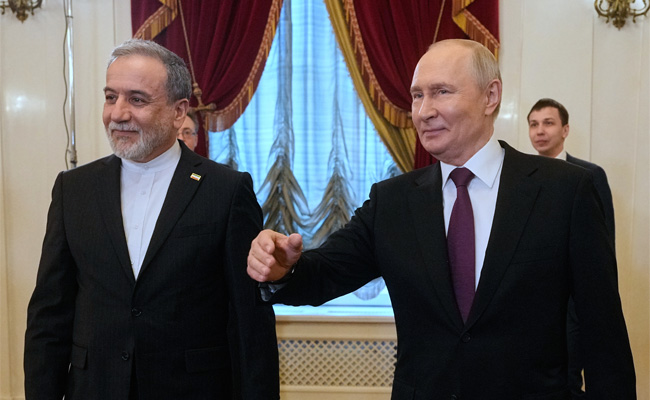
Moscow (PTI): Iran's Foreign Minister Abbas Araghchi on Monday met Russian President Vladimir Putin, who hailed the Iranian people for fighting bravely and heroically for their sovereignty and said Moscow is ready to do its best to help bring peace to West Asia as soon as possible.
Araghchi, who held talks with Omani and Pakistani leadership before arriving in Russia, met Putin in St. Petersburg and thanked him for supporting Iran, state-owned TASS news agency reported.
"Russia is ready to do everything in its power to ensure that peace in the Middle East is achieved as soon as possible," Putin said during his meeting with Araghchi, which was also attended by Russian Foreign Minister Sergey Lavrov.
Revealing that he received a message from Iranian Supreme Leader Mojtaba Khamenei last week, Putin asked Araghchi to convey his "gratitude for this message and best wishes for his health and well-being."
He praised the Iranian people for fighting "bravely and heroically" for their sovereignty, Iran's state-run PRESS TV reported.
"We really hope that, based on the courage and desire for independence, the Iranian people, under the guidance of the new leader, will weather this difficult period of trials and peace will come,” Putin said.
He also stressed that Russia “intends to maintain” its strategic relations with Iran.
Araghchi said that the world witnessed Iran’s strength in countering the US during the recent war, and that the Islamic Republic is a "stable and powerful establishment."
"With their courage, the Iranian people succeeded in resisting the US aggression and will be able to endure it,” he said.
He said that it became clear that Iran has “great friends and allies” like Russia, and conveyed “warmest greetings” from Supreme Leader Mojtaba Khamenei and President Masoud Pezeshkian to the Russian leader.
Araghchi said relations between Moscow and Tehran represent a “strategic partnership at the highest level” and will continue to develop "regardless of circumstances."
"We are grateful to you for the solid and strong positions in support of the Islamic Republic of Iran," he said.
Foreign Minister Lavrov said that the talks between President Putin and the Iranian Foreign Minister were "useful and constructive."
Kremlin Spokesman Dmitry Peskov later said that Russia is "ready to provide any good offices, any mediation services that are acceptable to the parties."
"We will be ready to do everything so that ultimately peace ensues, guaranteed peace, and that there is no return to hostilities," Peskov was quoted as saying by TASS.
He was asked how Moscow can assist in future negotiations on the Iranian settlement.
Araghchi arrived in Russia after his whirlwind trip to Islamabad, which, according to him, was “very productive” and involved “good consultations" with Pakistan's Army Chief Field Marshal Asim Munir, amid uncertainty over the second round of peace talks to resolve the war in West Asia.
"We held good consultations with our friends in Pakistan. The trip was successful. We assessed the outcome of our recent (meetings) and discussed in what direction and under what conditions talks can move on,” Araghchi said in a video posted on his Telegram channel upon his arrival in St Petersburg.
Referring to the second round of talks between the US and Iran to resolve the conflict in West Asia, Araghchi said: "Developments have taken place in the negotiations."
"Despite some progress in earlier rounds, the talks failed to reach their objectives due to the Americans' approach, the excessive demands they made, and the wrong approaches they adopted. Therefore, it was necessary to consult with our friends in Pakistan to review the latest situation,” Iran's official news agency IRNA quoted him as saying.
He said that the trip to Pakistan was a good opportunity to review developments related to the US-Israeli war against Iran, expressing confidence that “these consultations and coordination between the two countries will be highly significant.”
Araghchi arrived at St. Petersburg's Pulkovo Airport early Monday, where he was welcomed by Russian officials and Iran’s ambassador to Russia, Kazem Jalali, the report said.
The first round of peace talks between Iran and the US, held on April 11 and 12, failed to bring the desired result for the parties to the conflict.
The Iranian minister arrived in Islamabad for the second time on Sunday after a short visit to Oman, where he held talks with Sultan Haitham bin Tariq al-Said on security in the Strait of Hormuz and diplomatic efforts to end the Iran-US conflict.
After Araghchi left Pakistan for Oman on Saturday, President Donald Trump announced that US negotiators Steve Witkoff and Jared Kushner would no longer be going to Islamabad for talks with Iran, contending that Washington held all the cards on the matter.
Trump on Sunday reiterated that the US and Iranian officials can talk by phone for a peace solution to the conflict.
On Tuesday, Trump extended the two-week ceasefire with Iran indefinitely to give Tehran more time to prepare a unified proposal to end the war, just hours before the truce was set to expire.
The war began when the US and Israel jointly attacked Iran on February 28, killing Iranian Supreme Leader Ayatollah Ali Khamenei and several top commanders. The retaliation by the Islamic Republic extended the war to the entire Gulf region.