CRPF jawan gives blood to Naxal injured in Jharkhand encounter

Jamshedpur : Three CRPF personnel donated blood to help save the life of a woman Naxal, who was shot during an encounter in West Singhbhum district on February 14, a senior police officer said.
Superintendent of Police Chandan Kumar Jha said police had received specific information that around 24 Maoists, led by Kande Honhaga, the self-styled sub-zonal commander of the ultra group, had assembled to execute a "plan".
A team of security forces pooled from 174 and 60 battalions of the CRPF and the district police, headed by Additional Superintendent of Police (Ops) Manish Raman, rushed to the spot between Muffasil and Goilkera police stations of the district.
Not heeding the security forces' call for surrender, the Maoists triggered a landmine blast and started firing, Jha said.
The security personnel surrounded the jungle from two sides but the Maoists kept firing at them, forcing a retaliation. The Naxals made a hasty retreat, buckling under pressure, he said.
The security personnel then spotted a profusely bleeding woman during a search operation launched by them.
She had suffered a bullet wound on her left leg, he said, adding that she was rushed to Sonua Primary Health Centre before being shifted to Sadar Hospital, Chaibasa. The woman was later referred to M G M Hospital here for better treatment.
Raman said ASI Pankaj Sharma, Head Constable Bichitra Kumar Swain and Constable Birbahadur Yadav donated blood to help save her life.
In course of the search operation, the security personnel demolished a Naxal camp in the jungle and destroyed a large quantity of explosive materials, Jha said.
The police also seized 57 rounds of live cartridges of different bore, including 30, from the injured woman.
She told the police that around 25 Naxals led by Honhaga had gathered in the jungle to execute some plan and had taken her rifle away before escaping, he said.
Let the Truth be known. If you read VB and like VB, please be a VB Supporter and Help us deliver the Truth to one and all.
CPI(M) rebel Kunhikrishnan hopes for 5,000-vote win in Payyanur
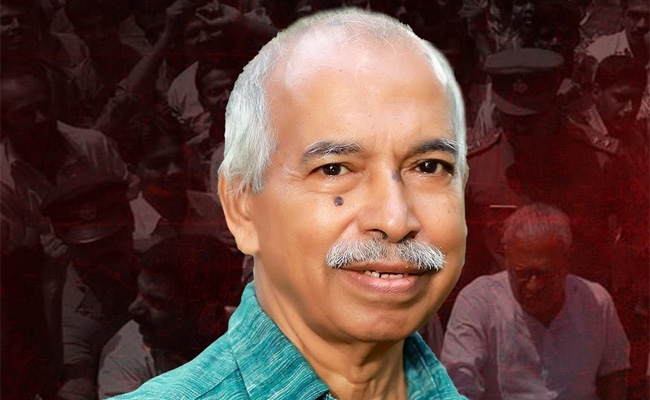
Kannur (Kerala) (PTI): CPI(M) rebel candidate V Kunhikrishnan, who contested as a UDF-backed Independent from Payyanur here, on Saturday said he was hoping to win the Assembly election by a margin of 5,000 votes.
Kunhikrishnan was expelled from the CPI(M) earlier this year after raising allegations of corruption in the party’s martyrs’ fund against sitting MLA T I Madhusoodanan.
Speaking to a TV channel, Kunhikrishnan said he had announced his candidature as a mark of protest and not with expectations of victory.
However, he said the situation had changed drastically, with a strong undercurrent within CPI(M) votes favouring him.
"The undercurrent in CPI(M) votes cannot be measured. Now people are giving a response indicating victory with a margin of at least 5,000 votes," he said.
Payyanur is considered a CPI(M) stronghold, and a defeat for Madhusoodanan there would be a major setback for the party.
On political violence in Payyanur, Kunhikrishnan said he had been facing it since filing his nomination.
"The people leading this violence should think about how long they can continue it. It is the police which has to take the initiative to stop this violence as part of maintaining law and order. But the police are not intervening at the required level," he said.
Regarding his political future, Kunhikrishnan said efforts were underway to strengthen Left groups, and discussions were being held across Kerala in that regard.
"After discussing with others, a decision will be taken," he said.
Kunhikrishnan is among six former CPI(M) leaders who either exited the party or were suspended before contesting for the UDF in the April 9 Assembly elections.
Elections to the 140-seat Kerala Assembly were held on April 9, and the counting of votes will be held on May 4.