Curbs imposed in parts of Kashmir; protests break out in Shia dominated areas
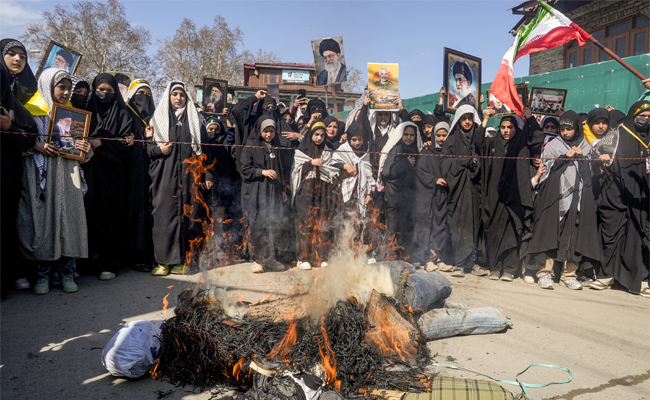
Srinagar (PTI): Protests broke out on Friday in some Shia-dominated areas of Kashmir, including Magam and Budgam, against the US-Israel strikes on Iran, officials said.
Apprehending the protests on the last Friday of Ramzan, restrictions were imposed this morning in Srinagar and other parts of the valley, especially the Shia-dominated areas.
The restrictions on the assembly of people were imposed in the morning as a precautionary measure to maintain law and order in view of the likelihood of protests, the officials said.
The protesters shouted slogans against the US and Israel aggression in Iran, and in support of Palestine, they said.
ALSO READ: Shivamogga: 26-year-old man dies by suicide after struggling with depression following love failure
However, the officials added that the protests remained peaceful so far.
They situation is being monitored closely, they said.
Juma-tul-Vida (last Friday of Ramzan) is also being observed as Youm-ul-Quds to express solidarity with Palestine and there are apprehensions of anti-Israel protests after the congregational prayers, they said.
The authorities also shut the historic Jamia Masjid in Nowhatta locality of the city here.
"On the last Friday of holy Ramzan, when tens of thousands gather from towns and villages for prayers and supplication at the historic Jama Masjid Srinagar, its gates have once again been locked from all sides," Kashmir's chief cleric Mirwaiz Umar Farooq said in a post on X.
He said it was the seventh consecutive year, "the rulers have denied permission to Muslims to pray here".
"As Israel has forcibly shut the gates of Masjid al-Aqsa during Ramzan, similar painful reality is witnessed here. Our hearts bleed. Shame on those who lock the houses of Allah against the faithful," the Mirwaiz added.
Let the Truth be known. If you read VB and like VB, please be a VB Supporter and Help us deliver the Truth to one and all.
Correspondents' dinner firing: World leaders say political violence has no place in democracy
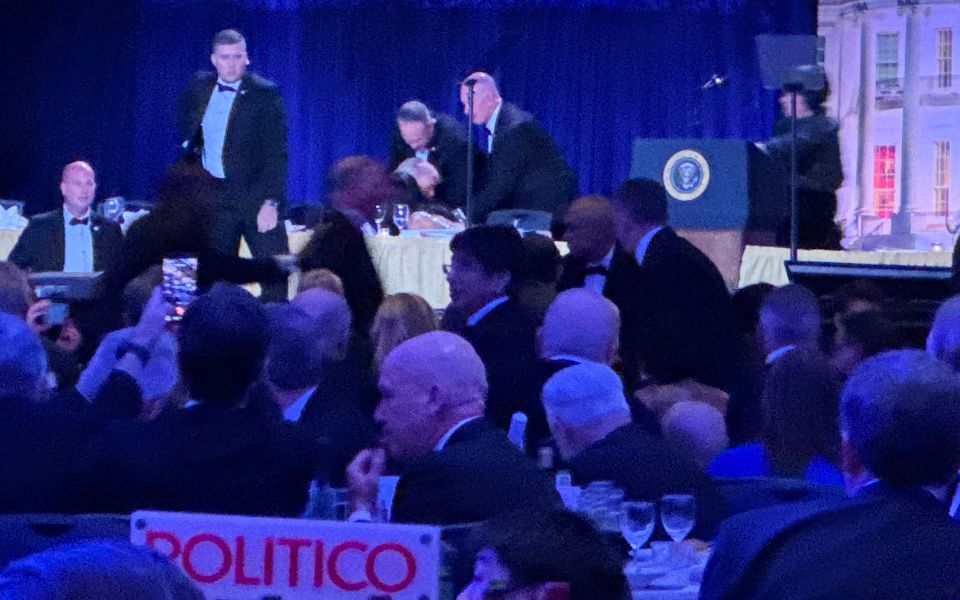
Washington (PTI): World leaders expressed relief that US President Donald Trump, First Lady Melania and other guests were unharmed after a shooting incident at the White House Correspondents' dinner here on Saturday night and asserted that political violence has no place in a democracy.
Reacting to the incident, Prime Minister Narendra Modi said he was relieved that President Trump, First Lady Melania and Vice President J D Vance were safe and unharmed after a security incident at the White House Correspondents' dinner in Washington.
Modi said violence has no place in democracy and must be unequivocally condemned.
"Relieved to learn that President Trump, the First Lady and Vice President are safe and unharmed following the recent security incident at a Washington DC hotel. I extend my best wishes for their continued safety and well-being. Violence has no place in a democracy and must be unequivocally condemned," Modi said in a post on X.
Canadian Prime Minister Mark Carney, who has had frequent run-ins with Trump, described the shooting incident at the Washington Hilton hotel as a “disturbing event”.
“I am relieved that the President, the First Lady, and all guests are safe following reports of gunfire at the White House correspondents’ dinner in Washington tonight. Political violence has no place in any democracy, and my thoughts are with all those who have been shaken by this disturbing event,” Carney said in a post on X.
President of the Republic of Korea, Lee Jae Myung asserted that political violence “can never be justified under any circumstances.”
“The Government of the Republic of Korea firmly opposes all forms of violence and extremism that erode the values of democracy and the rule of law,” he said in a social media post.
Prime Minister of Japan Sanae Takaichi said, “Violence must never be tolerated anywhere in the world”
“I am relieved to hear that President Trump is safe following the terrifying gunfire. Violence must never be tolerated anywhere in the world,” she posted on social media.
Israeli President Benjamin Netanyahu called the incident “an attack on all the democracies.”
"This wasn't just an attack on Donald Trump. This was an attack on a candidate for the presidency of the United States. This was an attack on America. It was an attack on democracy, it was an attack on all the democracies,” he posted on social media.
Mexican President Claudia Sheinbaum said it was “good that President Trump and his wife are safe following the recent events”.
“We send them our respect. Violence must never be the way,” she said.
Australian Prime Minister Anthony Albanese said he was pleased to hear all attendees were safe. “We applaud the work of the Secret Service and law enforcement agencies for their swift action,” he said in a statement.
Delcy Rodriguez, the acting President of Venezuela following the capture of Nicolas Maduro by US forces, condemned the attack against Trump.
"We extend our best wishes to them and to all attendees of the Correspondent’s dinner. Violence is never an option for those who uphold the values of peace," she wrote on X.
Pakistani Prime Minister Shehbaz Sharif also took to social media to condemn the incident, stating he was "deeply shocked" to hear the news.
"Relieved to know that President Trump, the First Lady, and other attendees are safe," Sharif said.
Trump has survived two assassination attempts over the past two years – first at a presidential election campaign rally in Butler, Pennsylvania, on July 13, 2024, and later in Palm Beach, Florida, on September 15, 2024.