Currency in circulation rises by 83 pc since demonetisation in 2016
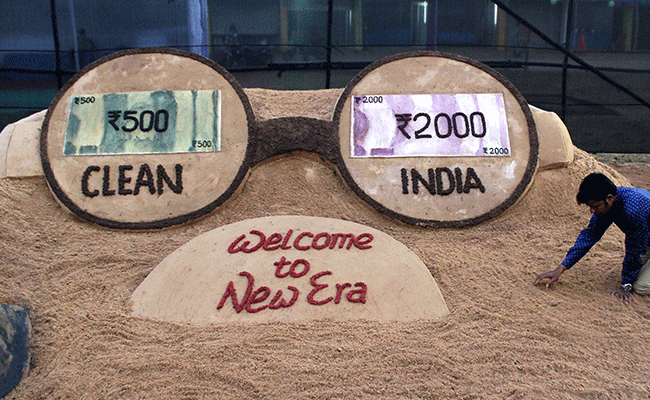
New Delhi (PTI): Demonetisation of the high value currency notes of Rs 500 and Rs 1,000 did not have any discernible impact on currency in circulation (CIC) in the country, which has soared by almost 83 per cent since its announcement on November 8, 2016.
The Supreme Court on Monday upheld the decision of the government on demonetisation.
On November 8, 2016 Prime Minister Narendra Modi had announced demonetisation of old Rs 1,000 and Rs 500 banknotes and one of the key objectives of the unprecedented decision was to promote digital payments and curb black money flows.
According to the Reserve Bank data, the CIC in value terms soared from Rs 17.74 lakh crore on November 4, 2016, to Rs 32.42 lakh crore on December 23, 2022.
However, soon after demonetisation, the CIC fell precipitously to a low of about Rs 9 lakh crore on January 6, 2017, nearly 50 per cent of Rs 17.74 lakh crore on November 4, 2016.
This was the lowest in the past six years following the scrapping of old 500/1,000 bank notes that accounted for around 86 per cent of the total notes at that time.
Compared with January 6, 2017 the CIC has seen more than 3-fold or 260 per cent jump, while from November 4, 2016 it has seen about 83 per cent jump.
As remonetisation gathered pace, CIC moved up week after week and reached 74.3 per cent of the peak by the end of the financial year. Subsequently around 85 per cent of its pre-demonetisation peak at the end of June 2017.
Demonetisation led to a decline in CIC by about Rs 8,99,700 crore (up to January 6, 2017) resulted in a large increase in surplus liquidity with the banking system, equivalent to a cut in the Cash Reserve Ratio (percentage of deposits parked with the RBI) by about 9 per cent.
This posed a challenge to the Reserve Bank's liquidity management operations and the central bank used instruments, especially reverse repo auctions under the liquidity adjustment facility (LAF) window to absorb surplus liquidity in the banking system.
CIC rose to Rs 32.42 lakh crore at the end of December 23, 2022 as compared to Rs 31.33 lakh crore at the end of March 31, 2022.
Since demonetisation, CIC has seen an increase barring the year of demonetisation. CIC contracted by 20.18 per cent to Rs 13.10 lakh crore at the end of March, 2016 from Rs 16.42 lakh crore at the end of March 31, 2015.
In the following year of demonetisation, it jumped by 37.67 per cent to Rs 18.03 lakh crore, and surged 17.03 per cent to Rs 21.10 lakh crore at the end of March 2019 and 14.69 per cent to Rs 24.20 lakh crore at the end of 2020.
In the previous two years, the pace of CIC growth in value terms was 16.77 per cent to Rs 28.26 lakh crore March 31, 2021 and 9.86 per cent to Rs 31.05 lakh crore at the end of March 31, 2022.
Asserting that the decision-making process was not flawed, the Supreme Court in a 4:1 majority verdict upheld the government's 2016 decision to demonetise the Rs 1,000 and Rs 500 denomination notes.
There has to be great restraint in matters of economic policy and the court cannot supplant the wisdom of the executive by a judicial review of its decision, a five-judge Constitution bench of the apex court, headed by Justice S A Nazeer, said.
Justice B V Nagarathna dissented from the majority judgment on the point of the Centre's powers under section 26(2) of the RBI Act and said the scrapping of the Rs 500 and Rs 1,000 series notes had to be done through a legislation and not through a notification.
"Parliament should have discussed the law on demonetisation, the process should not have been done through a gazette notification. Parliament cannot be left aloof on an issue of such critical importance for the country," Justice Nagarathna said.
She also said there was no independent application of mind by the Reserve Bank of India (RBI) and only its opinion was sought, which cannot be said to be a recommendation.
The bench, also comprising justices B R Gavai, A S Bopanna and V Ramasubramanian, said the Centre's decision-making process could not have been flawed as there was consultation between the RBI and the Union government.
The top court's judgment came on a batch of 58 petitions challenging the demonetisation exercise announced by the Centre on November 8, 2016.
Let the Truth be known. If you read VB and like VB, please be a VB Supporter and Help us deliver the Truth to one and all.
Right to vote under threat, must be made fundamental right: Cong's Jairam Ramesh
New Delhi (PTI): Congress leader Jairam Ramesh alleged on Thursday that the right to vote is under threat and the time has come when it should be made a fundamental right for citizens.
Speaking with reporters, Ramesh lashed out at Chief Election Commissioner (CEC) Gyanesh Kumar, saying the Election Commission (EC) has never been as compromised as it has been under him.
"The rot started under his predecessor. This man is a player and not a neutral observer," the Congress leader said, slamming Kumar.
Kumar is completely compromised and has become a player in elections, he alleged.
"Home Minister Amit Shah had talked about three Ds -- detect, delete and deport. So we want to know how many non-Indian citizens have been detected, how many have been deleted and how many have been deported," Ramesh said, adding that the right to vote is now under threat.
On opposition parties submitting a fresh notice in the Rajya Sabha, seeking to move a motion for the CEC's removal, the Congress leader said they will continue to make efforts for Kumar's removal as he is "compromised".
Ramesh also batted for the right to vote to be recognised as a fundamental right.
"I believe that the time has come that the right to vote should be made a fundamental right. It is a statutory right, it is not a fundamental right. Fundamental rights are justiciable," he said.
The former Union minister said this was discussed in the Constituent Assembly, but it was eventually decided that it should be made part of the Constitution.
B R Ambedkar and Jagjivan Ram had warned that in the future, governments might try to disenfranchise voters, he added.
"Once and for all, include the right to vote as a fundamental right for Indian citizens," Ramesh asserted.