Curtain falls on British-era laws, new criminal laws come into effect on July 1

New Delhi, Jun 30: Three new criminal laws will come into effect across the country from Monday, bringing widespread changes in India's criminal justice system and ending colonial-era laws.
The Bharatiya Nyaya Sanhita, Bharatiya Nagarik Suraksha Sanhita and the Bharatiya Sakshya Adhiniyam will replace the British-era Indian Penal Code, Code of Criminal Procedure and the Indian Evidence Act, respectively.
The new laws will bring in a modern justice system, incorporating provisions such as Zero FIR, online registration of police complaints, summonses through electronic modes such as SMS and mandatory videography of crime scenes for all heinous crimes.
They have tried to address some of the current social realities and crimes and provide a mechanism to effectively deal with these, keeping in view the ideals enshrined in the Constitution, official sources said.
Union Home Minister Amit Shah, who piloted the laws, said the new laws would give priority to providing justice, unlike the British-era laws that gave primacy to penal action.
"These laws are made by Indians, for Indians and by an Indian Parliament and marks the end of colonial criminal justice laws," he said.
Shah said the laws were not just about changing the nomenclature but bringing about a complete overhaul.
"Soul, body and spirit" of the new laws is Indian, he said.
Justice is an umbrella term that encompasses both the victim and the culprit, the home minister said and added these new laws would ensure political, economic and social justice with an Indian ethos.
According to the new laws, judgment in criminal cases has to come within 45 days of completion of trial and charges must be framed within 60 days of first hearing.
Statement of rape victims will be recorded by a female police officer in presence of her guardian or relative and medical reports have to come within seven days.
Organised crimes and acts of terrorism have been defined, sedition has been replaced with treason and video recording of all search and seizure have been made mandatory.
A new chapter on crimes against women and children have been added, buying and selling of any child has been made a heinous crime and there is a provision for death sentence or life imprisonment for gang rape of a minor.
The offences against women and children, murder and offences against the State have been given precedence in the new law.
Overlapping sections have been merged and simplified and will consist of only 358 sections against 511 in the Indian Penal Code, the sources said.
For example, definitions scattered from sections 6 to 52 have been brought under one section. Eighteen sections already stand repealed and four relating to weights and measures are covered under the Legal Metrology Act, 2009.
Instances of false promise of marriage, gang rape of minors, mob lynching, chain snatching, etc are reported but the current Indian Penal Code did not have specific provisions for dealing with such incidents.
These have been addressed in the Bharatiya Nyaya Sanhita, the sources said.
A new provision has been made for cases such as abandonment of women after making sexual relations on the false promise of marriage.
The three laws were based on justice, transparency and fairness, the sources said.
Under the new laws, a person can now report incidents by electronic communication, without the need to physically visit a police station. This allows for easier and quicker reporting, facilitating prompt action by the police.
With the introduction of Zero FIR, a person can file a First Information Report (FIR) at any police station, regardless of jurisdiction.
This eliminates delays in initiating legal proceedings and ensures immediate reporting of the offence.
An interesting addition of the law is that in the event of an arrest, the individual has the right to inform a person of his choice about his or her situation.
This will ensure immediate support and assistance to the arrested individual.
Besides, arrest details will now be prominently displayed within police stations and district headquarters, allowing families and friends of the arrested person easy access to important information.
To strengthen cases and investigations, it has become mandatory for forensic experts to visit crime scenes for serious offences and collect evidence.
Under the new laws, victims of crime against women are entitled to regular updates on the progress of their case within 90 days.
This provision keeps victims informed and involved in the legal process, enhancing transparency and trust.
The new laws guarantee free first-aid or medical treatment to victims of crimes against women and children at all hospitals.
This provision ensures immediate access to essential medical care, prioritising the wellbeing and recovery of victims during challenging times.
Summonses can now be served electronically, expediting legal processes, reducing paperwork and ensuring efficient communication among all parties involved.
For certain offences against woman, statements of the victim are to be recorded, as far as practicable, by a woman magistrate and, in her absence, by a male magistrate in the presence of a woman to ensure sensitivity and fairness, creating a supportive environment for victims.
Both the accused and the victim are entitled to receive copies of the FIR, police report, charge sheet, statements, confessions, and other documents within 14 days.
Courts grant a maximum of two adjournments to avoid unnecessary delays in case hearings, ensuring timely justice delivery.
The new laws mandate all state governments to implement witness protection schemes to ensure the safety and cooperation of witnesses, enhancing the credibility and effectiveness of legal proceedings.
The definition of "gender" now includes transgender individuals, promoting inclusivity and equality.
By conducting all legal proceedings electronically, the new laws offer convenience to victims, witnesses and accused, thereby streamlining and expediting the entire legal process.
To provide more protection to the victim and enforce transparency in investigation related to an offence of rape, the statement of the victim shall be recorded through audio-video means.
Women, persons below 15 years, persons above 60 years and those with disabilities or acute illnesses are exempt from attending police stations and can receive police assistance at their place of residence.
Let the Truth be known. If you read VB and like VB, please be a VB Supporter and Help us deliver the Truth to one and all.
MP cruise boat tragedy: Search ops expanded to trace four missing passengers
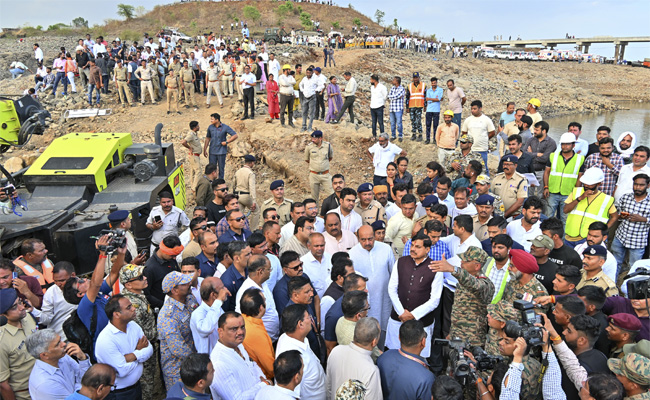
Jabalpur (PTI): Army divers and disaster response teams on Saturday expanded their search at Bargi Dam in Madhya Pradesh to locate a man and three children still missing after the cruise boat tragedy that claimed nine lives two days ago, officials said.
With 28 of the 41 identified passengers onboard the ill-fated cruise boat rescued safely, police are preparing to register an FIR in connection with the accident that occurred at the reservoir in Jabalpur district on Thursday evening, they said.
The search radius has been expanded to 5 km in the backwaters of the Bargi Dam, located downstream of the Narmada River, area sub-divisional officer of police (SDOP) Anjul Ayank Mishra told PTI.
Nine people drowned in the incident, while 28 were rescued, and efforts are ongoing to trace the missing persons, he said.
ALSO READ: Alleging unauthorised sorting of postal ballot covers, TMC files complaint with EC
According to the police, more than 200 rescuers, including around 20 Army divers airlifted from Agra, began the search operation at 5 am on Saturday to trace Kamraj, an employee of the Ordnance Factory in Khamaria, his son Tamil (5), Vijay Soni (6) and Mayuram (5).
Mishra said that an inquest case has been registered and the post-mortem of nine deceased persons has been completed.
"Our priority is to search for the missing persons. We will soon register an FIR," he said.
Investigators have said that CCTV footage near the boarding point showed 43 people heading towards the ill-fated boat, and the names of 41 persons, who boarded the vessel, have been ascertained so far.
Collector Raghvendra Singh confirmed that a search is underway for four missing persons.
The rescue operation, being carried out by the National Disaster Response Force (NDRF), State Disaster Response Force (SDRF) and local divers, was briefly affected around 9 am due to strong winds.
The state government on Friday ordered a probe into the incident and dismissed three crew members after survivors alleged negligence and safety lapses, including failure to provide life jackets.
The government also banned the operation of similar vessels in the state.
The boat, operated by the state tourism department, sank during a sudden storm around 6 pm on Thursday, and the wreckage was retrieved from the dam water on Friday, after the rescuers confirmed that there were no more bodies inside.
Eyewitnesses have said that strong winds made the water choppy, prompting passengers to raise an alarm and ask the crew to steer the vessel towards the riverbank.
A survivor alleged negligence by the crew and described a last-minute scramble for life jackets.