Cyclone Remal: One person killed in Kolkata, says NDRF
New Delhi (PTI): One person died in Kolkata due to a wall collapse incident that took place during cyclonic storm 'Remal' that made landfall last night in the coastal area between West Bengal and neighbouring Bangladesh, a senior NDRF officer said Monday.
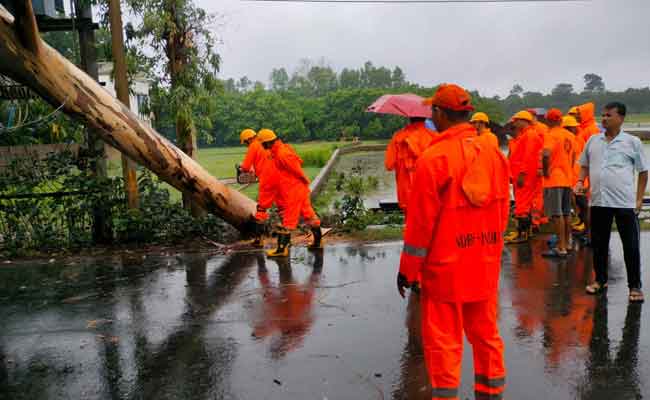
Fourteen teams of the federal contingency force are undertaking restoration and rescue work by clearing uprooted trees, electric poles and helping people come out of marooned areas hit by heavy rainfall, he said.
These teams have removed about 54 uprooted trees, two electric poles and cleared about 18 kms of roads in affected areas of Hasnabad, Sandeshkhali, Gosana, Sagar, Shyampur and Haringhata, he said.
According to the latest report received through the Ministry of Home Affairs (MHA), one person has been killed in a wall collapse incident in Kolkata.
The NDRF teams are on job to clear roads and aid West Bengal agencies in restoring normalcy in the aftermath of cyclone Remal that made a landfall in the midnight and is expected to convert into a deep depression by this evening, he said.
Visuals shared by the National Disaster Response Force (NDRF) this morning showed its rescuers using electric saws to cut uprooted trees even as some others were seen working on electricity and communication poles that were thrashed to the ground due to strong winds and rains.
Apart from the 14 teams in West Bengal, one NDRF unit is deployed in Tripura, which may see heavy rains due to Remal, the officer said.
The NDRF teams are deployed in various districts of West Bengal like Kolkata, North and South 24 Parganas, Purba and Paschim Medinipur, Murshidabad, Nadia, Howrah and Hooghly.
The cyclone ravaged adjacent coasts of the state and Bangladesh between Sagar Island and Khepupara, near the southwest of Mongla in the neighbouring country, after its landfall process began at 8.30 pm on Sunday, causing extensive damage to infrastructure and property.
Waterlogging has been reported in several areas, compounding the misery of the affected residents.
Let the Truth be known. If you read VB and like VB, please be a VB Supporter and Help us deliver the Truth to one and all.
ICSE, ISC results: Girls outperform boys, pass rate over 99%
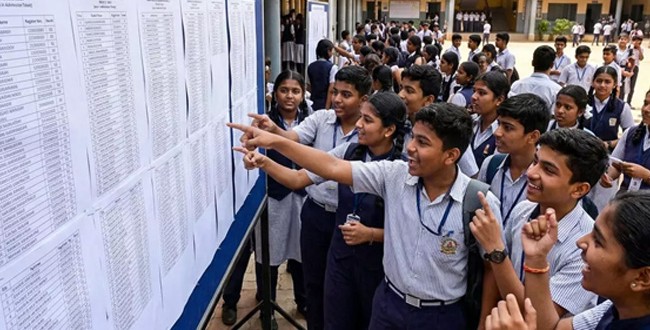
New Delhi (PTI): The Council for the Indian School Certificate Examinations on Thursday announced the Class 10 and Class 12 results for 2026, with overall pass percentages of 99.18 per cent and 99.13 per cent, respectively.
A total of 2,58,721 candidates appeared for the Indian Certificate of Secondary Education (ICSE), or Class 10, examination.
About 1,03,316 students took the Indian School Certificate (ISC), or Class 12, exam.
Girls outperformed boys in both examinations.
In ICSE, girls recorded a pass percentage of 99.46 per cent compared to 98.93 per cent for boys.
In ISC, girls achieved a 99.48 per cent pass percentage, while those of boys stood at 98.81 per cent.
Students can now access their scorecards on the official website cisce.org.