Cyclone Vayu turns "very severe", advances towards Gujarat
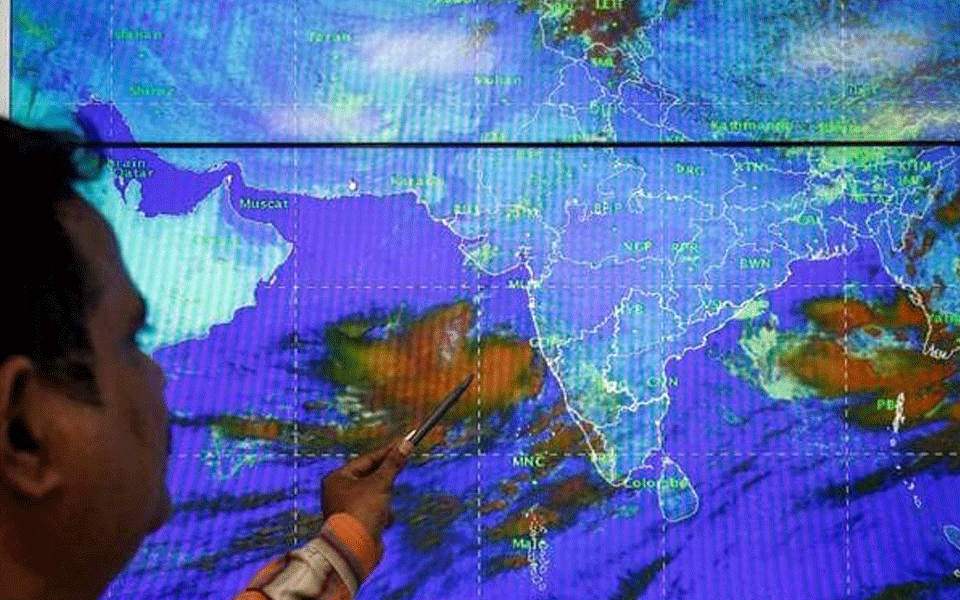
Mumbai: Mumbai and some neighbouring coastal areas of Maharashtra witnessed a windy Wednesday morning as cyclone 'Vayu' turned into a "very severe cyclonic storm", the weather department said.
As the cyclone continued to progress towards Saurashtra and Kutch regions of neighbouring Gujarat, the India Meteorological Department (IMD) upgraded its severity condition.
"Cyclone Vayu has turned into a very severe cyclonic storm. It would cause gusty winds to blow at a speed of 145 kmph to 170 kmph by Thursday morning," the IMD said.
Teams of the National Disaster Response Force (NDRF) started landing in Gujarat with the help of the Indian Air Force to undertake preventive evacuation of people living on the west coast, an IAF official said.
Because of the cyclonic storm, the Arabian Sea has turned turbulent and bigger waves are advancing towards coastal areas, the IMD said.
Huge sea waves lashed Devbaug village in Malvan tehsil of Maharashtra's Sindhudurg district on Wednesday.
An official at the district collectorate said since Devbaug is located in a low-lying area, it often gets inundated when the sea is rough, and maintained that so far the situation is under control.
Union Home Minister Amit Shah on Tuesday reviewed the preparations for cyclone Vayu, which is expected to make landfall in Gujarat on Thursday, and directed officials to ensure all possible steps for the safety of people.
The Indian Coast Guard, the Navy, Army and Air Force units have been put on standby and surveillance aircraft and helicopters are carrying out aerial surveillance, an official earlier said.
Let the Truth be known. If you read VB and like VB, please be a VB Supporter and Help us deliver the Truth to one and all.
Massive turnout in assembly polls across states, women voters outnumber men: EC data
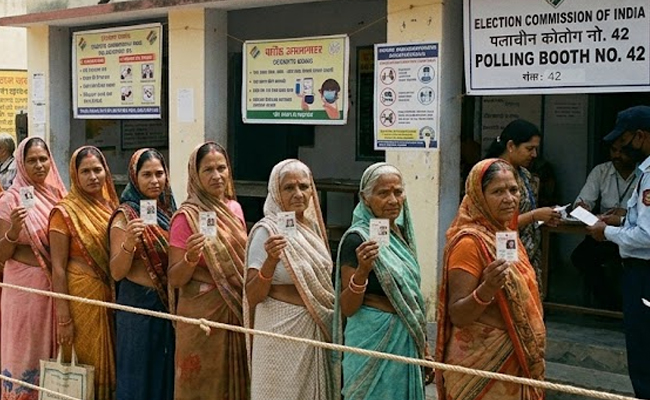
New Delhi (PTI): The recently-concluded assembly elections witnessed exceptionally high voter participation across states, with women voters outnumbering men in turnout percentages, according to Election Commission data.
West Bengal recorded the highest voter turnout among states, with 93.71 per cent polling in 293 constituencies where counting has been completed. The state saw over 6.38 crore votes cast, including postal ballots, against a total of more than 6.81 crore electors.
Women voters recorded a turnout of 93.8 per cent in the West Bengal Assembly polls, slightly higher than the 92.06 per cent participation among men.
The data for West Bengal does not include the figures for the Falta assembly constituency, which is scheduled for repolling.
Tamil Nadu registered an 85.01 per cent turnout, with nearly 4.8 crore votes polled from an electorate of 5.74 crore. Women voters recorded a turnout of 86.2 per cent, higher than the 83.77 per cent among men.
Assam also witnessed robust participation, with the final turnout touching 85.74 per cent. More than 2.15 crore votes were cast in the state, while female turnout at 86.53 per cent marginally exceeded the 84.95 per cent recorded among male voters.
Kerala registered a turnout of 78.11 per cent, with over 2.12 crore votes polled. Female voter participation stood at 81.17 per cent against 74.9 per cent among men.
Puducherry recorded a turnout of 89.82 per cent, with women voters again leading participation at 91.39 per cent. More than 8.5 lakh votes were polled in the Union territory.
Yet, women's representation among elected candidates remained modest.
Tamil Nadu elected 23 women MLAs (9.83 per cent) out of 234 members, West Bengal elected 37 women legislators (12.62 per cent) out of 293, while Kerala returned only 11 women MLAs (7.85 per cent) in the 140-member House.
Only two third-gender candidates contested the elections - one each from Tamil Nadu and Kerala, and both lost, forfeiting their deposits.
The elections also reflected extensive electoral mobilisation infrastructure. West Bengal had the highest number of polling stations at 85,092, followed by Tamil Nadu with 75,064 and Assam with 31,490.
In terms of candidates, Tamil Nadu saw the largest contest with 4,023 candidates in the fray across 234 constituencies, averaging 17 candidates per seat and peaking at 79 contestants in one constituency.
West Bengal pitted 2,920 candidates for 293 constituencies, while Kerala had the fewest contestants among the major states, with 883 candidates for 140 seats.
The data also showed relatively low NOTA votes across states. Tamil Nadu recorded the lowest NOTA share at 0.4 per cent of total votes polled, while Assam recorded the highest at 1.23 per cent. In West Bengal, 0.78 per cent of the total votes polled were NOTA, while it 0.77 per cent and 0.57 per cent of the electorate opted for None of the Above (NOTA) in Puducherry and Kerala, respectively.