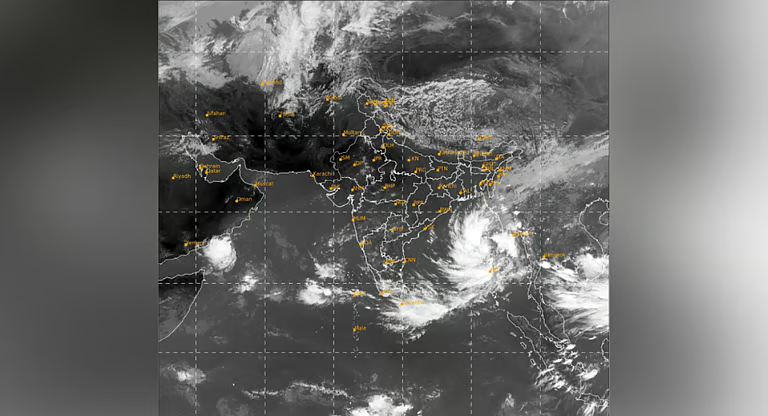
Chennai, Nov 27 (PTI): Cyclonic storm 'Ditwah', formed from a deep depression near the Sri Lanka coast, has begun moving towards the north Tamil Nadu, Puducherry and south Andhra coasts, Regional Meteorological Centre Director B Amudha said here on Thursday.
Strong winds, heavy rain and dangerous sea conditions are expected over the next few days, she added.
Meanwhile, Tamil Nadu State Disaster Management Authority met under the leadership of Chief Minister M K Stalin to review special initiatives undertaken for disaster management.
"It (Ditwah) is currently being treated as a cyclonic storm. Forecasts do not, at present, upgrade it to a severe cyclone," the RMC chief said.
However, the RMC has issued a red alert in some Cauvery Delta districts and an orange alert in five districts -- Chennai, Tiruvallur, Kancheepuram, Ranipet and Chengalpattu for November 20 and 30.
Thanjavur, Tiruvarur, Nagapattinam and Mayiladuthurai are the delta districts that have been issued a red alert.
A red alert indicates an extremely heavy rain of over 20 cm in 24 hours, while an orange alert means very heavy rain of 11 cm to 20 cm.
The name, 'Ditwah', referring to the lagoon, was suggested by Yemen, the RMC chief said. It is likely named after Detwah Lagoon, a large, saline lagoon on the northwest coast of the island of Socotra in Yemen.
Briefing reporters in the RMC's office in Chennai, Amudha said gale winds near the storm centre could reach 60–80 kmph with gusts up to 90 kmph, while outer bands are likely to experience winds of 35–45 kmph, gusting to 55 kmph.
"Similar squally winds of 35–45 kmph, with gusts up to 55 kmph, are also expected over parts of the Arabian Sea adjoining Kerala, Lakshadweep and Maldives," she added.
Fishermen, especially those already in the deep sea, have been advised to completely avoid the south, central, southwest and southeast Bay of Bengal for the next five days, she said.
In the 24 hours preceding the briefing, isolated rainfall was reported in Tamil Nadu with Thangachimadam recording about 3 cm, while Puducherry and Karaikal remained largely dry, Amudha said.
Reviewing the northeast monsoon, the official said Tamil Nadu has so far received around 35 cm of rain against a normal of 34 cm from October 1, translating to roughly two per cent above normal for the season.
"However, Chennai’s seasonal rainfall remains around 31 per cent below normal, and the storm could significantly improve the deficit if it brings widespread showers over the next few days," she said.
Possibility of landfall could be predicted only when the track and speed evolve, she added.
Following the warning by the RMC that very heavy rain (red alert) may occur in specific districts on November 29 and 30, CM Stalin has requested all government departments to coordinate among themselves and serve the people, according to an official release.
The functioning of automated weather instruments installed for real-time disaster monitoring, Chennai Real-Time Flood Forecasting System, the Integrated Flood Monitoring Center of the Tamil Nadu Disaster Risk Reduction System, the upgraded State Emergency Operations Center, the TN Alert app for the public and the TN Smart 2.0 web portal for government officials were also discussed in the meeting, the release added.
Let the Truth be known. If you read VB and like VB, please be a VB Supporter and Help us deliver the Truth to one and all.
When you go to a shop and the shopkeeper says, “Price badh gaya hai, naya tax laga hai,” you usually do only one thing — you sigh and pay more. You do not argue with the government; you simply adjust your household budget. That is exactly what is happening in the United States right now. And when prices and taxes change in America, the effect does not stay there. It slowly travels across oceans and reaches India too.
On 21 February, American President Donald Trump announced a new 15% import tax on almost all goods entering the US from other countries. An import tax, also called a tariff, is simply extra money charged when a product crosses the border — like a gate fee. A T-shirt from Tiruppur, a medicine from Hyderabad, or an electronic item from China — if it wants to enter the US market, it must now pay 15% extra. Companies usually pass this extra cost to customers. So in the end, it is the ordinary American buyer in a supermarket who pays more.
This 15% tax did not come out of nowhere. Just one day earlier, on 20 February, Trump had announced a 10% global import tax. Before that, he had introduced even higher tariffs, which the US Supreme Court struck down. The court said he was misusing a law called the International Emergency Economic Powers Act (IEEPA). That law is meant for genuine emergencies — like dealing with hostile nations or blocking dangerous financial flows — not for imposing wide import taxes on almost the entire world. In simple terms, the court said normal trade cannot be labelled an emergency just to collect extra tax.
So Trump turned to another legal option: Section 122 of the Trade Act of 1974. This rarely used law allows a president to impose temporary import surcharges when there is a serious trade imbalance. It permits tariffs of up to 15%, but only for 150 days — roughly five months. That is why it feels like a 150-day fuse. The law was originally designed for situations when the US was buying far more from other countries than it was selling to them — what economists call a trade deficit. Trump argues that America’s large and long-standing trade deficit justifies this step.
However, legal experts are divided. Some believe today’s trade deficit may not fully match the conditions envisioned when Section 122 was written decades ago. That means the new tariff could also face legal challenges. But until any court decision changes it, the 15% tariff is active.
The numbers explain the shift clearly. Before the Supreme Court struck down the earlier tariffs, the average import tax in America had risen to about 16%. After the court ruling, it fell sharply to around 9%. Now, with the new 15% global tariff, analysts expect the overall average to settle somewhere between 13% and 14%. In simple words, tariffs are lower than last year’s peak but higher than they were just days ago. They have not returned to old normal levels.
Why does this matter for India? Because the US is one of India’s largest export markets. India sends medicines, IT services, textiles, gems and jewellery, engineering goods, and auto components to America. If a 15% tariff is applied, Indian exporters face a difficult choice. Either they absorb the extra cost and accept lower profits, or they raise prices and risk losing customers. Lower profits often mean slower hiring, reduced investment, and cautious spending. Trade policy may look distant, but it quietly influences jobs and incomes here at home.
Earlier discussions between India and the US involved a possible 18% tariff structure. On paper, 15% seems better. But the earlier framework was clearer and more stable. The new 15% tariff comes with a 150-day time limit and the possibility of court battles. In business, predictability is often more valuable than small numerical advantages. Companies can manage higher costs if they are stable; uncertainty is harder to manage.
There are some exemptions. Certain medicines, critical minerals, defence-related goods, and some products from Canada and Mexico are excluded under special agreements. So the rule is not entirely universal. But for a large share of imports — including many low-cost online products — the 15% tariff applies.
Another important change concerns the “de minimis” rule. Earlier, goods valued at 800 dollars or less could enter the US without paying import tax. This allowed online sellers and platforms to ship small packages directly to American consumers easily. That benefit is now effectively suspended. The administration has confirmed that even these small parcels will face the new tariff. In addition, a major tax bill passed recently will permanently phase out the de minimis system for commercial shipments by around mid-2027.
Trump has also mentioned other legal tools. Section 232 of the Trade Expansion Act of 1962 allows tariffs on industries linked to national security, such as steel, aluminium, and automobiles. Some of these sectors already face tariffs of 25% to 50%. The new 15% global tariff will not be added on top of those existing Section 232 tariffs. Another option, Section 301 of the Trade Act of 1974, allows long-term tariffs on countries accused of unfair trade practices. However, both Section 232 and Section 301 require detailed investigations and take months to implement. Section 122, in contrast, acts quickly.
What happens on the ground? Studies from the Federal Reserve Bank of New York suggest that most of the cost of earlier tariffs was ultimately paid by American companies and consumers. When importers pay more, they try to pass that cost along the supply chain. This leads to higher prices for goods like home appliances, furniture, and vehicles. Some companies delay hiring or postpone expansion plans.
Not everyone loses. Certain domestic industries benefit from protection. For example, US shrimp fishermen have said that higher tariffs on imported shrimp made their local products more competitive. In trade policy, one sector’s protection often means another sector’s higher cost.
The broader issue is stability. Tariffs are powerful economic tools. But when they change frequently or face repeated legal challenges, businesses struggle to plan. They hesitate to invest, hire, or sign long-term contracts. Uncertainty itself becomes a cost.
Trump believes America has been disadvantaged in global trade and wants to strengthen domestic manufacturing. Many supporters agree that protecting key industries and reducing dependence on foreign supply chains is important. The debate is less about the objective and more about the method. A major trading nation needs policies that are clear, predictable, and legally sound.
Trade policy may appear technical, but it has everyday consequences. It can influence the price of shoes in a shop, the hiring decision of a factory in Chennai, or the expansion plan of an exporter in Gujarat.
Trump’s 15% global tariff and its 150-day timeline are not just political headlines. They represent a shift in how trade costs are distributed across countries and consumers. And in global economics, the final bill almost always reaches ordinary people — whether they wrote the rules or not.
(Girish Linganna is an award-winning science communicator and a Defence, Aerospace & Geopolitical Analyst. He is the Managing Director of ADD Engineering Components India Pvt. Ltd., a subsidiary of ADD Engineering GmbH, Germany.)
Disclaimer: The views and opinions expressed in this article are solely those of the author. They do not necessarily reflect the views, policies, or position of the publication, its editors, or its management. The publication is not responsible for the accuracy of any information, statements, or opinions presented in this piece.