Dabholkar murder case: Court denies CBI further custody of lawyer, aide
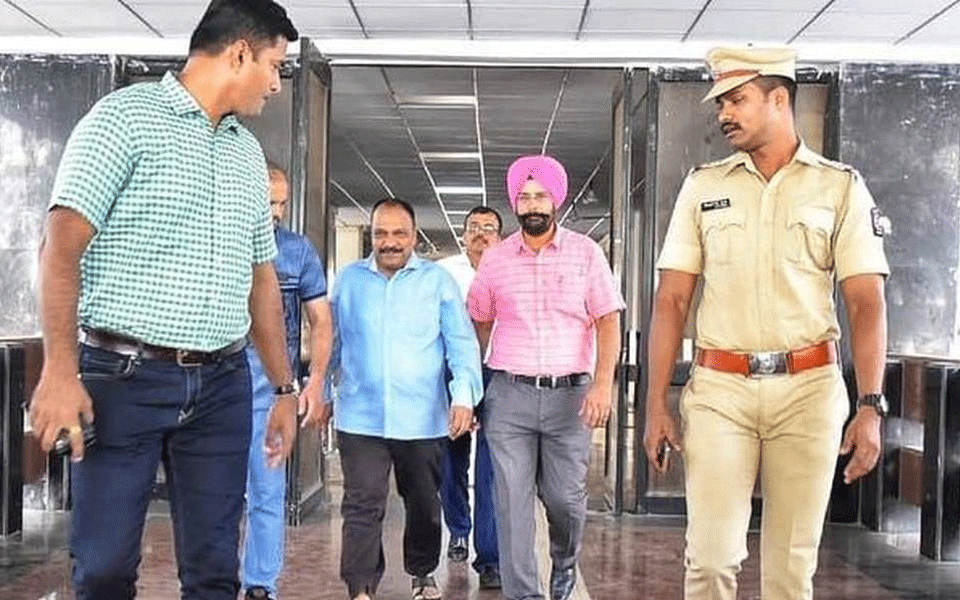
Pune, Jun 4: A court here on Tuesday turned down a CBI request seeking further custody of advocate Sanjeev Punalekar and his assistant Vikram Bhave, arrested in the Narendra Dabholkar murder case, and sent them to judicial custody for 14 days.
The agency did not present any fresh grounds for seeking their custody, the court said.
Punalekar, who had represented some of the accused in the Dabholkar murder case of 2013, and Bhave were arrested on May 25 by the Central Bureau of Investigation (CBI) in the same case.
Seeking further custody of the duo, Special Public Prosecutor Prakash Suryawanshi said the CBI had recovered some crucial data, including names and contact numbers, from Punalekar's laptop and mobile phone, and it wanted to interrogate him further based on these leads.
The "Forensic Psychology Assessment" and "Forensic Statement Assessment" tests of Punalekar indicated that he was deceptive, the prosecutor claimed.
Punalekar and Bhave were in CBI's custody for 11 days.
Additional Sessions Judge R M Pande rejected the central probe agency's request for further remand and sent the two accused to judicial custody.
The judge, in the written order, said the grounds cited while asking for further custody were not "satisfactory".
"I have gone through the earlier remand reports...on the same grounds, the police (CBI) custody was granted and thereafter, on the same grounds, it was extended," he said.
Sufficient CBI custody had already been granted, the order said.
Dabholkar, a well-known anti-superstition activist, was shot dead in Pune on August 20, 2013.
According to the CBI, which has arrested some persons connected to right-wing organisation Sanatan Sanstha in the case, Punalekar had advised one of the alleged shooters to destroy the weapons.
Some of the accused in the case are also linked to the 2015 murder of communist leader Govind Pansare and the 2017 murder of journalist Gauri Lankesh, investigating agencies have claimed.
Let the Truth be known. If you read VB and like VB, please be a VB Supporter and Help us deliver the Truth to one and all.
Two arrested for allegedly sexually assaulting woman at knifepoint in Kochi

Kochi (PTI): Two persons have been arrested after a three-member gang allegedly sexually assaulted a woman at knifepoint near Ernakulam Junction Railway station, officials said on Friday.
The arrested accused were identified as Danish (26), a native of Varkala in Thiruvananthapuram district, and Rahul (39), a native of Paravoor in Kollam district.
Police officials said they were searching for the prime accused, Sanjay, a native of Aroor in Alappuzha district.
According to police, the incident occurred on the night of May 5 when the victim was chatting with her friend near a closed hotel near Ernakulam Junction Railway station.
Officials said the accused approached them, attacked the victim’s friend and then allegedly threatened the woman with a knife before sexually assaulting her.
Police said the accused also allegedly disrobed the victim during the attack.
However, the woman managed to escape from the spot and approached a nearby shop for help.
Police were informed immediately and shifted the victim to the police station.
Officials said the accused were heavily drunk at the time of the incident and went into hiding soon after the attack.
Police registered a case on May 6 under charges including rape, disrobing a woman, criminal intimidation and robbery.
The two accused were later arrested in the city, while efforts are continuing to trace Sanjay, police said.
The accused were produced before a court and remanded to judicial custody.