12-year-old Dalit boy kills himself after being locked in cowshed by 'upper caste' woman
Shimla: A 12-year-old Dalit boy from the Rohru subdivision of Shimla district has died by suicide after allegedly being humiliated and locked inside a cowshed by an upper-caste neighbour. The incident has triggered outrage in the local community, with the police initiating an investigation under the Scheduled Castes and Scheduled Tribes (Prevention of Atrocities) Act.
According to the boy’s uncle, Suresh Banta, the child had gone to a neighbour's house, where a woman accused him of defiling her home. She reportedly locked him inside a cowshed and later told the boy that his parents would need to give her a goat to "purify" the house.
The boy managed to escape and return home, where he consumed poison. He was admitted to Indira Gandhi Medical College and Hospital in Shimla, but succumbed to his injuries a day later.
Pranav Chauhan, Deputy Superintendent of Police (Rohru), confirmed that a case has been registered and that the investigation is ongoing. "We are relying on scientific evidence, as there were no eyewitnesses. A thorough probe is underway," he stated.
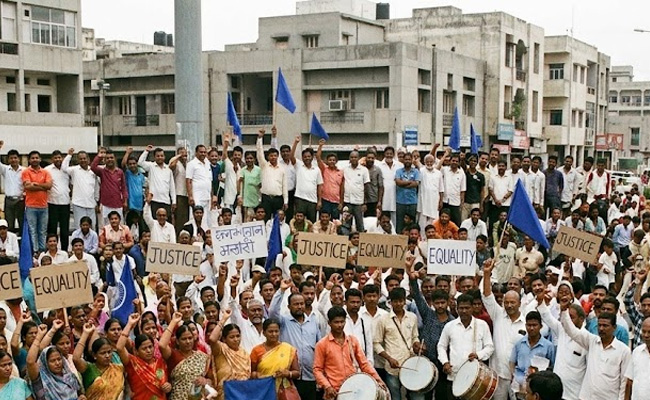
The incident has sparked widespread condemnation from the Dalit community and political leaders. Vinod Singhta, treasurer of the Koli Samaj, described the incident as a reflection of the entrenched caste discrimination in the region.
"A dog can enter an upper-caste household without issue, but if a Scheduled Caste person does, it is considered defiled. This mindset is deeply unfortunate," Singhta said.
State secretary of the CPI(M), Sanjay Chauhan, also expressed his anger. "If this boy died because of caste-based humiliation, it is a matter of national shame. Stern action must be taken to ensure this never happens again," he said.
Let the Truth be known. If you read VB and like VB, please be a VB Supporter and Help us deliver the Truth to one and all.
Bengal CM Mamata Banerjee holds roadshow in south Kolkata to end campaign
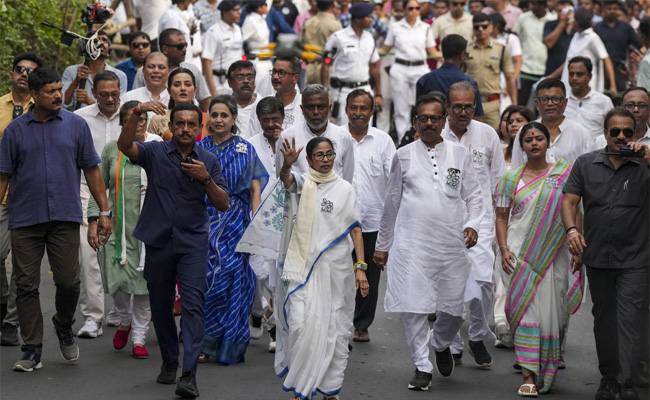
Kolkata (PTI): Chief Minister Mamata Banerjee undertook a roadshow in south Kolkata spanning over six kilometres on Monday afternoon at the fag end of campaigning for the second and final phase of the West Bengal assembly election.
The TMC chief was accompanied by party Rajya Sabha MP Sagarika Ghose and candidates Aroop Biswas and Debasish Kumar from Tollygunge and Rashbehari, respectively.
People waiting on the roadside and on rooftops and balconies waved at Banerjee as she greeted them with folded hands, walking briskly, as her party compatriots had a tough time keeping pace with her.
The chief minister is contesting from the Bhabanipur assembly seat, where she is pitted against her bete noire, Suvendu Adhikari of the BJP, who defeated her in the 2021 elections in Nandigram.
Banerjee was subsequently elected from Bhabanipur in a byelection.
The roadshow started at Sukanta Setu in the Jadavpur area and culminated at Gopalnagar crossing, past her Kalighat residence, with two small stopovers in between.
TMC flags, festoons, cutouts of Banerjee and banners with slogans in favour of the candidates adorned the roadsides through which the road show passed and culminated at around 5.30 pm.
A large number of TMC supporters participated in the roadshow that Banerjee conducted to end her campaign for the 2026 assembly election in West Bengal.