Dalit leader Prakash Ambedkar detained near Aarey Colony, hits out at Maharashtra govt
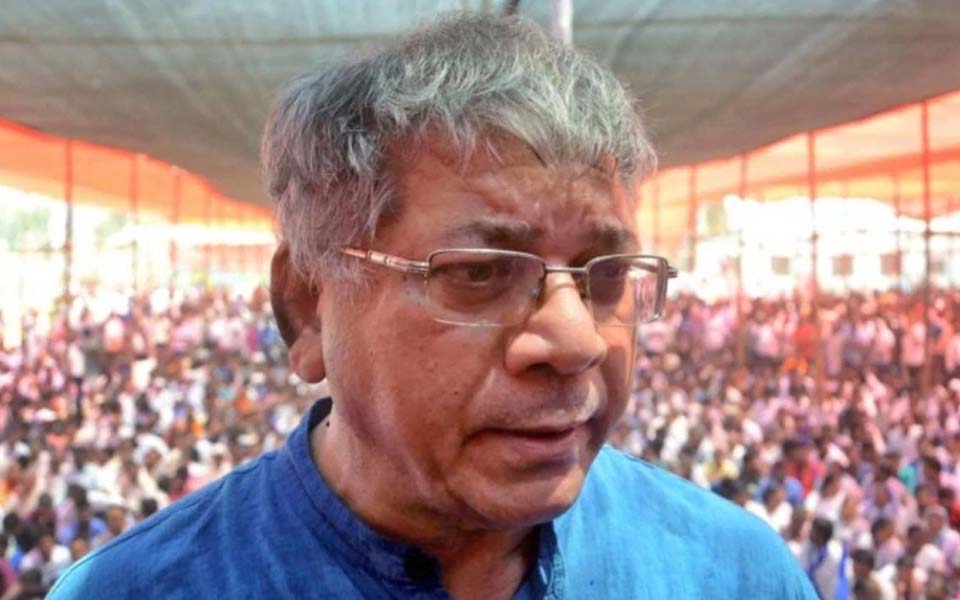
Mumbai, Oct 6: Dalit leader Prakash Ambedkar was on Sunday detained when he tried to enter the Aarey Colony here in support of the activists who are opposing the cutting of trees in the area to make way for a Metro car shed.
He alleged that the Maharashtra government was using "muscle power" to silence those raising voice against tree felling.
The police on Saturday imposed Section 144 of the Criminal Procedure Code in Aarey, restricting movements and gathering of groups, and cordoned off the area.
When the Vanchit Bahujan Aghadi (VBA) chief reached the Aarey area located in suburban Goregaon on Sunday in support of those opposing tree felling, he was detained by police for a brief period.
Later, after being left off, he told reporters, "The green cover at Aarey Colony helps in the purification of air, the same way as fresh breeze coming from the Arabian Sea helps in keeping Mumbai air clean."
Hitting out at the state government for using "muscle power" to silence the activists opposing tree felling, he said the VBA extends its support to the cause of saving the Aarey forest.
"We were told that some 700 trees have been axed. We will continue to oppose the tree felling in all forms, even if we fail to come to power in the state after the upcoming Assembly elections," he said.
On Saturday, clashes broke out between the police and green activists who tried to stop tree cutting by Mumbai Metro Rail Corporation Ltd (MMRCL) in Aarey Colony, leading to arrest of at least 29 people.
The MMRCL started hacking trees from Friday night to make way for the car shed, hours after the Bombay High Court dismissed four petitions filed by NGOs and activists challenging the decision to allow felling of nearly 2,700 trees in the prime green lung of the city.
Some local tribals also opposed the tree cutting, claiming they were largely dependent on the Aarey forest for their livelihood.
Earlier, opposition parties slammed the ruling BJP- Shiv Sena, saying they failed to save the trees.
Yuva Sena leader Aaditya Thackeray also criticised the MMRCL and backed the protesters.
The MMRCL has defended tree felling by contending that it is restricted only to a small area in Aarey Colony, and is necessary to ensure a modern transport system for Mumbaikars.
The proposed car shed for the Metro-3 line (Colaba- Bandra-Seepz) will occupy 33 hectares.
Let the Truth be known. If you read VB and like VB, please be a VB Supporter and Help us deliver the Truth to one and all.
Man arrested with Rs 2.54-crore heroin in Mumbai

Mumbai (PTI): Police have arrested a man and seized over 500 grams of heroin worth Rs 2.54 crore in the illicit market from him in Mumbai, officials said on Friday.
The police's Anti-Narcotics Cell (ANC) made the drug seizure in Santacruz in the western suburbs. The operation was conducted by the Kandivali unit of the ANC on Thursday as part of a special crackdown against drug trafficking in the area, they said.
Acting on specific inputs, an ANC team conducted a raid in Santacruz (East) and intercepted a man. During a search, the team recovered 508 grams of high-grade heroin from his possession, an official said.
The seized contraband, a highly addictive, opioid drug derived from morphine, is estimated to be worth Rs 2.54 crore in the international market, he informed.
Following the seizure, a case was registered against the man under relevant sections of the Narcotic Drugs and Psychotropic Substances (NDPS) Act, 1985, and he was formally placed under arrest in the early hours of Friday.
The police are currently investigating the source of the drug and trying to identify the intended recipients of the consignment, he said.