Danve says Rahul Gandhi is of no use to anyone, likens him to stray bull; leaves Congress fuming
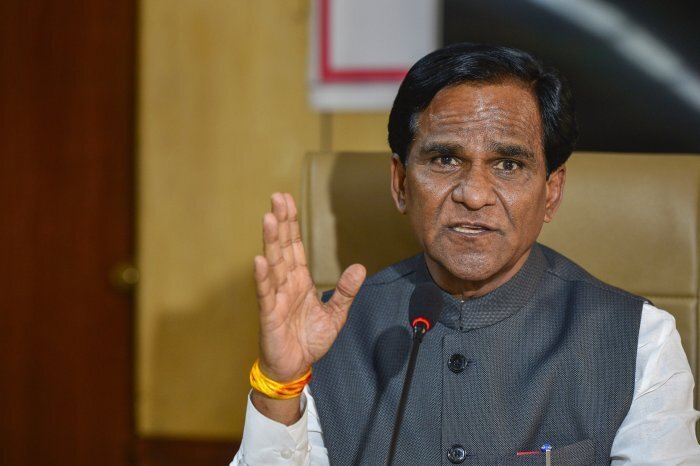
Mumbai, Aug 21: Union minister Raosaheb Danve has criticised Congress leader Rahul Gandhi, saying that he was of no use to anyone, and also likened him to a stray bull.
The Congress objected to his "indecent and shocking" remarks and demanded his removal from the Union cabinet.
Danve made the remarks while speaking at a public rally in Jalna district of Maharashtra as part of the Jan Ashirwad Yatra' taken out by newly-inducted Minister of State for Finance Dr Bhagwat Karad.
Giving his speech in Marathi, Danve said, "Rahul Gandhi is of no use to anybody. He is like a saand' (bull) dedicated to god. He roams everywhere, but is of no use to anyone. I have been in the Lok Sabha for 20 years and have seen his work."
It is a practice in rural Maharashtra and some other parts of the country to dedicate a newly-born male calf to a local deity. That bull is not used for any agriculture or transportation purposes.
The Union Minister of State for Railway further said, "Even if such a bull enters a farm and eats the crop, the farmer forgives the animal saying it needs food."
"One should look at the great work being done by Prime Minister Narendra Modi...The government is spending money from its coffers as Railways does not generate enough revenue from various sources, including through the sale of tickets," he said.
Reacting to his remarks, Congress's state unit chief Nana Patole sought Danve's resignation.
"He (Danve) has crossed all the boundaries. His remarks are indecent and shocking. We demand his removal from Union cabinet for using such a foul language against Gandhi," he said.
"It makes me wonder how he can be given such an important post in the cabinet despite his track record of using foul language," he said.
Let the Truth be known. If you read VB and like VB, please be a VB Supporter and Help us deliver the Truth to one and all.
Lakhimpur Kheri violence case: SC expresses disappointment over non-production of witnesses in trial
New Delhi (PTI): The Supreme Court on Friday expressed disappointment over the non-production of witnesses in the ongoing trial against Ashish Mishra, son of former Union minister Ajay Mishra, and others in the 2021 Lakhimpur Kheri violence case.
A bench of Chief Justice Surya Kant and Justice Joymalya Bagchi said the status report filed before it by the Uttar Pradesh government has not assigned any reason whatsoever for the non-production of witnesses.
It noted that no witnesses have been examined in the trial for the last two months.
"We direct the presiding judge to take lawful measures to secure the presence of witnesses," the bench said.
It asked the trial judge to make an endeavour to conclude the trial in a time-bound manner, and also to file a status report before it.
The trials in two cases related to the incident are going on before a court in Uttar Pradesh.
The bench noted that in the first case, out of 131 witnesses to be examined, 44 have been examined, 15 have been discharged and 72 are still to be produced.
In the second FIR, out of 35 witnesses, 26 have been examined and nine were left, it said.
Senior advocate Siddharth Dave, appearing for Ashish Mishra, said that as per the latest status report filed by Uttar Pradesh, 44 witnesses have been examined so far in the first FIR.
"No witnesses have been examined in the last two months," Dave said.
He argued that the last status report filed by the state in March also said that 44 witnesses had been examined.
"What have you done from March till today?" the bench asked the counsel appearing for Uttar Pradesh.
The state's counsel said that 3-4 witnesses were summoned for the recording of their deposition during the trial.
The bench said at least 7-8 witnesses should be summoned instead of three or four for a day, so that even if some of them do not turn up, the trial court could proceed with the recording of statements of those appearing before it.
The top court also wondered how official witnesses can remain absent during the trial.
"We are disappointed to note that the so-called status report does not assign any reason whatsoever for non-production of witnesses...," the bench said.
Advocate Prashant Bhushan, appearing for the relatives of the farmers who were allegedly mowed down in the incident, said the apex court will have to do something regarding the manner in which the trial was going on.
The bench noted that besides the two FIRs, another FIR was registered in October last year concerning alleged witness intimidation.
It said that, as per the state's status report, the chargesheet was filed against the main accused in that case.
The bench noted that the status report reveals that, as far as Ashish Mishra is concerned, his alleged role in the third case is still being investigated.
The top court directed the investigating officer of the third case to conclude the pending probe and ensure that the appropriate report is filed before the concerned court within four weeks.
The bench posted the next hearing in the Lakhimpur Kheri violence case for July.
On October 3, 2021, eight people, including four farmers, were killed in Tikunia in Lakhimpur Kheri district during a protest by farmers against Deputy Chief Minister Keshav Prasad Maurya's visit to the area.
Four farmers were mowed down by a sports utility vehicle. A driver and two BJP workers were then allegedly lynched by angry farmers. A journalist also died in the violence.
In one of the cases, the trial court in December 2023 framed charges against Mishra and 12 others for alleged murder, criminal conspiracy and under other penal laws in the case of the farmers' deaths, paving the way for the trial.