Death of Malappuram girl confirmed as Nipah, Palakkad reports new case
New Delhi/Thiruvananthapuram, Jul 5 (PTI): The recent death of an 18-year-old girl in Kerala's Malappuram district was confirmed as Nipah infection, health department sources here said on Saturday.
The patient, hailing from Chettiyarangadi in Malappuram, had succumbed after receiving treatment at a private hospital in Kozhikode district.
Initial tests indicated Nipah and the infection was subsequently confirmed by the National Institute of Virology (NIV) in Pune after sample examination, the sources said.
A 38-year-old woman from Thachanattukara in Palakkad district also tested positive for Nipah, prompting the authorities on Friday to issue a strong warning to the public and health workers to remain extremely vigilant.
In view of the Nipah case reported in the district, health authorities in Malappuram initiated surveillance in 20 wards in panchayats like Makkaraparamba, Kuruva, Kootilangadi, and Mankada, an official statement said here on Saturday.
The objective was to identify the source of the disease and strengthen household-based awareness, it said.
A total of 65 teams visited 1,655 houses and found no one with symptoms of Nipah during the survey, the statement added.
State Health Minister Veena George held a high-level meeting in Thiruvananthapuram to review the situation.
She informed that 425 people are on the Nipah contact list, with 228 in Malappuram, 110 in Palakkad, and 87 in Kozhikode.
Of them, five people are admitted to the intensive care unit (ICU), and the test result of another person in the contact list turned negative for the infection, the minister's office said in a statement.
Meanwhile, the Union Health Ministry is considering deploying the National Joint Outbreak Response Team (NJORT) to Kerala to assist the state government in implementing public health measures, following the detection of two Nipah virus cases, sources said in New Delhi.
The Central Surveillance Unit of the Integrated Disease Surveillance Programme (IDSP), NCDC, is in close contact with the state unit and is actively monitoring the situation.
The State Control Room has been activated for coordinating the various containment activities.
The public health response is guided by the Kerala State NiVD guidelines for surveillance, diagnosis, treatment, prevention and control.
"Although prima facie, the two cases are epidemiologically unlinked, the timelines of symptom onset and the possibility of a common social event connecting the two are being investigated," a source said.
Let the Truth be known. If you read VB and like VB, please be a VB Supporter and Help us deliver the Truth to one and all.
Sack Dharmendra Pradhan: Rahul to PM amid NEET row
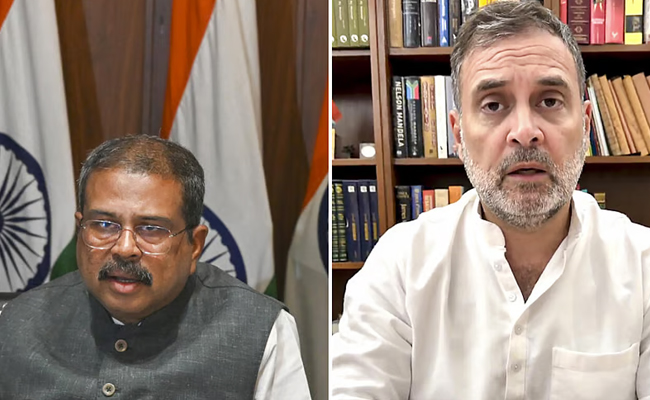
New Delhi (PTI): Amid the NEET paper leak row, Congress leader Rahul Gandhi on Saturday demanded that Prime Minister Narendra Modi should immediately sack Education Minister Dharmendra Pradhan or take personal accountability, and alleged that the "BJP-RSS nexus" has destroyed India's education system.
The Leader of Opposition in Lok Sabha said the hard work of 22 lakh NEET aspirants has gone to waste.
"The whole country knows that two days before NEET, its question paper was being distributed on WhatsApp. Dharmendra Pradhan ji says he has nothing to do with the matter. The (Parliamentary) Committee had made recommendations but he put it in the dustbin on the pretext that opposition people were on the committee and that it was of no use," Gandhi said in a video statement.
"The truth is that you (government) have damaged the core of India. This is a nexus of the RSS, the BJP and their people that have been installed in universities, vice chancellors and professors, to mint money," the former Congress president said.
This nexus has destroyed India's education system, he alleged.
"The whole country knows that if you want to become the vice chancellor of a university, you don't need subject knowledge, experience, you just have to be from the RSS.
If your ideology is not that of the RSS then you cannot become a vice chancellor c Gandhi alleged.
This is the reason that 80 times in this country, exam papers have been leaked and the future of two crore youth has been destroyed, he said.
"The PM should immediately order that Dharmendra Pradhan should be sacked and the people who are guilty of this be put in jail," Gandhi said.
In a post on X along with the video, Gandhi said, "2.2 million NEET aspirants have been betrayed. Yet, Modi ji has not uttered a single word. Remove Dharmendra Pradhan ji immediately, or take personal accountability. Modi ji, SACK Dharmendra Pradhan ji NOW."
In another post in Hindi, Gandhi said, "Mr. Dharmendra Pradhan has betrayed 22 lakh NEET aspirants. Furthermore, he has insulted Parliament itself - by dismissing the Parliamentary Committee's report solely because it included MPs from the Opposition."
How can those who do not even trust Parliament be expected to be trusted with NEET reforms, he asked.
"Remove Mr. Pradhan immediately," Gandhi said, tagging a post on NSUI protest against the NEET paper leak.
Pradhan Friday announced that the NEET-UG re-examination would be held on June 21 and said the medical entrance exam would be computer-based from next year onwards as part of reforms in view of allegations of irregularities linked to it.
Addressing a press conference, Pradhan said students' future remained the government's topmost priority, adding that there would be "zero tolerance" for any irregularities found in the conduct of the NEET-UG.
Strict action was being taken, he said.
The National Eligibility cum Entrance Test (NEET)- Undergraduate held on May 3 was cancelled following allegations of irregularities in the examination process.