Decision on politicians invoking armed forces in campaigning soon: EC sources
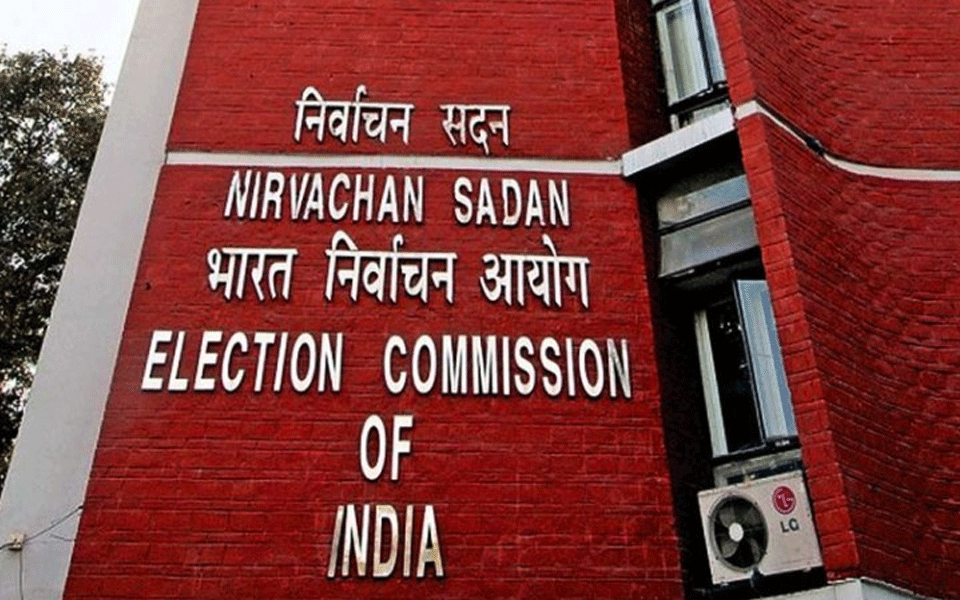
New Delhi: The Election Commission will "soon" take a decision on complaints regarding political leaders invoking armed forces in campaigns, highly-placed sources said Wednesday.
While the commission had asked Uttar Pradesh Chief Minister Yogi Adityanath to be careful in his utterances in future on his "Modi ji ki sena" remarks, it is examining reports on comments made by Prime Minister Narendra Modi and BJP president Amit Shah on the armed forces.
Union minister Mukhtar Abbas Naqvi was also asked to be careful in future for his "Modi ji ki sena" remarks.
The EC had sought reports on Modi and Shah in the context of its advisory issued last month asking parties to desist from indulging in political propaganda involving actions of the armed forces.
"...parties/candidates are advised that their campaigners/candidates should desist, as part of their election campaigning, from indulging in any political propaganda involving activities of defence forces," the commission said on March 19.
"Decision will be taken soon. The commission is examining the matter," highly-placed sources said.
On Tuesday, Deputy Election Commissioner Chandra Bhushan Kumar, responding to a question on Shah's reported remarks on 'Modi ji ki vayu sena' made in West Bengal on Monday, had said, "details have to be collected which will come in a day or two".
Responding to a volley of questions on 'delay' on the part of the commission in finalising its response on the prime minister's remarks in Latur, Maharashtra on April 9 urging young voters to cast ballot in the name of heroes of Balakot air strike, Chandra Bhushan Kumar had said, before taking a decision, the EC looks into the issue in its "entirety".
Initially, he said, district authorities had sent only the relevant paragraph of the PM's speech. "The officials there are good in English and Marathi. But Hindi is an issue. When we demanded, a certified transcript was sent to us on April 16. The matter is (now) under examination," he said.
Asked why in some cases the EC has taken decisions immediately and why was it delaying in other matters, another Deputy Election Commissioner Sandeep Saxena said the EC takes decision after looking into various aspects such as model code of conduct, legal angle.
Kumar said every speech is different and is to be considered in different contexts.
"It is not that the work has stopped," he said, adding that poll officials are also busy preparing for elections and holding them smoothly.
"As and when a decision is taken, it will be known to you," he said.
Responding to a question on complaint against Congress president Rahul Gandhi for his 'chowkidar chor hai' jibe against Modi, he said transcripts of his two media interactions have been obtained and it is under the consideration of the commission.
Let the Truth be known. If you read VB and like VB, please be a VB Supporter and Help us deliver the Truth to one and all.
Punjab CM Mann calls twin blasts 'minor', blames BJP for creating atmosphere of fear
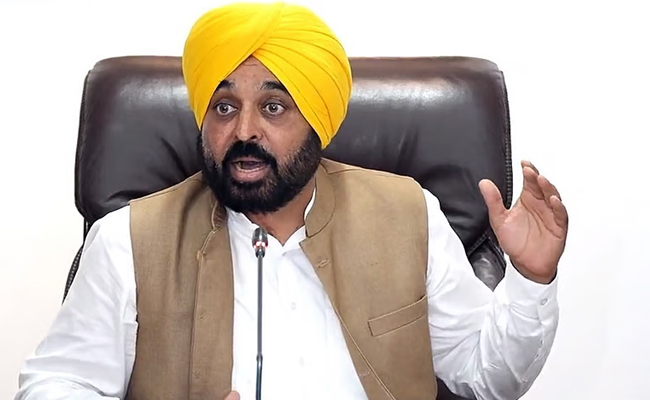
Chandigarh (PTI): Terming the twin blasts in Amritsar and Jalandhar "minor", Punjab Chief Minister Bhagwant Mann on Wednesday targeted the BJP and said this was how the party was preparing for the upcoming assembly elections in the state.
Two blasts occurred on Tuesday night, one outside the Border Security Force's Punjab Frontier headquarters in Jalandhar at around 8 pm and another near the army cantonment area in Khasa, Amritsar, at around 11 pm.
The BJP wants to create an atmosphere of fear, Mann told reporters, adding that the party wanted to scare people into getting their votes. "BJP is a communal party. The assembly elections are over in West Bengal, and they (BJP) have said that now it is Punjab's turn, which indicates that these minor blasts are part of their preparation for the Punjab assembly elections," the chief minister said, adding that investigations are underway.
Mann further alleged that the BJP always sought to gain votes by inciting violence and intimidating the public.
"I urge the BJP to cease such tactics. Punjab is a peaceful state. We are the people who always seek the welfare of the world," Mann said while speaking to reporters in Anandpur Sahib after starting his four-day 'Shukrana Yatra' for the implementation of the anti-sacrilege law.
He claimed that the BJP had a penchant for stirring up trouble in states where it is contesting elections.
Noting the significance of the newly enacted anti-sacrilege law -- the Jaagat Jot Sri Guru Granth Sahib Satkar Amendment Act, 2026 -- Mann stated that it counteracts the BJP's efforts to provoke conflict between communities.
"With the anti-sacrilege law in place, no one will engage in sacrilegious acts at their behest," he said, further alleging that the law contradicts the BJP's agenda.
Mann expressed concern regarding the BJP's tactics, saying, "The BJP claims it is ready for Punjab. Are they trying to scare people with these minor blasts to secure votes? Punjab has already experienced dark times in the past."
"This is the BJP's style of working. In every state where it contests elections, it instigates riots, carries out minor blasts, and divides people based on religion and caste. This demonstrates their preparation for Punjab," he further alleged.
Mann also noted that Punjab often plays a significant role whenever the country faces a crisis. He emphasised that peace, along with law and order, will be maintained at all costs.
Later, in a statement, Mann alleged that the bomb blasts in Amritsar and Jalandhar were part of a deliberate strategy to destabilise the state after the passage of the anti-sacrilege law.
Drawing parallels with West Bengal, Mann alleged that the BJP "thrives on creating communal tension, panic and unrest in poll-bound states to polarise voters," but asserted that peace-loving Punjabis would never allow the saffron party to destroy the hard-earned harmony of Punjab for electoral gains.
He further alleged that the BJP was trying to create "unrest" in Punjab on the pattern of West Bengal ahead of elections, but the people of Punjab are politically aware and united against such conspiracies.
"Violence, divisiveness and communal tension are the patent of the BJP and an integral part of the saffron party's politics. BJP is trying to incite violence and fear in Punjab on the pattern of Bengal to win the ensuing polls. However, BJP's nefarious designs will never succeed in Punjab because anything can germinate on the fertile land of Punjab, but seeds of hatred can never grow here," the chief minister claimed.
Condemning the blasts in the state, Mann alleged such incidents reflected the BJP's "brand of politics", aimed at spreading terror and panic to polarise society and garner votes. "This divisive politics is being pursued by the BJP in every poll-bound state for electoral gains," he alleged.
Mann said those responsible for the blasts would soon be exposed and brought to justice. "All those involved in this heinous crime against humanity will be brought to book and put behind bars very soon. Strict punishment will be ensured for these people because the Punjab Government has zero tolerance for any activity that threatens the peace, safety and integrity of Punjab," he said.
In response to a question about the West Bengal assembly elections, Mann mentioned Mamata Banerjee's complaints regarding the looting of the electoral mandate. "The Election Commission is also facing accusations. It should clarify its stance, ensuring it is not one-sided," Mann added.